

CNC ROUTER MACHINES
CNC ROUTER WITH ROTARY
A CNC router equipped with a rotary attachment or axis for machining suitable cylindrical and shaped workpieces. Selection depends on the part geometry, material, dimensions, required operations, accuracy, and production volume.
A CNC router with rotary capability combines standard routing movements with controlled workpiece rotation. Depending on the verified configuration, it may machine profiles, grooves, patterns, lettering, or other supported features around suitable cylindrical components.
The correct machine and rotary configuration must be selected from the part drawing, material, diameter, length, weight, required operations, tooling, accuracy, and production quantity. Explore related CNC machines or submit your application for technical review.
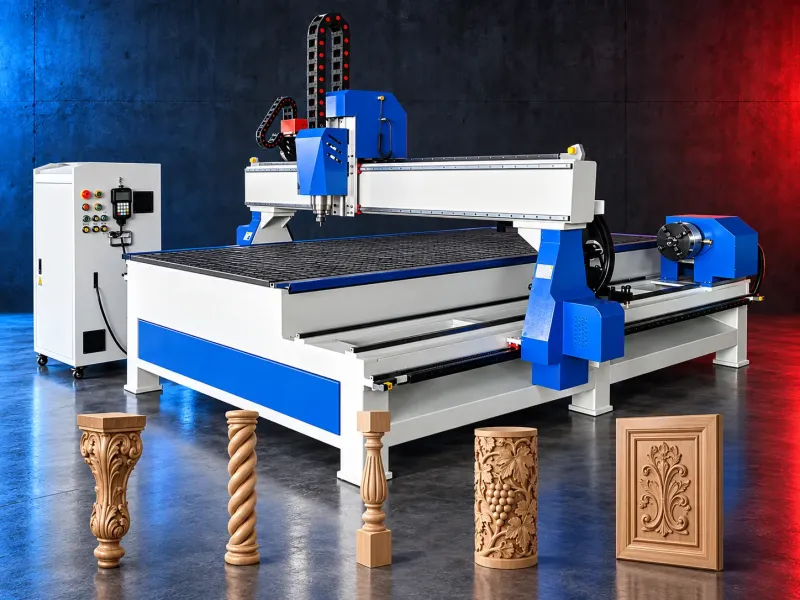
What is a CNC router with rotary capability?
It is a CNC router fitted with a rotary attachment or controlled rotary axis that rotates the workpiece during machining. The rotary unit may be integrated or removable, and its movement may be indexed or simultaneous depending on the verified machine configuration.
Typical applications
- Machining suitable cylindrical components
- Producing grooves and patterns around a workpiece
- Engraving supported curved or rotational surfaces
- Machining columns, posts, rollers, or handles where compatible
- Producing decorative or functional rotational features
- Machining custom parts from approved drawings
- Repeating defined profiles across production batches
- Materials and applications must be confirmed from the selected model’s official documentation and a review of the actual part.
Potential production benefits
- Combine flat routing and supported rotary operations
- Control the angular position of suitable workpieces
- Reduce manual rotation and repositioning
- Produce repeatable patterns under controlled conditions
- Support several designs through CNC programming
- Expand the machine’s application range where technically compatible
- Accuracy, finish, output, and cycle time depend on machine rigidity, rotary-unit accuracy, workholding, tooling, material, programming, and operating conditions.
How to choose the machine
- Provide the complete part drawing or 3D model
- Confirm the material and blank condition
- Define minimum and maximum workpiece diameter
- Define workpiece length and weight
- Identify the required flat and rotary operations
- Confirm whether indexed or simultaneous movement is required
- State dimensional tolerances and finish requirements
- Review workholding, chuck, tailstock, and support requirements
- Confirm spindle speed, power, and tooling needs
- Define batch size and target output
- Confirm CAD/CAM and post-processor requirements
- Review dust, chip, coolant, and extraction requirements
- Confirm electrical supply, air, space, and safety conditions
Technical data to verify
- Manufacturer, brand, model, and country of origin
- Number and configuration of controlled axes
- Integrated or removable rotary unit
- Indexed or simultaneous rotary movement
- Rotary-axis resolution, speed, and positioning accuracy
- Minimum and maximum workpiece diameter
- Maximum workpiece length and weight
- Chuck type, capacity, and clamping method
- Tailstock and intermediate-support configuration
- Table dimensions and linear-axis travels
- Spindle speed, power, torque, taper, or collet type
- Tool-changing system and tool capacity
- Feed rates, rapid movements, accuracy, and repeatability
- CNC control, CAD/CAM compatibility, and post-processor
- Dust extraction, chip collection, or coolant systems
- Dimensions, weight, utilities, guarding, and safety requirements
Rotary configuration
A rotary attachment does not automatically mean full four-axis simultaneous machining. The control system, rotary drive, software, post-processor, and machine mechanics must all support the required movement.
Materials and tooling
Suitable materials, cutting tools, speeds, feeds, depth of cut, and workholding must be confirmed for the selected machine and application. Compatibility with wood, plastics, composites, foam, or non-ferrous materials must not be assumed without official evidence.
Limitations and alternatives
A rotary attachment may restrict the maximum workpiece diameter, length, weight, or available cutting area. Complex parts may require a simultaneous multi-axis router, CNC lathe, machining center, or specialized production solution.
Installation and lifecycle support
Installation planning must consider machine leveling, electrical supply, compressed air, extraction or coolant requirements, rotary-unit alignment, workpiece loading, guarding, tooling, software, and operator training. Supply, maintenance, spare parts, consumables, and warranty scope must be confirmed in the approved offer.
Request a technical review
Send the drawing or 3D model, material, diameter, length, weight, required operations, tolerances, and production quantity. SAKKARY MACHINERY will review the application before recommending a machine and rotary configuration.
Questions we are asked
Does a rotary attachment provide full four-axis machining?
Not always. The controller, rotary drive, mechanics, software, and post-processor must support simultaneous movement when the application requires it.
What workpiece information is required?
Provide the material, diameter, length, weight, drawing or 3D model, tolerances, required features, and production quantity.
Can the router machine both flat sheets and cylindrical parts?
Some configurations support both, but the usable table area, rotary installation, setup method, and machine limits must be confirmed.
Which materials can be machined?
Material compatibility depends on the spindle, machine rigidity, tooling, extraction or coolant system, and the manufacturer’s approved applications.
Does the rotary system include a chuck and tailstock?
These components and their capacities vary by model and must be verified from the official supply list.
Tell us the part you need to make
An engineer reads every request. Usually the same working day.
Related
- CNC WOOD ROUTER CNC routing solutions for cutting, drilling, engraving and machining suitable wood panels and furniture components.
- Automatic Edge Banding Machines Automatic edge banding machines apply and finish compatible edge material on straight panel edges through a controlled production sequence. Correct selection depends on the panel material dimensions edge tape adhesive production volume finish requirement installed processing units utilities and extraction system.
- Panel Saws for Wood Based Sheet Materials Panel saws divide compatible full size boards into accurately planned components for furniture cabinetry fit out and panel processing work. Machine selection depends on the panel material dimensions thickness cut pattern edge quality tolerance production volume blade system handling method dust extraction and required cutting functions.