

HYDRAULIC PLATE ROLLING MACHINES
Three Roll Hydraulic Plate Bending Machines
A three roll hydraulic plate bending machine forms compatible metal plate into cylinders, arcs, and supported conical shapes through controlled roll movement. Correct selection depends on material strength, plate thickness and width, target diameter, prebending requirement, geometry, tolerance, handling, and production pattern
Plate rolling gradually bends a flat plate between three rolls. The roll arrangement supports and drives the plate while hydraulic movement changes the roll position or pressure to develop the required curvature. The exact motion and roll layout depend on the verified machine configuration. The machine may support prebending, cylindrical rolling, rerolling, calibration, or cone forming when the structure, controls, tooling, and process are suitable. These functions and their achievable results must be confirmed from the approved technical documents for the exact machine.
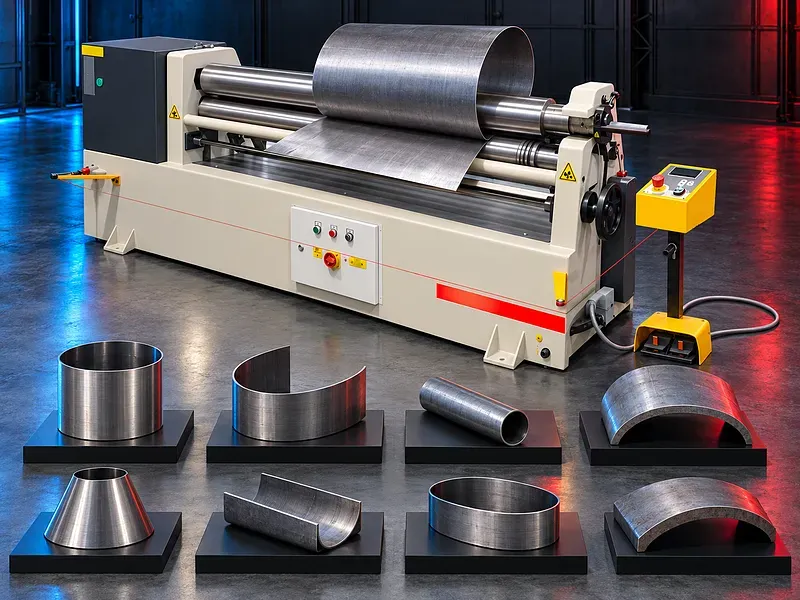
Three roll bending principle
The plate passes between three rolls that provide support, rotation, and bending force. Progressive roll movement and repeated passes develop curvature until the required radius or diameter is reached.
The position and function of the upper and lower or side rolls vary by machine design. Roll arrangement, hydraulic circuit, drive method, and control sequence must be confirmed before describing the exact operating principle.
Prebending the plate ends
Prebending reduces the straight unbent section remaining at the leading and trailing edges of the plate. The plate end is positioned and bent using the supported roll movement permitted by the machine.
The achievable prebending thickness and remaining flat length depend on material yield strength, plate width, thickness, roll diameters, roll spacing, grip, tooling, and process settings. They require model specific verification.
Rolling cylinders and arcs
For cylindrical work, the plate is aligned and passed through the rolls while the bending position is adjusted progressively. Multiple passes may be needed to approach the target diameter and compensate for material springback.
Arc segments can be produced when the machine supports the required geometry and the process includes controlled start and stop positions. Diameter, roundness, seam gap, edge alignment, and surface condition should be checked against the approved drawing.
Cone forming
Cone forming requires controlled differential movement or a verified cone rolling method so the inner and outer plate edges travel at different paths. Suitable roll geometry, cone device, guides, plate layout, and operator procedure may be required.
Cone angle, small diameter, large diameter, axial length, plate thickness, material strength, seam position, and permissible marking must be reviewed. Cone forming should not be promised unless the exact machine and tooling are approved for the part.
Hydraulic system
The hydraulic system may position bending rolls, apply forming force, operate supports, release the workpiece, or control auxiliary functions according to the machine design. Stable pressure and controlled movement support repeatable setup when the system is correctly maintained and calibrated.
Maximum pressure, cylinder arrangement, valve control, hydraulic oil, filtration, cooling, pressure protection, leakage monitoring, and maintenance intervals require confirmation from approved documentation.
Roll drive and plate movement
One or more rolls may be driven to move the plate through the bending zone. Drive arrangement, torque, traction, surface condition, roll speed, and synchronization influence feeding stability and the ability to handle the specified plate.
Motor power, hydraulic drive data, speed range, torque limits, overload protection, braking, and recovery procedures must be verified for the selected machine.
Controls and position indication
Controls may range from hydraulic levers and digital position displays to programmable systems that coordinate roll positions and stored bending steps. The exact interface and level of automation depend on the verified configuration.
A control system does not by itself guarantee dimensional accuracy. Material variation, plate preparation, alignment, roll deflection, springback, operator setup, calibration, and inspection all affect the result.
Plate preparation and alignment
The plate should be checked for correct dimensions, edge condition, flatness, lamination, surface defects, weld preparation, material identity, and sufficient allowance before rolling. Scale, dirt, or sharp projections can affect feeding and damage the rolls.
Accurate alignment helps prevent helical rolling and uneven edges. Reference marks, side guides, support tables, measuring tools, and a controlled loading method may be needed according to plate size and machine configuration.
Rolling workflow
The process normally includes reviewing the drawing, confirming material data, preparing the plate, selecting the setup, positioning and aligning the plate, prebending the first end, rolling the body, prebending the second end, checking the diameter, compensating for springback, and performing final inspection.
The exact sequence may require plate reversal or repositioning depending on the roll arrangement. Trial pieces and an approved process sheet are recommended before production batches.
Materials and capacity
Capacity depends on more than plate thickness. Material grade, yield strength, tensile strength, plate width, target diameter, rolling direction, temperature, prebending requirement, welds, and number of passes all influence machine load.
Carbon steel, stainless steel, aluminum, high strength steel, or other materials should only be listed after the exact machine capacity has been checked against approved material properties and the intended geometry.
Rolls and surface protection
Roll diameter, working length, material, hardness, surface finish, crown or compensation method, bearing support, and alignment influence forming performance and plate condition.
Sensitive or polished materials may require cleaned rolls, protective arrangements, controlled handling, or special roll surfaces. Claims of mark free rolling require validation on the actual material and finish.
Handling and support equipment
Large plates and formed shells can be heavy, flexible, and unstable. Overhead supports, side supports, feeding tables, cranes, lifting devices, or coordinated handling may be required to control the plate and prevent deformation.
Handling equipment must be selected from the plate dimensions, mass, center of gravity, formed diameter, site layout, lifting plan, and risk assessment. It should not be assumed to be included with the machine.
Applications
Potential applications include cylindrical shells, tank sections, pressure vessel components, ducts, silos, pipes, cones, structural arcs, and fabricated metal products when the machine capacity and process are suitable.
Use in general metal fabrication, construction, shipbuilding, energy, storage, or process equipment should be confirmed against the actual part and applicable code. The machine category alone does not establish compliance with an industry standard.
Quality and inspection
Inspection can include diameter, radius, roundness, straightness, seam gap, edge alignment, cone dimensions, surface condition, local flattening, and dimensional consistency along the rolled length.
The measuring method, tolerance, sampling frequency, reference temperature, inspection tools, first part approval, and correction process should be defined before production. Welding and code inspection remain separate requirements where applicable.
How to choose the correct machine
Provide the finished part drawing and plate blank drawing. State material grade, yield strength, tensile strength, thickness range, maximum width, smallest target diameter, prebending requirement, cone dimensions, tolerances, surface finish, weld details, batch size, and annual quantities.
Also provide the required production sequence, available electrical supply, floor space, foundation data, crane capacity, loading route, operator access, safety rules, inspection method, and upstream and downstream processes.
Technical information to verify
Approved documents must confirm the maximum rolling capacity, prebending capacity, reference material strength, working length, minimum rolling diameter, roll diameters, roll speed, drive power, hydraulic data, roll positioning, controls, dimensions, weight, electrical supply, foundation, and required options.
Capacity values must include their test conditions. Maximum thickness at full width may differ from maximum thickness at a shorter width, and prebending capacity may differ from rolling capacity.
Safety and operating risks
Risks include rotating rolls, inrunning nip points, crushing zones, moving plates, falling or springing material, unexpected movement, sharp edges, hydraulic pressure, electrical hazards, and unsafe lifting.
The installation should use approved guards, emergency stops, safe controls, exclusion zones, work supports, lifting plans, lockout procedures, personal protective equipment, trained operators, and a documented local risk assessment.
Installation and commissioning
Site preparation should cover access, unloading, floor loading, foundation where required, anchoring, leveling, electrical isolation, hydraulic service, lighting, working clearances, material flow, lifting equipment, and maintenance access.
Commissioning should include alignment checks, hydraulic and electrical inspection, safety function testing, roll condition, calibration, trial rolling with approved material, operator training, inspection of sample parts, and handover of technical documents.
Maintenance and lifecycle support
Preventive maintenance should follow the approved schedule for hydraulic oil, filters, hoses, seals, cylinders, bearings, roll surfaces, guides, lubrication, alignment, drive components, sensors, controls, guards, and emergency systems.
Recommended spare parts, wear items, hydraulic consumables, service tools, calibration method, technical support, training scope, and document availability should be agreed for the exact machine.
Limitations and publication status
The supplied description is generic and does not prove precision, repeatability, efficiency, medium or thick plate capacity, cone capability, advanced controls, reliability, or any specific performance level.
The page requires an approved datasheet or manual for the exact machine, verified capacity calculations, technical review, approved images, staging review, and final content approval before publication.
Questions we are asked
What is a three roll hydraulic plate bending machine?
It is a plate forming machine that uses three rolls and hydraulic movement to develop controlled curvature in a compatible metal plate.
Can it prebend both plate ends?
Some three roll configurations support prebending, but the sequence, capacity, and remaining flat length depend on the verified machine design and plate data.
Can it roll cones?
Cone rolling may be available with a suitable machine configuration, cone device, tooling, process, and part range. It must be confirmed for the required cone drawing.
How is the required capacity selected?
Selection requires plate material strength thickness width smallest diameter prebending requirement cone geometry temperature and production pattern. Thickness alone is not enough.
What information is needed for a technical proposal?
Provide finished and blank drawings material certificates thickness width diameters cone dimensions tolerances weld details quantities electrical supply floor plan crane data and the required inspection method.
Tell us the part you need to make
An engineer reads every request. Usually the same working day.
Related
- CNC Hydraulic Press Brake CNC-controlled hydraulic press brakes for bending sheet metal components according to defined angles, dimensions and production requirements.
- CNC TUBE BENDING MACHINE CNC tube bending machines control the bending sequence to produce defined tube and pipe geometries. Selection depends on the material, section, diameter, wall thickness, bend radius, part geometry, accuracy, and production volume.
- CNC Gantry Plasma Cutting Machines A CNC gantry plasma cutting machine moves one or more cutting stations across a guided bridge to process suitable electrically conductive plate and supported profiles. The correct configuration depends on the material, thickness, plate size, part geometry, edge quality, bevels, secondary operations, extraction, automation, and required output.