

TUBE BENDING MACHINES
CNC TUBE BENDING MACHINE
CNC tube bending machines control the bending sequence to produce defined tube and pipe geometries. Selection depends on the material, section, diameter, wall thickness, bend radius, part geometry, accuracy, and production volume.
A CNC tube bending machine controls the feed, rotation, and bending movements required to produce programmed tube geometries. Depending on the verified model, the machine may support several controlled axes, multiple bends, automatic loading, and additional production functions.
Correct machine selection starts with the finished-part drawing, tube specification, material, diameter, wall thickness, bend radii, straight lengths, tolerances, and production target. Explore related CNC machines or send your component drawing for a technical review.
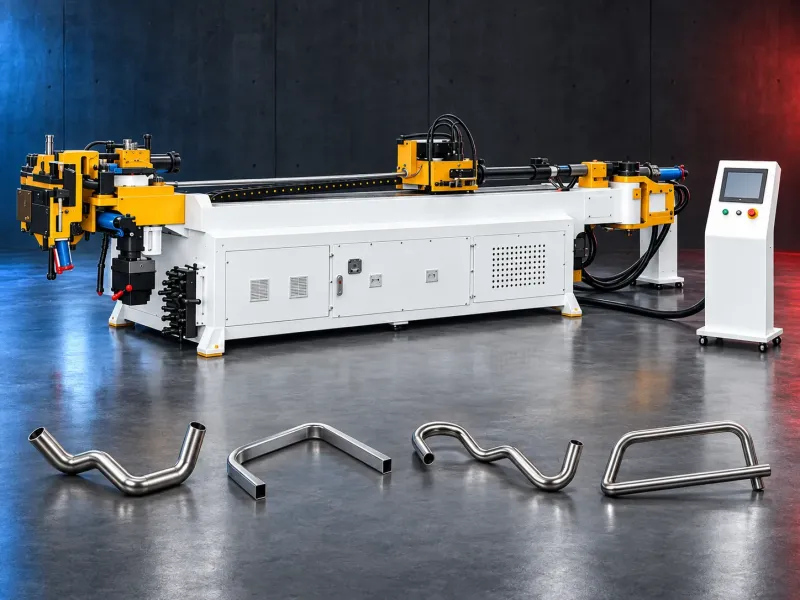
What is a CNC tube bending machine?
A CNC tube bending machine uses programmed movements to control tube feeding, rotation, clamping, and bending. The machine architecture, bending method, controlled axes, tooling, automation, and supported tube range vary by manufacturer and model.
Typical applications
- Tubular frames and structures
- Automotive and transport components
- Furniture and display components
- Exhaust and fluid-transfer tubes
- HVAC and refrigeration tubing
- Agricultural and industrial equipment
- Handrails and fabricated tube assemblies
- Custom bent components produced from approved drawings
- Every application must be checked against the material, tube specification, bend geometry, tooling, and verified machine capacity.
Potential production benefits
- Programmed control of multi-bend components
- Repeatable feed, rotation, and bending movements
- Reduced manual layout and positioning
- Storage of multiple part programs where supported
- Consistent production under controlled conditions
- Integration with loading, cutting, measuring, or unloading systems where available
- Part quality, output, repeatability, and cycle time depend on the material, tube condition, bend geometry, tooling, lubrication, setup, programming, and machine configuration.
How to choose the machine
- Provide a complete finished-part drawing
- Confirm tube or pipe material and applicable specification
- Define outside diameter or section dimensions
- Define wall thickness and dimensional tolerances
- State the minimum centerline bend radius
- Identify every bend angle and rotation
- Define straight lengths between bends
- Confirm overall part dimensions
- Identify round, square, rectangular, or special sections
- Define acceptable ovality, thinning, wrinkling, and springback
- Confirm whether a mandrel or wiper die is required
- State batch size and target output
- Review loading, cutting, piercing, and unloading requirements
- Confirm inspection and quality-control methods
- Review electricity, air, oil, space, and safety requirements
- Technical data to verify
- Manufacturer, brand, model, and country of origin
- Bending method and machine architecture
- Number and function of CNC-controlled axes
- Maximum tube diameter and wall thickness
- Supported round, square, rectangular, or profile sections
- Maximum bending radius and bend angle
- Minimum verified centerline radius
- Maximum feeding length and part envelope
- Bending direction and multi-stack tooling capability
- Mandrel, wiper-die, pressure-die, and booster systems
- Bending torque, force, and speed
- Feed and rotation accuracy and repeatability
- Springback-compensation functions
- CNC control and programming software
Tooling-change and setup requirements
Automatic loading, cutting, piercing, and unloading optionsHydraulic, electric, or hybrid drive configuration
Dimensions, weight, power, air, oil, foundation, and safety systems
Tooling and process control
Bend die, clamp die, pressure die, mandrel, wiper die, lubrication, and program settings must be selected for the material and part geometry. Tooling from another tube size or material must not be assumed compatible.
Quality considerations
The production plan must define bend angle, radius, part dimensions, springback, ovality, wall thinning, wrinkling, surface marks, and inspection method. A sample trial may be required before confirming suitability and output.
Limitations and alternatives
A CNC tube bender may not be suitable for every section, wall thickness, radius, or three-dimensional geometry. Roll bending, section bending, press bending, hydroforming, welded fabrication, or another process may be more appropriate for some parts.
Installation and lifecycle support
Installation planning must consider floor loading, machine leveling, electrical supply, compressed air, hydraulic oil where applicable, lubrication, tooling storage, material handling, guarding, and inspection equipment. Installation, commissioning, training, maintenance, spare parts, tooling, consumables, and warranty scope must be confirmed in the approved offer.
Request a bending review
Send the finished-part drawing, tube material, section, diameter, wall thickness, bend radii, angles, tolerances, and required quantity. SAKKARY MACHINERY will review the application before recommending a machine and tooling configuration.
Questions we are asked
What information is required to select a CNC tube bender?
Provide the finished-part drawing, material, tube section, outside diameter, wall thickness, bend radii, angles, tolerances, and production quantity.
Can one machine bend different tube sizes?
Some machines support several sizes through tooling changes, but every size, material, radius, and tool set must be verified.
When is a mandrel required?
A mandrel may be required to support the tube and control deformation in demanding bends. The decision depends on diameter, wall thickness, radius, material, and quality requirements.
Can the machine bend square or rectangular sections?
Only when the selected model and tooling are approved for the section dimensions, wall thickness, material, radius, and required quality.
How are wrinkling and springback controlled?
Control may involve suitable tooling, lubrication, material data, machine settings, compensation, and trial bending. The result must be verified on the actual part.
Tell us the part you need to make
An engineer reads every request. Usually the same working day.
Related
- CNC Hydraulic Press Brake CNC-controlled hydraulic press brakes for bending sheet metal components according to defined angles, dimensions and production requirements.
- CNC Gantry Plasma Cutting Machines A CNC gantry plasma cutting machine moves one or more cutting stations across a guided bridge to process suitable electrically conductive plate and supported profiles. The correct configuration depends on the material, thickness, plate size, part geometry, edge quality, bevels, secondary operations, extraction, automation, and required output.
- Dished Head Flanging Machines A dished head flanging machine forms the knuckle and straight flange of supported vessel heads after the blank has been prepared or dished. The correct configuration depends on the head diameter, thickness, material, profile, central opening, forming temperature, tooling, handling, tolerance, and required output.