

Servo-Fed Universal Milling Solutions
Universal Milling Machine with 3-Axis Servo Table Feed
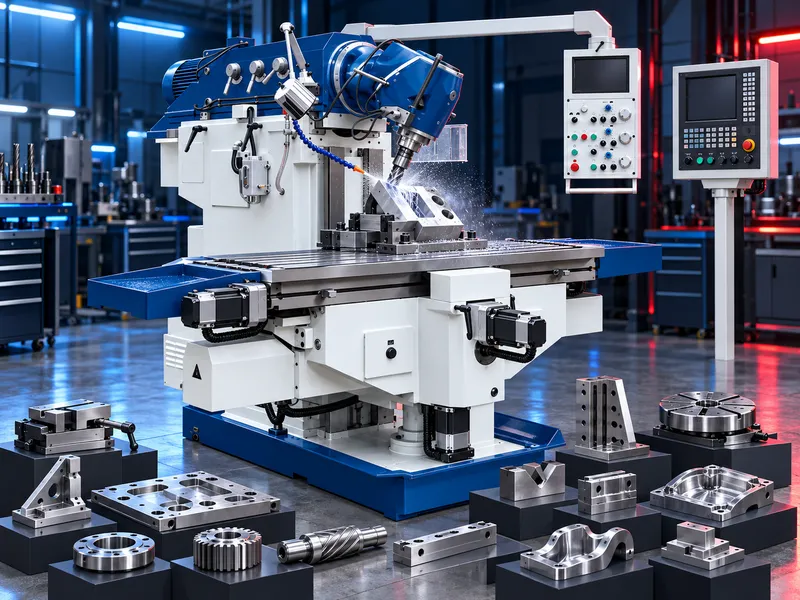
Universal milling machine with three-axis ball-screw table movement and separate servo motors for X, Y and Z feeding, designed for flexible milling operations with variable feed speeds and a swiveling milling head for angular machining.
A universal milling machine provides flexible machining for workshops, toolrooms, maintenance departments and general metalworking applications where different milling operations are required on one machine.
The supplied configuration uses ball screws on the three table axes, with separate servo motors for X, Y and Z feeding. Independent axis drives allow variable feed speeds and simplify controlled table movement during machining.
Mechanical speed changes in the headstock provide the spindle drive for milling operations, while an additional table-supporting column is intended to improve support for heavier workpieces.
The swiveling milling head allows machining of angular surfaces by changing the head orientation. Selected configurations may also be offered with CNC control; the source mentions Siemens 808D and Siemens 828D as optional examples, subject to the exact machine configuration.
What it is for
- General milling of metal workpieces
- Face milling and surface machining
- Slot, groove and keyway milling
- Angular and inclined-surface milling using the swiveling head
- Workshop, maintenance and toolroom machining
- Machining jobs requiring controlled X, Y and Z table feeding
- Low-volume and varied-part production where universal setup flexibility is important
Key machine features
- Three table axes with ball screws
- Separate servo motor for each X, Y and Z table feed axis
- Variable axis feed speeds
- Independent axis drives
- Mechanical speed change in the headstock
- Swiveling milling head for angular-surface machining
- Additional table-supporting column for workpiece support
- Optional CNC controller on selected configurations
How the machine works
STEP - Set and clamp the workpiece
Select suitable workholding and securely position the part on the machine table.
STEP - Select the milling tool and spindle setting
Choose the cutter and headstock speed according to the material and machining operation.
STEP - Set table movement
Use the independently driven X, Y and Z axes to position and feed the workpiece during machining.
STEP - Set the milling-head angle when required
Swivel the milling head when the job requires an inclined or angular machining surface.
STEP - Machine and inspect
Complete the required milling operations and verify dimensions and surface requirements according to the production drawing.
How to choose
STEP - Define the workpiece size and weight
Confirm maximum part dimensions and weight so the required table size, travels and support capacity can be selected.
STEP - Define the required operations
List face milling, slotting, angular machining and other required operations to determine the suitable machine configuration and accessories.
STEP - Confirm travel and spindle requirements
Specify required X/Y/Z travel, spindle speed range, spindle interface and expected cutting duty. These values are model-specific and must be verified.
STEP - Choose manual, servo-fed or CNC operation
The supplied description includes servo-driven table feeds and mentions optional CNC control. Select the control level according to part complexity, repeatability and production volume.
STEP - Confirm tooling and workholding
Define vise, clamps, cutter holders, arbor requirements and any indexing or rotary accessories needed for the actual jobs.
Information required for machine selection
- Workpiece material
- Maximum workpiece dimensions and weight
- Required X, Y and Z travels
- Required milling operations
- Required spindle speed range and interface
- Accuracy and surface-finish requirement
- Typical batch size and daily operating hours
- Required workholding and accessories
- Manual/servo-fed or CNC control requirement
- Available electrical supply
Important configuration note
The source mentions Siemens 808D and Siemens 828D as optional CNC controllers. Controller brand/model, axis configuration and CNC functions must be confirmed for the selected machine before publication or quotation.
Questions we are asked
What is a universal milling machine?
It is a flexible milling machine designed to perform multiple milling operations on different workpiece geometries, with adjustable table movement and a milling head arrangement suited to varied workshop jobs.
How are the table axes moved?
The supplied description specifies ball screws on three table axes and separate servo motors for the X, Y and Z table feeds, allowing variable and independent axis movement.
Can the machine mill angled surfaces?
Yes. The supplied description states that the milling head can swivel through its front half-sphere arrangement to machine surfaces at different angles.
Does the machine have CNC control?
CNC control is described as optional. Siemens 808D and Siemens 828D are mentioned as examples, but the exact controller and functions must be confirmed for the selected configuration.
What information is needed to select the correct machine?
Provide the workpiece material, maximum dimensions and weight, required travels, milling operations, spindle requirements, accuracy target, production volume, tooling and preferred control configuration.
What specifications still need model confirmation?
Table dimensions, axis travels, load capacity, spindle speed range, spindle interface, motor power, machine dimensions, weight, electrical supply, accuracy values and exact CNC configuration require the selected model datasheet.
Tell us the part you need to make
An engineer reads every request. Usually the same working day.
Related
- Heavy-Duty Gap-Bed Conventional Lathes Heavy-duty conventional lathes for turning large-diameter, long, and heavy rotational components. The gap-bed design provides additional swing near the headstock for suitable short workpieces.
- Gantry Type Milling Machine A gantry-type milling machine provides an open working area for machining suitable large or heavy components. Selection depends on workpiece dimensions, weight, material, required operations, tolerances, finish, and production requirements.
- Boring Machine for Workshop Machining A boring machine for drilling, enlarging, finishing, and aligning suitable holes in individual parts and small production batches. The correct model depends on workpiece size, material, hole diameter, depth, tolerance, surface finish, setup, tooling, and required output.