

Heavy-Duty Conventional Turning
Heavy-Duty Gap-Bed Conventional Lathes
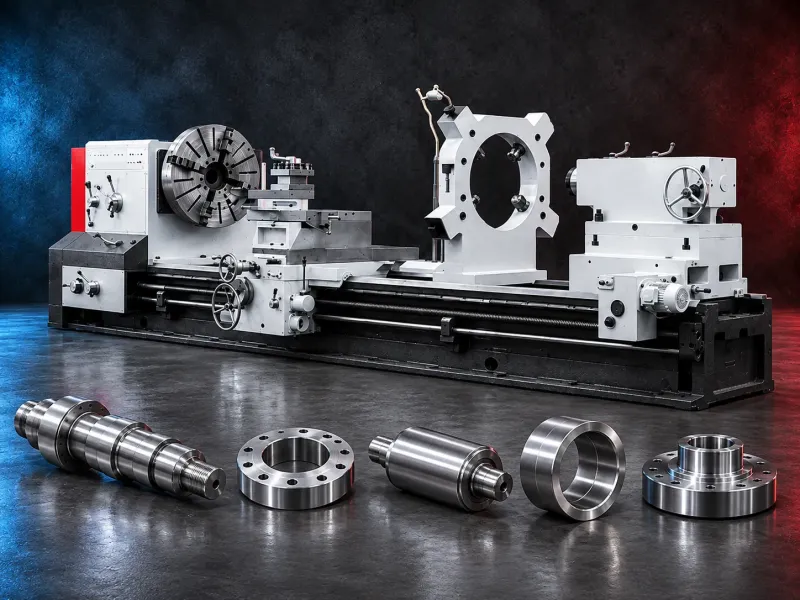
Heavy-duty conventional lathes for turning large-diameter, long, and heavy rotational components. The gap-bed design provides additional swing near the headstock for suitable short workpieces.
Heavy-duty gap-bed conventional lathes are manually operated horizontal turning machines designed for demanding machining applications and larger rotational workpieces.
The removable or recessed gap section near the headstock provides additional clearance for machining short parts with diameters larger than the normal swing over the bed. This additional capacity applies only within the gap area and must be verified for each model.
Machine selection depends on the workpiece diameter, length, weight, material, spindle bore, required operations, accuracy, surface finish, workholding method, and available site utilities.
Typical Applications
- External and internal turning
- Facing and taper turning
- Thread cutting
- Grooving and parting
- Drilling, boring, and reaming
- Machining large flanges and discs
- Producing shafts, rollers, sleeves, and bushings
- Repair and maintenance of industrial components
- Low-volume and job-shop machining
What Does the Gap Bed Provide?
- Additional turning clearance near the headstock
- Capacity for suitable short, large-diameter workpieces
- Normal turning operations along the standard bed length
- Flexible handling of different workpiece geometries
The turning diameter over the gap is not available along the complete bed length. The gap dimensions and permissible workpiece capacity must be verified from the selected model datasheet.
How to Select the Right Lathe
- Provide the maximum workpiece diameter and length.
- Confirm the maximum workpiece weight.
- Specify the material and machining condition.
- Identify the required turning, threading, drilling, and boring operations.
- Define the required tolerance and surface finish.
- Confirm whether the larger diameter is required only near the chuck.
- Specify the required spindle bore and chuck size.
- Identify the required steady rests, follow rest, faceplate, and centers.
- Define the required spindle-speed and feed ranges.
- Review power, foundation, lifting, space, and operator requirements.
Technical Data to Verify
- Swing over bed
- Swing over cross slide
- Swing over the gap
- Gap length and usable machining area
- Distance between centers
- Maximum workpiece weight
- Spindle bore and spindle nose
- Chuck and faceplate sizes
- Spindle-speed range
- Main motor power
- Longitudinal and cross-feed ranges
- Available threading ranges
- Tailstock quill diameter, travel, and taper
- Bed width and guideway construction
- Machine dimensions, weight, and electrical supply
All values must be taken from the official datasheet of the selected brand and model.
Standard and Optional Equipment
Depending on the selected model, equipment may include:
- Three-jaw or four-jaw chuck
- Faceplate
- Fixed steady rest
- Follow rest
- Quick-change tool post
- Coolant system
- Chuck and tool-post guards
- Digital readout system
- Taper-turning attachment
- Rapid-traverse system
Standard and optional items must be confirmed in the approved quotation.
Installation and Support
- Application and workpiece review
- Site, foundation, and electrical assessment
- Machine positioning and installation
- Levelling and commissioning
- Operator training
- Workholding and tooling recommendations
- Preventive-maintenance planning
- Spare-parts and consumables support
- Warranty according to the approved quotation
Request a Technical Recommendation
Send the workpiece drawing, material, maximum diameter, length and weight, required operations, tolerance, surface finish, and production quantity to determine the appropriate machine size and
Questions we are asked
What is a heavy-duty gap-bed conventional lathe?
It is a manually operated horizontal lathe designed for demanding turning work. Its gap area provides additional clearance for suitable short, large-diameter parts.
What is the difference between swing over bed and swing over gap?
Swing over bed applies along the normal bed area. Swing over gap is the larger diameter available only within the gap section near the headstock.
Can the maximum gap diameter be machined along the full bed length?
No. The additional diameter is normally limited to the usable length of the gap area.
What information is required to select the machine?
Provide the drawing, material, diameter, length, weight, required operations, tolerance, surface finish, and production quantity.
Can the machine support every heavy workpiece?
No. Workpiece weight must remain within the machine’s verified capacity and requires the correct chuck, centers, steady rests, foundation, and handling method.
Are installation and training included?
Installation, commissioning, training, accessories, warranty, and service scope are defined in the approved quotation.
Tell us the part you need to make
An engineer reads every request. Usually the same working day.
Related
- Gantry Type Milling Machine A gantry-type milling machine provides an open working area for machining suitable large or heavy components. Selection depends on workpiece dimensions, weight, material, required operations, tolerances, finish, and production requirements.
- Boring Machine for Workshop Machining A boring machine for drilling, enlarging, finishing, and aligning suitable holes in individual parts and small production batches. The correct model depends on workpiece size, material, hole diameter, depth, tolerance, surface finish, setup, tooling, and required output.
- Double Column Horizontal Bandsaw A horizontal bandsaw with a double column guide structure for controlled cutting of suitable metal bars, tubes, profiles, and billets. The correct model depends on material, section shape, cutting size, bundle arrangement, required finish, batch pattern, automation, and target output.