

Heavy-Duty Manual Facing & Turning for Large-Diameter Parts
Conventional Flange Turning & Facing Lathe Machine
A heavy-duty conventional horizontal face lathe designed for turning, facing, grooving and boring large-diameter, short-length rotational workpieces such as steel and HDPE flanges, rings, discs, valves, tire molds and selected shipyard components.
This conventional flange turning lathe is designed for machining large-diameter circular workpieces where a standard long-bed lathe may not be the most practical configuration. It is commonly described as a flange turning lathe, facing lathe, face lathe or floor-type face lathe. The machine can perform facing, outside-diameter turning, internal boring, grooving, cylindrical and conical machining on suitable workpieces. It is intended for rough and finish turning using appropriate high-speed-steel or carbide cutting tools according to the workpiece material and cutting conditions. Typical workpieces include HDPE flanges, steel flanges, valves, glands, rings, disc plates, flywheel-type parts, tire molds, motor covers and other short, large-diameter rotational components. Depending on the selected configuration, the machine may use a large faceplate, independent-jaw heavy chuck or special workholding fixture. DRO measurement can also be specified on suitable configurations to support manual positioning and dimensional control
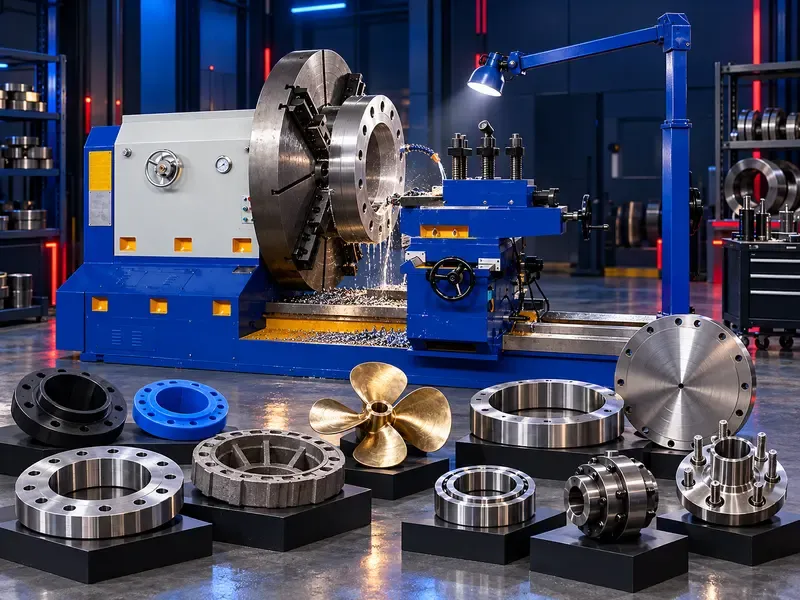
Machining Functions
- Flange facing
- External diameter turning
- Internal boring
- Grooving
- Cylindrical turning
- Conical surface turning
- End-face machining
- Rough and finish turning of large disc and ring-type parts
Machine Structure & Design
- Heavy-duty conventional horizontal / floor-type face-lathe layout
- Wide and rigid bed/guideway arrangement intended for large-diameter workpieces
- Large workholding arrangement for disc, ring and flange components
- Manual machine operation with conventional controls
- Optional DRO configuration depending on machine specification
- Precision-ground gearing is described for the supplied machine family
- Hardened guideways and guideway protection are described for the supplied machine family
Available Size Range
The machine family can be configured for different workpiece diameters. Representative conventional flange-turning machines cover approximately:
- Turning diameter: approximately Ø1,000 to Ø2,600 mm or larger, depending on configuration
- Workpiece length: generally optimized for short, large-diameter rotational parts; exact capacity must be confirmed
- Workholding diameter and chuck/faceplate arrangement: selected according to workpiece size and weight
- Spindle speed, motor power and feed range: configuration-dependent
Final capacity must be confirmed from the actual workpiece drawing, outside diameter, thickness/length, weight, material and required machining operations.
Workholding Options
- Large-diameter faceplate
- Independent 4-jaw chuck on applicable configurations
- Independent heavy multi-jaw chuck on applicable configurations
- Special fixtures for irregular or application-specific workpieces
An 8-jaw independent heavy chuck is available in some flange-lathe configurations, but it should be specified only when required by the workpiece and confirmed in the selected machine configuration.
Suitable Materials
- Carbon steel and suitable steel grades
- Cast iron
- Forgings
- Non-ferrous metals, subject to tooling and cutting parameters
- HDPE flange components, with suitable machine setup and tooling
Typical Workpieces
- Steel flanges
- HDPE flanges
- Valve and gland components
- Ring parts
- Disc and plate-type rotational parts
- Tire molds
- Flywheels and large circular components
- Motor covers
- Selected shipyard propeller or marine rotational components, subject to size and setup
Industry Applications
- Flange manufacturing and repair
- Valve manufacturing and maintenance
- Shipyards and marine workshops
- Energy and power industries
- Oil and chemical equipment manufacturing
- Mining and heavy engineering
- Railway and transportation equipment
- Automotive and machinery manufacturing
- General heavy metalworking
Why Use a Face / Flange Lathe?
- Designed around large-diameter, relatively short workpieces
- Provides direct access for facing and diameter turning operations
- Supports heavy workholding arrangements for discs, rings and flanges
- Conventional operation is suitable where manual machining flexibility is preferred
- DRO can support dimensional positioning on appropriately equipped machines
How to Select the Correct Machine
- Define the maximum and minimum workpiece outside diameter.
- Confirm workpiece thickness/length and maximum weight.
- Provide the workpiece drawing and required finished dimensions.
- Specify material: steel, cast iron, non-ferrous metal, HDPE or other.
- List required operations: facing, OD turning, boring, grooving, taper turning or other.
- Define required chuck, faceplate or special-fixture arrangement.
- Confirm required spindle speed and cutting-tool type.
- Specify whether DRO is required.
- Confirm electrical supply, installation space and material-handling method.
Information Required for Quotation
- Workpiece drawing
- Maximum/minimum outside diameter
- Workpiece thickness or length
- Maximum workpiece weight
- Material grade
- Required machining operations
- Required tolerance and surface finish
- Workholding requirement
- Required DRO or accessories
- Expected production volume
Questions we are asked
What is a conventional flange turning lathe?
It is a conventional machine tool designed mainly for large-diameter, short-length rotational workpieces such as flanges, rings, discs and valve components.
What operations can it perform?
Depending on configuration and tooling, it can perform facing, external turning, internal boring, grooving, cylindrical turning and conical turning.
Can it machine steel and HDPE flanges?
The supplied application information includes both steel and HDPE flanges. The correct cutting tools, speed and setup must be selected for the material.
What diameter range is available?
Representative machines cover approximately Ø1,000 to Ø2,600 mm or larger. Exact capacity depends on the selected configuration.
Is this machine CNC controlled?
This page is for the conventional/manual flange-turning machine. CNC flange lathes should be treated as a separate product category.
Can the machine have a DRO?
DRO can be specified on applicable configurations to support manual dimensional positioning and measurement.
Does every machine use an 8-jaw chuck?
No. Workholding varies by configuration. An independent 8-jaw heavy chuck may be used for selected large-flange applications when specified.
What information is needed to select the machine?
Provide the workpiece drawing, diameter, length or thickness, weight, material, machining operations, tolerances and required workholding.
Tell us the part you need to make
An engineer reads every request. Usually the same working day.
Related
- Heavy-Duty Gap-Bed Conventional Lathes Heavy-duty conventional lathes for turning large-diameter, long, and heavy rotational components. The gap-bed design provides additional swing near the headstock for suitable short workpieces.
- Gantry Type Milling Machine A gantry-type milling machine provides an open working area for machining suitable large or heavy components. Selection depends on workpiece dimensions, weight, material, required operations, tolerances, finish, and production requirements.
- Boring Machine for Workshop Machining A boring machine for drilling, enlarging, finishing, and aligning suitable holes in individual parts and small production batches. The correct model depends on workpiece size, material, hole diameter, depth, tolerance, surface finish, setup, tooling, and required output.