

Precision Bar Turning Solutions
Swiss-Type CNC Lathes
CNC sliding-headstock lathes for producing small, complex and slender turned components from bar stock, with configurations selected according to the part and production requirements.
A Swiss-type CNC lathe, also known as a sliding-headstock automatic lathe, feeds bar stock through the main spindle toward the cutting tools. A guide bushing may support the material close to the cutting area, depending on the machine configuration.
Swiss-type machines can combine turning with drilling, milling and secondary operations when equipped with the required axes, driven tools and counter spindle. Explore more CNC machine solutions or send your part drawing for technical review.
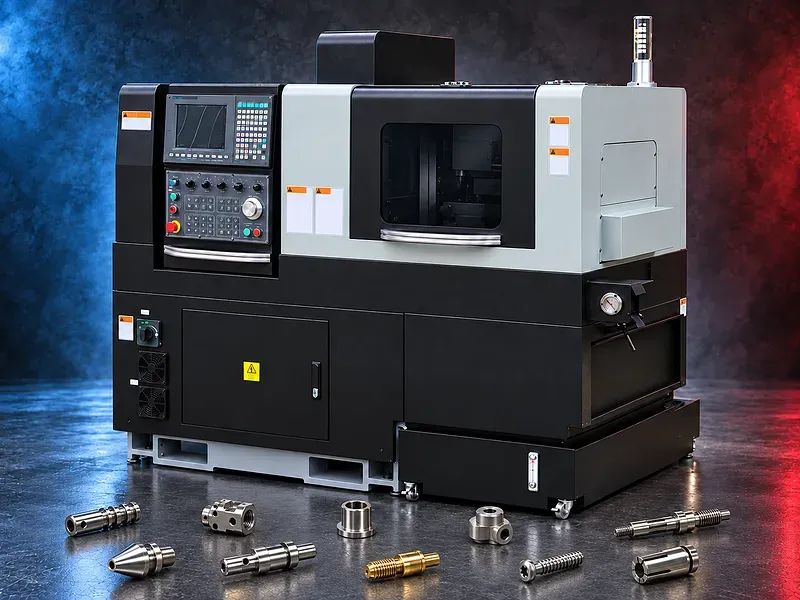
What is a Swiss-type CNC lathe?
A Swiss-type CNC lathe is an automatic turning machine commonly designed around a sliding headstock and bar-feeding process. Supporting the material close to the cutting zone can help when machining slender components, subject to the selected guide-bushing configuration.
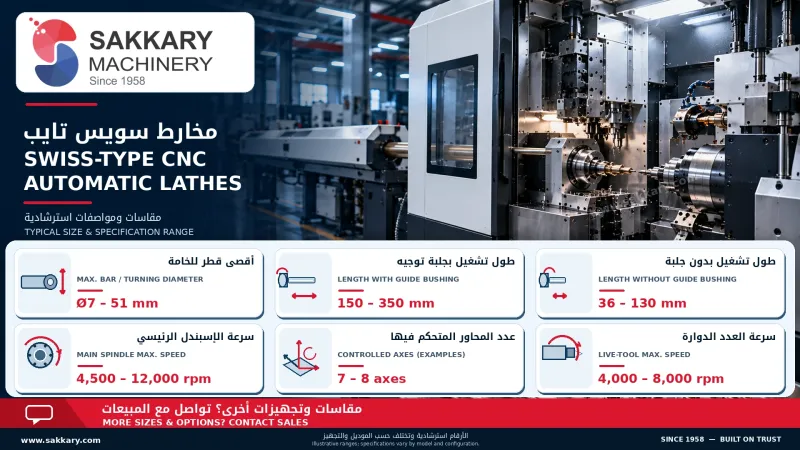
Suitable applications
- Small turned components
- Long and slender parts
- Pins, shafts and precision fasteners
- Bushes, sleeves and connectors
- Medical and dental components
- Automotive and electronic components
- Parts combining turning, drilling and milling
- Repeated production from bar stock
Functional benefits
- Production directly from bar stock
- Support close to the cutting area when using a guide bushing
- Integration of multiple operations in supported configurations
- Main-spindle and counter-spindle machining when equipped
- Availability of fixed and driven tooling
- Potential for simultaneous machining with independent tool systems
- Integration with bar feeders and part-handling equipment
How to select the right machine
- - Define the workpiece material and stock-bar diameter
- - Review the finished-part length and diameter
- - Check the length-to-diameter relationship
- - Determine whether a guide bushing is required
- - Define turning, drilling, milling and threading operations
- - Confirm main-spindle and counter-spindle requirements
- - Review the required number and arrangement of tools
- - Determine the need for driven tools and additional axes
- - Specify the required tolerances and surface finish
- - Review bar-feeder and raw-material preparation requirements
- - Define chip control, coolant and part-collection requirements
- - Confirm the expected production quantity and cycle requirements
Technical data to verify
- Maximum bar diameter
- Headstock stroke and machining length
- Guide-bushing or guide-bushless configuration
- Main and counter-spindle speed, power and torque
- Number and type of controlled axes
- Available C-axis and B-axis functions
- Number of tool positions
- Number of driven-tool positions
- Maximum driven-tool speed
- Bar-feeder compatibility
- Positioning and repeatability values
- Machine dimensions, weight and utilities
Installation and lifecycle requirements
Electrical supply, compressed air, coolant, oil-mist extraction, bar feeder, bar preparation, tooling, guide bushes, collets, chip control, operator training, preventive maintenance and spare-parts requirements must be confirmed from the official documentation for the selected model.
Send the part drawing, material, bar diameter, finished length, tolerances, machining operations and production quantity to SAKKARY MACHINERY for technical machine selection.
Questions we are asked
What is the difference between a Swiss-type lathe and a conventional CNC lathe?
A Swiss-type lathe commonly uses a sliding headstock and may support the bar close to the cutting zone with a guide bushing. The best choice depends on the part geometry and production requirements.
Does every Swiss-type lathe require a guide bushing?
No. Some machines can operate with or without a guide bushing. The suitable configuration depends on the stock material, diameter, straightness and part length.
Can a Swiss-type lathe perform milling and drilling?
Supported models can combine turning with drilling, milling, cross-working and secondary operations using driven tools and additional controlled axes.
What information is required for machine selection?
Provide the drawing, material, bar diameter, finished-part length, tolerances, surface finish, required operations and production quantity.
Tell us the part you need to make
An engineer reads every request. Usually the same working day.
Related
- VICTOR Slant-Bed CNC Lathes Slant-bed CNC turning machines from VICTOR Taichung for machining shafts, bushings, flanges, threaded parts, and other rotational components. The appropriate model is selected according to the workpiece, operations, accuracy, and production requirements.
- CNC Vertical Machining Center (VMC) Vertical CNC machining solutions for milling, drilling, tapping and producing engineered metal components.
- CNC Wire EDM Machines Precision machining solutions for producing complex profiles in electrically conductive materials using a CNC-controlled wire electrode.