

EDM MACHINES
PNC EDM Die Sinking Machine
A die-sinking EDM machine for producing cavities, profiles, ribs, internal corners, and detailed features in suitable electrically conductive workpieces. Machine selection depends on the component, electrode, cavity geometry, material, accuracy, surface finish, and production requirements.
A PNC EDM die-sinking machine removes material through controlled electrical discharges between a shaped electrode and an electrically conductive workpiece. The electrode geometry is transferred progressively into the workpiece without conventional cutting contact.
The process is used for suitable dies, molds, tooling, cavities, and complex internal features. Selecting the correct machine requires the component drawing, material, electrode data, cavity dimensions, required accuracy, surface finish, and production target. Explore related CNC and EDM machines or send your application for technical review.
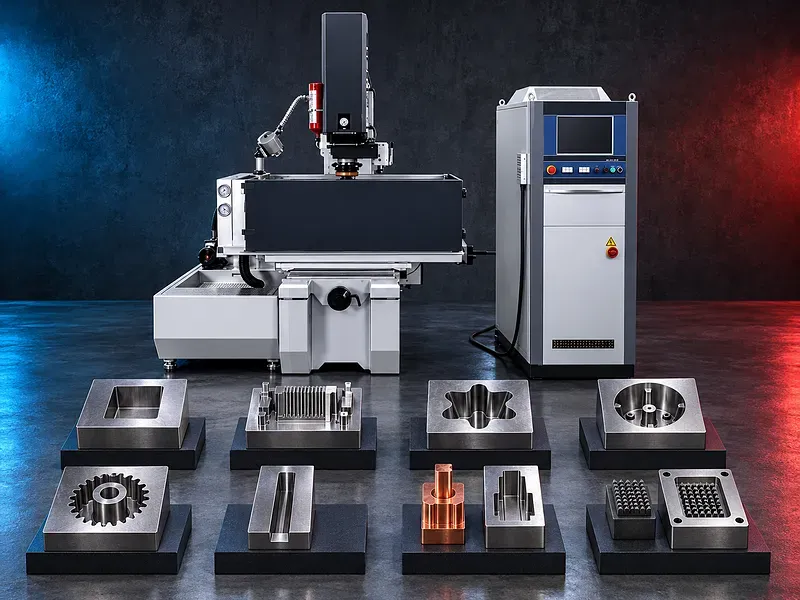
What is PNC die-sinking EDM?
A PNC die-sinking EDM machine uses controlled electrical pulses to erode an electrically conductive workpiece. A shaped electrode is positioned close to the workpiece inside a suitable dielectric-fluid system.
Paragraph:
The electrical discharges reproduce the electrode geometry in the workpiece. The available axis control, programmable movements, orbiting functions, discharge generator, accuracy, and automation depend on the selected model.
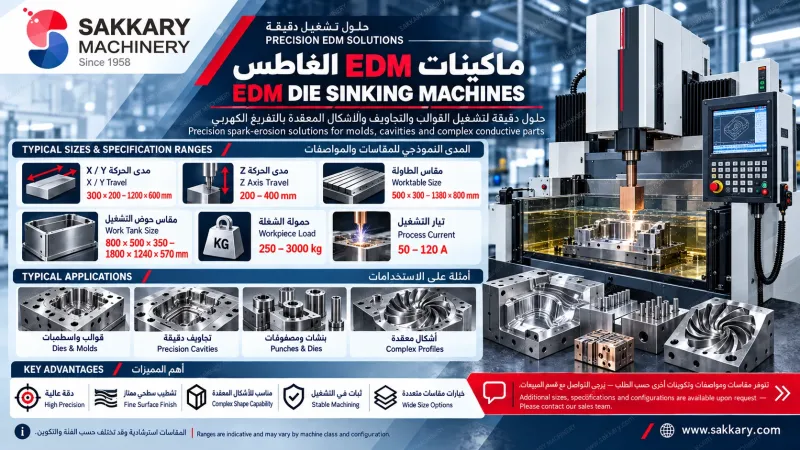
Typical applications
- Dies and molds
- Injection-mold cavities and inserts
- Deep or stepped cavities
- Ribs and narrow internal features
- Internal corners that are difficult to machine conventionally
- Profiles and angled features
- Punches and precision tooling
- Connectors and precision conductive components
- Features requiring a shaped electrode
- Removal of material from hardened conductive workpieces
How the EDM process works
The electrode and workpiece do not make conventional cutting contact. Controlled electrical pulses generate repeated discharges across a small gap, removing material from the conductive workpiece.
The dielectric fluid helps control the discharge, cool the machining area, and remove eroded particles. Stable flushing and correct electrode positioning are important for consistent operation.
Potential production benefits
- Machine suitable hardened electrically conductive materials
- Produce complex cavities and internal profiles
- Reduce mechanical cutting forces on the workpiece
- Create features that may be difficult to reach with conventional tools
- Control roughing and finishing stages through programmed discharge settings
- Support repeated cavity production under controlled conditions
- Use shaped electrodes for defined component geometry
Accuracy, surface finish, electrode wear, processing time, and productivity depend on the machine, material, electrode, cavity geometry, dielectric condition, flushing, setup, and selected parameters.
How to choose the machine
- - Provide a complete component drawing and 3D model where available
- - Confirm the workpiece material and electrical conductivity
- - Define the maximum workpiece dimensions and weight
- - Define cavity dimensions, depth, and geometry
- - Identify deep, narrow, stepped, or angled features
- - State dimensional and geometric tolerances
- - Define the required surface roughness
- - Provide electrode drawings, material, dimensions, and weight
- - Define roughing and finishing requirements
- - Identify the required axis movements and orbiting patterns
- - Define batch size and target output
- - Review dielectric-fluid, filtration, and flushing requirements
- - Confirm inspection and quality-control methods
- - Review electrical supply, grounding, ventilation, and site conditions
Technical data to verify
- Manufacturer, brand, model, and country of origin
- Meaning and functions of the PNC control designation
- Available models within the series
- Worktable dimensions and maximum table load
- Work-tank dimensions and dielectric-fluid capacity
- Maximum workpiece dimensions and height
- X, Y, and Z axis travels
- Distance between the electrode holder and worktable
- Maximum electrode dimensions and weight
- Generator type and maximum working current
- Positioning accuracy and repeatability
- Verified machining accuracy and test conditions
- Surface-roughness range and applicable conditions
- Electrode-wear performance and test conditions
- Maximum material-removal rate and test conditions
- Orbiting and programmable machining patterns
- Servo system and axis-control functions
- Filtration, cooling, flushing, and fire-protection systems
- Dimensions, weight, electrical supply, and installation requirements
PNC control and axis functions
The term PNC may represent different programmable control functions depending on the manufacturer. The exact controlled axes, coordinate movements, orbiting patterns, memory functions, and automatic parameter adjustment must be confirmed from the official control manual.
Electrodes and dielectric fluid
Electrode material, geometry, polarity, undersize, wear allowance, flushing holes, and manufacturing method must be selected for the workpiece and required result. Copper, graphite, or another electrode material must not be assumed suitable without process review.
The dielectric fluid, filtration system, liquid level, temperature, and flushing method must follow the machine manufacturer's approved requirements.
Quality and process control
The production plan should define cavity dimensions, electrode wear, dimensional allowance, surface roughness, flushing, inspection stages, and acceptance criteria. Roughing and finishing may require different electrodes and discharge settings.
Limitations and alternative processes
Die-sinking EDM works only with electrically conductive workpieces. It is generally selected for cavities and internal features rather than through-profile cutting. Wire-cut EDM, EDM drilling, CNC milling, grinding, or another process may be more suitable for other geometries.
Installation and lifecycle support
Installation planning must consider floor loading, machine leveling, electrical supply, grounding, dielectric-fluid storage, filtration, cooling, ventilation, fire protection, electrode handling, workpiece lifting, and operator training.
Installation, commissioning, training, maintenance, spare parts, consumables, dielectric fluid, filters, and warranty scope must be confirmed in the approved technical and commercial offer.
Request a technical review
Send the component drawing, workpiece material, cavity dimensions, tolerances, surface-finish requirement, electrode information, workpiece weight, and production quantity. SAKKARY MACHINERY will review the application before recommending a machine model.
Questions we are asked
What is the difference between die-sinking EDM and wire-cut EDM?
Die-sinking EDM uses a shaped electrode to produce cavities and internal features. Wire-cut EDM uses a moving wire electrode to cut through profiles in conductive material.
Which materials can be machined?
The workpiece must be electrically conductive. Final suitability depends on the material grade, electrode, dielectric system, geometry, and required result.
What information is required for machine selection?
Provide the component drawing, material, cavity dimensions, depth, tolerances, surface finish, electrode information, workpiece weight, and production quantity.
What does PNC mean?
The designation varies by manufacturer. The exact programmable axes, orbiting functions, memory, and automatic controls must be confirmed from the official manual.
Can the machine produce deep cavities and internal corners?
It may produce suitable deep cavities and internal features, but capability depends on electrode design, flushing, machine travel, generator, material, and required accuracy.
Are the specifications shown in the image approved?
No. The values shown in the artwork require confirmation from the official manufacturer catalog for the exact models before publication.
Tell us the part you need to make
An engineer reads every request. Usually the same working day.
Related
- VICTOR Slant-Bed CNC Lathes Slant-bed CNC turning machines from VICTOR Taichung for machining shafts, bushings, flanges, threaded parts, and other rotational components. The appropriate model is selected according to the workpiece, operations, accuracy, and production requirements.
- CNC Vertical Machining Center (VMC) Vertical CNC machining solutions for milling, drilling, tapping and producing engineered metal components.
- CNC Wire EDM Machines Precision machining solutions for producing complex profiles in electrically conductive materials using a CNC-controlled wire electrode.