

CNC TURNING CENTERS
Multi-tasking Milling Turning Center
A CNC machining center that combines turning, milling, drilling, and other supported operations in one production platform. The correct configuration depends on the part geometry, material, tolerances, and production requirements.
A multi-tasking milling turning center is designed for components that require several machining operations. Combining turning and milling in one platform may reduce transfers between machines, repeated workholding, and work-in-progress when the configuration matches the application.
Machine selection must be based on the complete part drawing, material, dimensions, tolerances, required operations, batch size, and automation needs. Explore related CNC machines or submit your component for a technical application review.
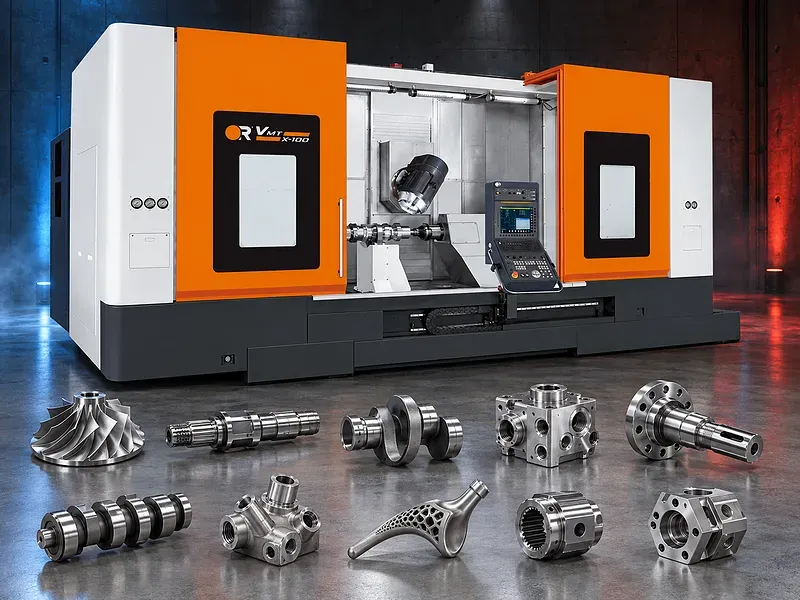
What is a multi-tasking milling turning center?
A multi-tasking milling turning center combines turning with milling, drilling, tapping, and other supported machining operations. Depending on the verified model, it may include additional axes, driven tools, a milling spindle, a sub-spindle, or automatic part-handling functions.
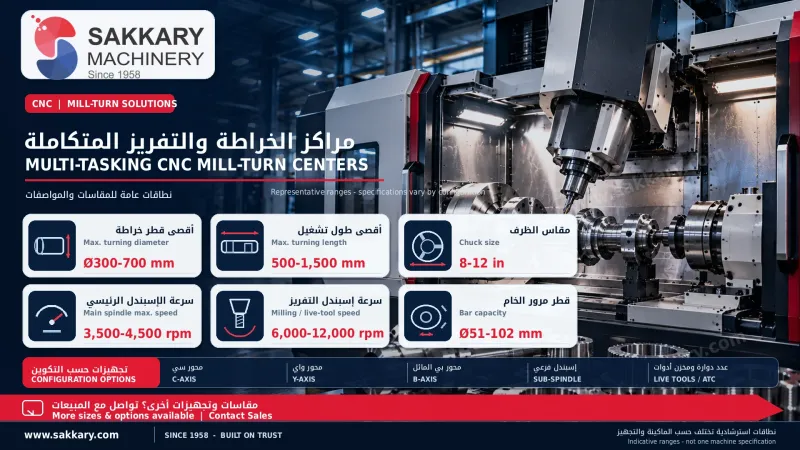
Typical applications
Complex shafts and rotational components
Flanges and fittings with milled features
Parts requiring turning and off-center drilling
Components with flats, slots, holes, or contours
Parts requiring front and back machining
High-mix components requiring several machining operations
Custom industrial parts produced from approved drawings
Every application must be verified against the component drawing and the selected model’s working envelope.
Potential production benefits
Combine several machining operations in one platform
Reduce transfers between separate machines
Reduce repeated workholding on suitable components
Support machining of complex part features
Reduce work-in-progress between production stages
Support automation where compatible equipment is available
Cycle time, accuracy, output, and cost improvements are not guaranteed and must be evaluated from the actual application.
How to choose the center
- Provide a complete component drawing
- Define the material and blank condition
- Confirm the maximum part diameter, length, and weight
- List every turning, milling, drilling, and tapping operation
- Identify off-center and angled features
- State tolerances and surface-finish requirements
- Confirm whether back-working is required
- Define batch size, product mix, and target output
- Determine the required axes and simultaneous movements
- Confirm main-spindle, milling-spindle, and sub-spindle requirements
- Review tooling, workholding, feeding, and automation
- Confirm CNC control, CAD/CAM, and operator requirements
- Review utilities, floor space, foundation, and safety requirements
- Technical data to verify
- Manufacturer, brand, model, and country of origin
- Machine architecture and actual number of axes
- Simultaneous machining functions
- Maximum turning and milling capacities
- Chuck size and bar capacity
- Main-spindle speed, power, and torque
- Milling-spindle or driven-tool specifications
- Sub-spindle availability and capacity
- Turret, tool magazine, and tool-interface details
- Axis travels, rapid movements, accuracy, and repeatability
- CNC control and supported programming functions
- Coolant, chip-management, probing, and automation systems
- Dimensions, weight, electrical supply, and compressed air
- Standard equipment, options, and safety configuration
Limitations and alternatives
Not every component benefits from a multi-tasking center. Simple parts may be produced more economically on a conventional CNC lathe or machining center. Parts outside the machine’s capacity or requiring unsupported processes may need a different machine or a separate production stage.
Installation and lifecycle support
Transportation, installation, commissioning, training, tooling, maintenance, spare parts, consumables, software, and warranty scope must be confirmed in the approved technical and commercial offer for the selected model.
Request an application review
Send the part drawing, material, dimensions, tolerances, operations, batch size, and target output. SAKKARY MACHINERY will review the production requirement before recommending a machine configuration.
Questions we are asked
What is a multi-tasking milling turning center?
It is a CNC platform that combines turning with milling and other supported machining operations. Exact capabilities depend on the selected model and configuration.
Can it machine a complete part in one setup?
Some components can be completed in one setup, but this depends on part geometry, available axes, spindle configuration, tooling, and workholding.
When is a multi-tasking center preferable to separate machines?
It may be suitable when a component requires several turning and milling operations and reducing transfers or repeated workholding is important.
What information is required for machine selection?
Provide the drawing, material, blank dimensions, tolerances, operations, batch size, target output, and automation requirements.
Does every model include a sub-spindle or milling spindle?
No. Spindle arrangement, axes, tooling functions, and automation vary by model and must be verified from the official datasheet.
Tell us the part you need to make
An engineer reads every request. Usually the same working day.
Related
- VICTOR Slant-Bed CNC Lathes Slant-bed CNC turning machines from VICTOR Taichung for machining shafts, bushings, flanges, threaded parts, and other rotational components. The appropriate model is selected according to the workpiece, operations, accuracy, and production requirements.
- CNC Vertical Machining Center (VMC) Vertical CNC machining solutions for milling, drilling, tapping and producing engineered metal components.
- CNC Wire EDM Machines Precision machining solutions for producing complex profiles in electrically conductive materials using a CNC-controlled wire electrode.