

Heavy-Duty CNC Machining for Rolling Mill Rolls & Large Cylindrical Parts
Heavy-Duty Horizontal CNC Roll Turning Lathe Machine
A heavy-duty horizontal CNC lathe designed for machining, re-turning, profiling and reconditioning large cylindrical rolls, rolling-mill rolls, shafts and industrial cylinders. The machine supports demanding turning, facing, grooving and contouring operations on large workpieces.
The CNC roll turning lathe is intended for large cylindrical workpieces used in steel mills, rolling plants, foundries and heavy engineering. It can be applied to new roll production as well as re-machining worn roll surfaces to restore the required diameter, profile and groove geometry. A rigid heavy-duty bed and robust headstock/tailstock arrangement support long and heavy workpieces during demanding cutting operations. Machine capacity, workholding and support systems must be selected according to the actual roll diameter, length, weight and material. CNC control enables programmed turning, facing, profiling and grooving operations. Depending on the selected configuration, industrial CNC systems such as Siemens SINUMERIK or equivalent controls and multi-station tool arrangements may be specified. Roll material, hardness, required stock removal, groove geometry and surface-finish requirements are essential inputs when selecting the machine, cutting tools and machining parameters.
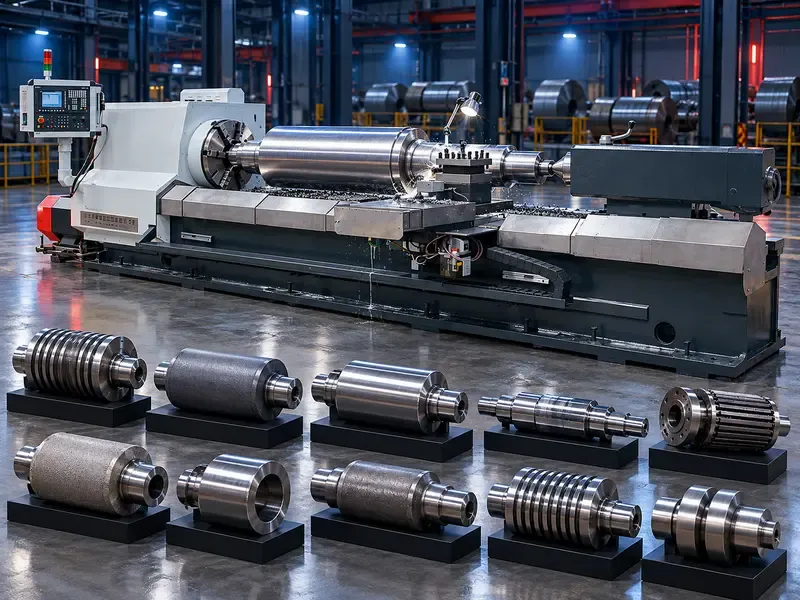
Core Machining Operations
- Roll outside-diameter turning
- Re-turning of worn rolling-mill rolls
- Facing
- Profile and contour turning
- Groove machining and roll-caliber machining
- Rough and finish turning
- Large shaft and cylindrical-part machining
Machine Structure
- Heavy-duty horizontal CNC lathe configuration
- Rigid cast machine bed designed for demanding cutting loads
- Large headstock and workholding arrangement
- Robust tailstock support for long cylindrical workpieces
- Guideway system selected for rigidity and controlled axis movement
- Machine guarding, lubrication and chip-management arrangements according to configuration
CNC Control & Tooling
- CNC-controlled longitudinal and cross-axis movement
- Programmable profiles and machining cycles
- Industrial CNC control system according to selected configuration
- Multi-position or hydraulic turret options on applicable configurations
- Tooling selected according to roll material, hardness, groove profile and required surface finish
Indicative Capacity Range
The information supplied describes a family of heavy-duty roll-turning machines rather than one fixed model. Representative applications include:
- Roll diameters approximately from 550 mm to 1,100 mm or larger, depending on machine configuration
- Workpiece lengths around 3,000 mm or longer on suitable configurations
- Heavy cylindrical workpieces requiring headstock and tailstock support
Exact swing diameter, distance between centers, workpiece weight, spindle bore, spindle speed, motor power, axis travel and machine dimensions must be confirmed for the selected machine. These values should not be inferred from a similar model.
Typical Workpieces
- Rolling-mill rolls
- Steel and metal-forming rolls
- Casting rollers
- Large industrial shafts
- Heavy cylinders
- Rotors and cylindrical components
- Roller-type components requiring reconditioning
Roll Reconditioning
During rolling operations, roll surfaces can wear and lose their specified diameter, profile or groove geometry. A CNC roll lathe can remove the worn surface layer and machine the roll back to an approved profile, subject to the remaining roll diameter, material condition and engineering limits.
- Re-turning worn roll surfaces
- Restoring cylindrical geometry
- Re-machining roll profiles
- Machining or restoring grooves and calibers
- Finish turning before inspection and return to service
Materials & Cutting Conditions
Applications can include cast-iron and steel rolls as well as other suitable heavy cylindrical workpieces. Cutting-tool grade and machining parameters must be selected according to material grade, hardness, surface condition and required stock removal.
- Cast-iron rolls
- Steel rolls
- Hardened or difficult-to-machine roll materials, subject to suitable tooling and machine specification
- Heavy steel shafts and cylinders
Industry Applications
- Steel rolling mills
- Metal rolling plants
- Foundries
- Roll manufacturing and repair workshops
- Heavy machining facilities
- Forging and metal-processing plants
- Industrial maintenance and reconditioning centers
How to Select the Correct CNC Roll Lathe
- Provide the roll or workpiece drawing.
- Define maximum and minimum roll diameter.
- Define total workpiece length and machining length.
- Confirm maximum workpiece weight.
- Specify roll material and hardness.
- Define the required operations: rough turning, finish turning, profiling, grooving or reconditioning.
- Provide groove/profile drawings when caliber machining is required.
- Specify required tolerances and surface finish.
- Define workholding and tailstock/support requirements.
- Confirm preferred CNC control and turret/tooling configuration.
- Confirm production rate and whether the machine is for new-roll production, maintenance or both.
Information Required for Quotation
- Workpiece/roll drawing
- Maximum and minimum diameter
- Overall length and machining length
- Workpiece weight
- Material grade and hardness
- Current diameter and target diameter for reconditioning
- Groove/profile drawing
- Required tolerance and surface finish
- Required production quantity
- Preferred CNC control, if specified
- Required tooling and workholding configuration
Questions we are asked
What is a CNC roll turning lathe used for?
It is used for turning, profiling, grooving and reconditioning large cylindrical rolls, rolling-mill rolls, shafts and similar heavy rotational parts.
Can the machine recondition worn rolling-mill rolls?
Yes. Re-turning and profile restoration are typical applications, provided the remaining roll dimensions and condition are within the approved engineering limits.
Can it machine roll grooves and calibers?
CNC configurations can be specified for groove and profile machining. The groove drawing, material and required accuracy should be reviewed before machine selection.
What roll diameter can be machined?
Representative applications in the supplied information extend from approximately 550 mm to 1,100 mm or larger. Exact capacity depends on the selected machine.
What workpiece length is available?
Configurations for approximately 3,000 mm or longer workpieces are referenced. The exact distance between centers and machining length must be confirmed.
Is Siemens CNC standard?
Not necessarily. Siemens SINUMERIK is one possible industrial control option referenced in the supplied information. Final CNC control depends on the selected configuration.
Can the machine process hardened rolls?
This depends on roll material and hardness, machine rigidity and power, and the selected cutting-tool technology. These details must be reviewed for the actual application.
What data is required to select the machine?
The key data are roll diameter, length, weight, material, hardness, profile/groove geometry, stock removal, tolerance and required surface finish.
Tell us the part you need to make
An engineer reads every request. Usually the same working day.
Related
- VICTOR Slant-Bed CNC Lathes Slant-bed CNC turning machines from VICTOR Taichung for machining shafts, bushings, flanges, threaded parts, and other rotational components. The appropriate model is selected according to the workpiece, operations, accuracy, and production requirements.
- CNC Vertical Machining Center (VMC) Vertical CNC machining solutions for milling, drilling, tapping and producing engineered metal components.
- CNC Wire EDM Machines Precision machining solutions for producing complex profiles in electrically conductive materials using a CNC-controlled wire electrode.