

CNC Turning and Pipe Threading Solutions
CNC Pipe Threading Lathes
CNC lathes for turning and threading pipes, tubes and couplings, with spindle bore, workholding and threading capabilities selected for the application.
A CNC pipe threading lathe performs internal or external threading and related turning operations on pipes, tubes and couplings. Many configurations use a large spindle bore and front or rear workholding to accommodate long tubular workpieces.
Machine selection depends on the pipe material, outside diameter, wall thickness, length, weight and required thread specification. Explore more CNC machine solutions or send your pipe and thread details for technical review.
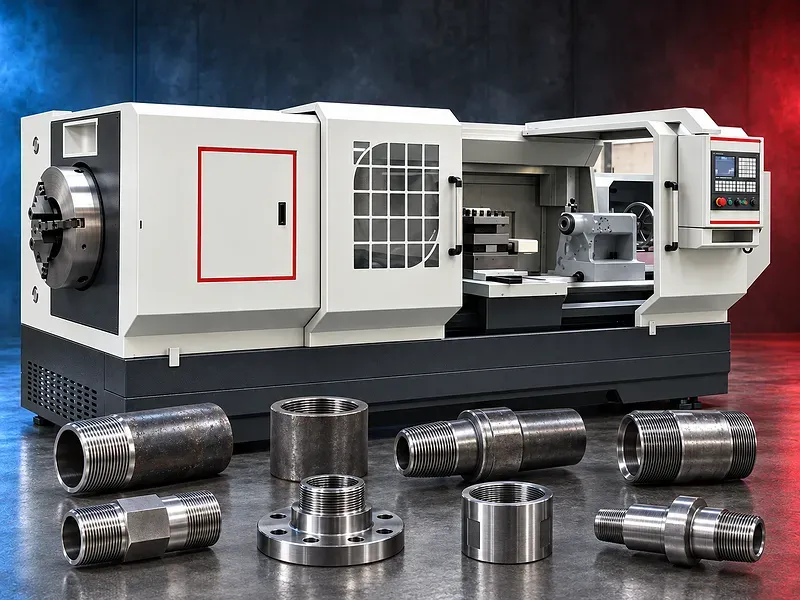
What is a CNC pipe threading lathe?
A CNC pipe threading lathe is configured to cut internal and external threads and perform turning operations on tubular workpieces. Its CNC system coordinates spindle rotation and tool feed according to the programmed thread geometry.
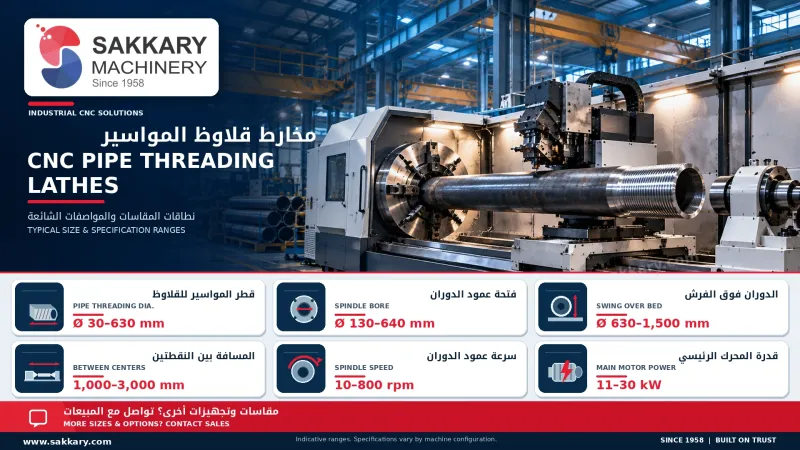
Suitable applications
- Pipes and tubular components
- Pipe couplings and sleeves
- Internal and external pipe threads
- Straight and tapered threads when supported
- Facing and end preparation
- External and internal turning
- Boring, grooving and chamfering
- Drill pipes and casings within the verified machine capacity
- Energy, water and general engineering components
Functional benefits
- CNC control of threading and turning operations
- Processing of different thread profiles when supported
- Large spindle-bore options
- Front and rear workholding options
- Support for long tubular workpieces
- Integration of facing, boring, grooving and threading
- Availability of different bed lengths and spindle configurations
- Single-turret or multiple-turret options according to the model
How to select the right machine
- - Define the pipe material and hardness
- - Provide the outside and inside diameters
- - Specify the wall thickness, length and weight
- - Confirm whether the pipe must pass through the spindle
- - Identify the exact thread standard and profile
- - Specify the pitch, taper, thread length and tolerance
- - Confirm whether the thread is internal or external
- - Define whether one or both pipe ends require machining
- - Review spindle-bore and chuck requirements
- - Determine the required pipe-support arrangement
- - Define facing, turning, boring, grooving and chamfering operations
- - Confirm tooling, coolant and chip-control requirements
- - Specify the production quantity and operating pattern
Technical data to verify
- Swing over bed and cross slide
- Maximum turning diameter
- Distance between centres
- Spindle-bore diameter
- Spindle nose and chuck configuration
- Rear-chuck availability
- Spindle speed, power and torque
- Supported thread standards and ranges
- X-axis and Z-axis travels
- Turret type and tool capacity
- Tailstock and steady-rest specifications
- Pipe-support and loading requirements
- Positioning and repeatability values
- Machine dimensions, weight and utilities
Installation and lifecycle requirements
Foundation, electrical supply, compressed air, pipe supports, lifting and loading equipment, chucks, tooling, thread gauges, coolant, chip handling, operator training, preventive maintenance and spare-parts requirements must be confirmed from the official documentation for the selected model.
Send the pipe drawing, material, diameter, wall thickness, length, weight, thread specification and production quantity to SAKKARY MACHINERY for technical machine selection.
Questions we are asked
What thread standards can the machine produce?
Supported standards, profiles, pitches and tapers depend on the CNC control, tooling and selected model. The exact thread specification must be provided.
Why is the spindle-bore diameter important?
The spindle bore determines whether the pipe can pass through the headstock. It must be checked against the pipe outside diameter and required clearance.
Can the machine perform general turning operations?
Many pipe threading lathes can also perform facing, turning, boring, grooving and chamfering within their verified capacity.
How are long pipes supported?
Long pipes may require a tailstock, steady rests, roller supports or other handling equipment. The arrangement must be designed for the pipe length, diameter and weight.
Tell us the part you need to make
An engineer reads every request. Usually the same working day.
Related
- VICTOR Slant-Bed CNC Lathes Slant-bed CNC turning machines from VICTOR Taichung for machining shafts, bushings, flanges, threaded parts, and other rotational components. The appropriate model is selected according to the workpiece, operations, accuracy, and production requirements.
- CNC Vertical Machining Center (VMC) Vertical CNC machining solutions for milling, drilling, tapping and producing engineered metal components.
- CNC Wire EDM Machines Precision machining solutions for producing complex profiles in electrically conductive materials using a CNC-controlled wire electrode.