

Multi-Sided and Complex-Part Machining
5-Axis CNC Milling Machines
Advanced CNC milling solutions for machining complex, multi-sided parts with fewer setups. Available configurations may support 3+2 positioning or simultaneous 5-axis machining.
A 5-axis CNC milling machine combines three linear axes with two rotary axes, allowing the cutting tool to approach the workpiece from multiple directions. This supports complex geometries and multi-sided machining with fewer setups.
Advanced CNC milling solutions for machining complex, multi-sided parts with fewer setups. Available configurations may support 3+2 positioning or simultaneous 5-axis machining.
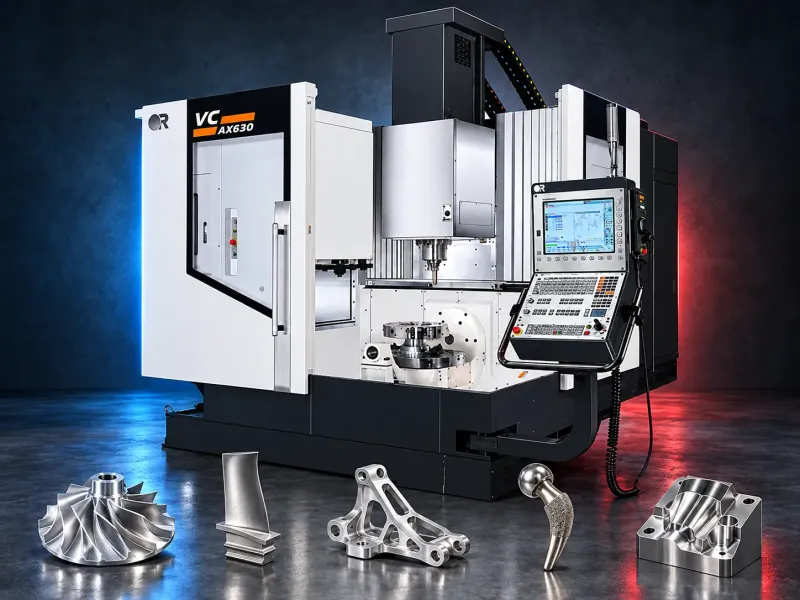
What is 5-axis CNC milling?
A 5-axis CNC milling machine controls movement along three linear axes and two rotary axes. Depending on the machine configuration and control system, it may perform indexed 3+2 machining or simultaneous 5-axis machining.
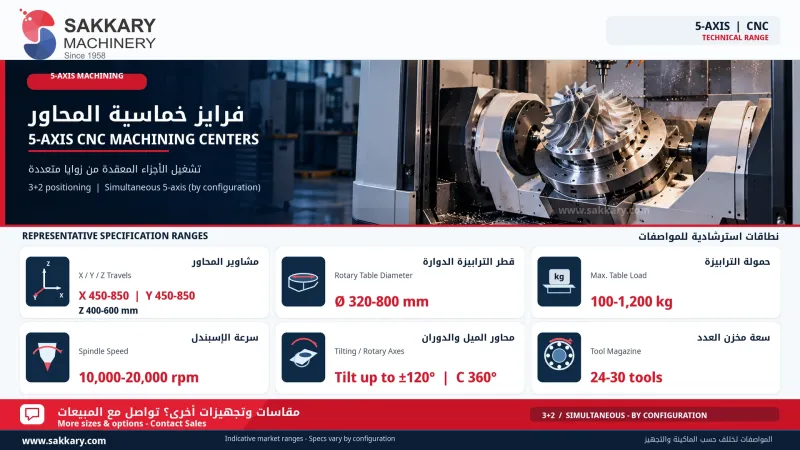
Suitable applications
- Complex multi-sided components
- Moulds, dies and precision tooling
- Impellers, blades and curved surfaces
- Parts requiring machining from several angles
- Components where fewer setups may improve process consistency
- Prototype, precision and production machining
Functional benefits
- Access to multiple sides of the workpiece
- Fewer repositioning and clamping operations
- Improved continuity when machining complex surfaces
- Shorter tool reach for suitable part geometries
- Support for indexed or simultaneous machining, where verified
- Potential integration with probing, tool measurement and automation
How to select the right machine
- - Define whether the application requires 3+2 or simultaneous 5-axis machining
- - Review the part drawing, geometry and required tool access
- - Confirm the workpiece material, dimensions and weight
- - Define the required tolerances and surface finish
- - Check the linear travels and rotary-axis movement range
- - Review table size, load capacity and workholding requirements
- - Select the spindle speed, torque, taper and power for the intended material
- - Confirm tool-magazine capacity and maximum tool dimensions
- - Review the CNC control, CAM software and post-processor compatibility
- - Assess probing, coolant, chip removal and automation requirements
- Technical data to verify
- - X, Y and Z-axis travels
- - Rotary-axis configuration and movement range
- - Table dimensions and maximum load
- - Maximum workpiece envelope
- - Spindle speed, power, torque and taper
- - Rapid-traverse and cutting-feed rates
- - Tool-magazine capacity
- - Positioning and repeatability values
- - CNC control system
- - Machine dimensions and weight
- - Electrical, pneumatic and coolant requirements
Installation and lifecycle requirements
Electrical supply, foundation, compressed air, coolant, tooling, workholding, CAM integration, operator training, preventive maintenance and spare-parts requirements must be confirmed from the official documentation for the selected model.
Send the part drawing, material, dimensions, tolerances and production volume to SAKKARY MACHINERY for a technical machine-selection review.
Questions we are asked
What is the difference between 3+2 and simultaneous 5-axis machining?
In 3+2 machining, the rotary axes position the workpiece before cutting with the linear axes. In simultaneous machining, the linear and rotary axes can move together during cutting.
What information is required to select a 5-axis CNC milling machine?
Provide the part drawing, material, dimensions, weight, tolerances, surface finish, production volume and required machining operations.
Does every 5-axis machine support simultaneous machining?
No. Simultaneous capability depends on the machine configuration, CNC control, installed options and software. It must be verified for the selected model.
What software is required?
The application may require compatible CAD/CAM software and a validated post processor for the machine and CNC control.
Tell us the part you need to make
An engineer reads every request. Usually the same working day.
Related
- VICTOR Slant-Bed CNC Lathes Slant-bed CNC turning machines from VICTOR Taichung for machining shafts, bushings, flanges, threaded parts, and other rotational components. The appropriate model is selected according to the workpiece, operations, accuracy, and production requirements.
- CNC Vertical Machining Center (VMC) Vertical CNC machining solutions for milling, drilling, tapping and producing engineered metal components.
- CNC Wire EDM Machines Precision machining solutions for producing complex profiles in electrically conductive materials using a CNC-controlled wire electrode.