

CNC TURNING MACHINES
3 Axis CNC Turning
A CNC turning machine with driven tooling for selected turning, drilling, and milling operations. Machine selection depends on the part drawing, material, dimensions, tolerances, and production requirements.
A 3-axis CNC turning machine combines conventional turning with selected drilling and milling operations using driven tools. This configuration can help reduce repeated workholding and movement between separate machines when it matches the component geometry.
Choosing the correct machine starts with the part drawing, material, maximum dimensions, required features, tolerances, and production volume. Explore related CNC machines or send your production requirements for a technical application review.
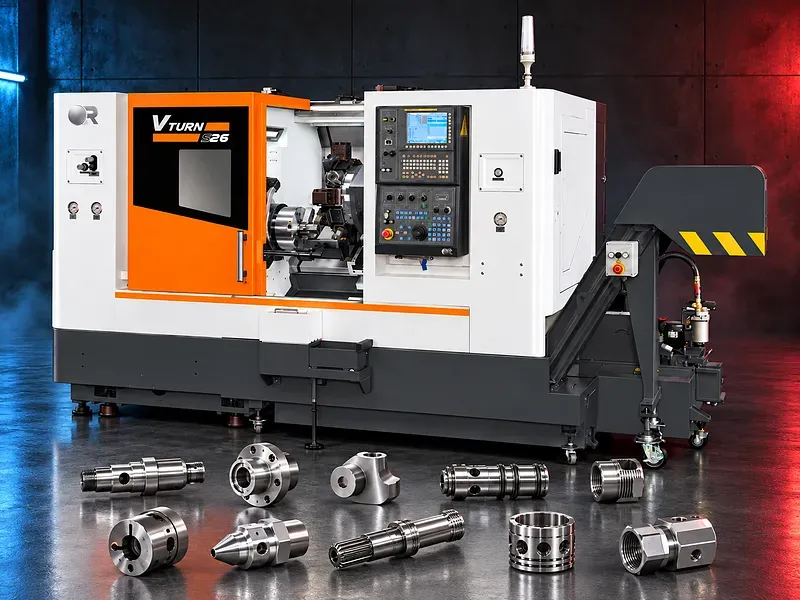
What is 3-axis CNC turning?
A 3-axis CNC turning machine with milling is configured to perform turning together with selected drilling and milling operations. The actual axes, driven-tool functions, and machining limits vary by manufacturer and model and must be verified from the official datasheet.
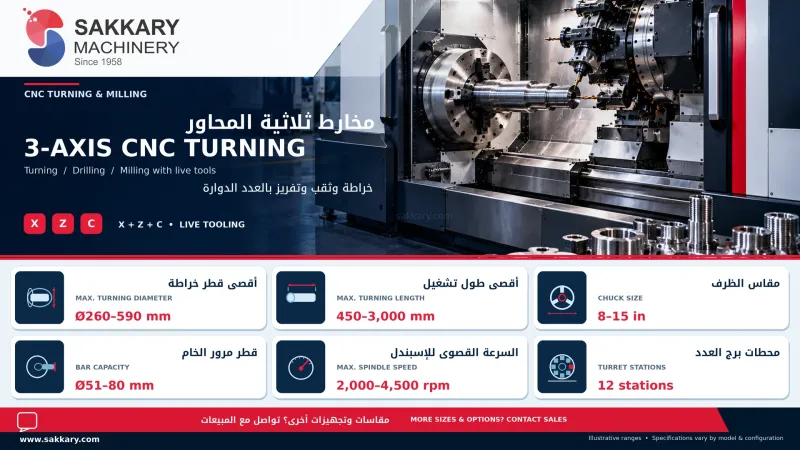
Typical applications
Shafts and rotational components requiring additional machining
Bushes, sleeves, and fittings
Flanges and turned components with bolt holes
Parts requiring axial or cross drilling
Components with flats, slots, or limited milled features
Custom mechanical parts produced from approved drawings
Application suitability must be confirmed against the part drawing and the working envelope of the selected model.
Potential production benefits
Combine selected turning and milling operations in one setup
Reduce repeated part handling on suitable components
Maintain feature relationships from a single workholding setup
Reduce the need for a separate milling operation on some parts
Support repeatable production when the machine, tooling, and process are correctly selected
Actual productivity and accuracy depend on the machine configuration, tooling, programming, material, workholding, and operating conditions.
How to choose the machine
- Provide a complete component drawing
- Confirm the material type and condition
- Define the maximum part diameter, length, and weight
- Identify whether production uses bar stock or individual blanks
- List all turning, drilling, and milling operations
- Identify off-center holes, flats, and slots
- State the required tolerances and surface finish
- Define the batch size and target production output
- Confirm whether a C-axis, Y-axis, or sub-spindle is required
- Confirm tooling, chucking, feeding, and automation requirements
- Review electrical supply, compressed air, space, and site conditions
- Technical data to verify
- Manufacturer, brand, model, and country of origin
- Actual axis configuration and interpolation functions
- Maximum turning diameter and length
- Swing diameter, chuck size, and bar capacity
- Main-spindle speed, power, and torque
- Driven-tool speed, power, and available positions
- Turret type and number of stations
- Axis travels, accuracy, and repeatability
- CNC control and programming functions
- Machine dimensions, weight, and utility requirements
- Standard equipment, optional equipment, and safety configuration
Limitations and alternatives
A three-axis configuration may not suit components requiring complex off-center milling, extensive contouring, simultaneous multi-axis machining, or complete back-working. These applications may require a Y-axis, sub-spindle, additional axes, or a separate machining process.
Installation and lifecycle support
Transportation, installation, commissioning, training, maintenance, spare parts, consumables, and warranty scope must be confirmed in the approved technical and commercial offer for the selected model.
Request a technical review
Send the part drawing, material, dimensions, tolerances, required operations, and production quantity. SAKKARY MACHINERY will review the application before recommending a machine configuration.
Questions we are asked
What operations can a 3-axis CNC turning machine perform?
It can perform turning together with selected drilling and milling operations when equipped with the appropriate driven tools. Exact capabilities depend on the model and configuration.
Can the component be completed in one setup?
Some components can be completed in one setup, but this depends on part geometry, required operations, available axes, tooling, and whether back-working is required.
What information is required for machine selection?
Provide the part drawing, material, dimensions, tolerances, surface-finish requirements, production quantity, and preferred loading method.
Is a three-axis configuration suitable for every complex part?
No. Some components may require a Y-axis, sub-spindle, additional axes, or a separate machining operation.
Are installation, training, and warranty included?
Their scope must be confirmed in the approved technical and commercial offer for the selected machine.
Tell us the part you need to make
An engineer reads every request. Usually the same working day.
Related
- VICTOR Slant-Bed CNC Lathes Slant-bed CNC turning machines from VICTOR Taichung for machining shafts, bushings, flanges, threaded parts, and other rotational components. The appropriate model is selected according to the workpiece, operations, accuracy, and production requirements.
- CNC Vertical Machining Center (VMC) Vertical CNC machining solutions for milling, drilling, tapping and producing engineered metal components.
- CNC Wire EDM Machines Precision machining solutions for producing complex profiles in electrically conductive materials using a CNC-controlled wire electrode.