

MANUAL SHEET METAL CUTTING MACHINES
Manual Arm Steel Body Guillotine Shears
A manual arm guillotine shear cuts compatible sheet metal through a lever operated blade stroke. Correct selection depends on the material grade, sheet thickness, cutting length, required edge quality, clamping, gauging, operator effort, and production pattern
The machine uses a manually operated arm to move the cutting blade through the sheet against a fixed blade. The frame, blade geometry, clearance, hold down method, work support, and operator technique determine whether the cut is safe and suitable for the required part. This machine category is generally considered for straight cutting and workshop tasks with compatible sheets. Cutting capacity, blade material, cutting length, gauges, angular cutting support, dimensions, weight, and achieved quality must be confirmed from approved technical documentation.
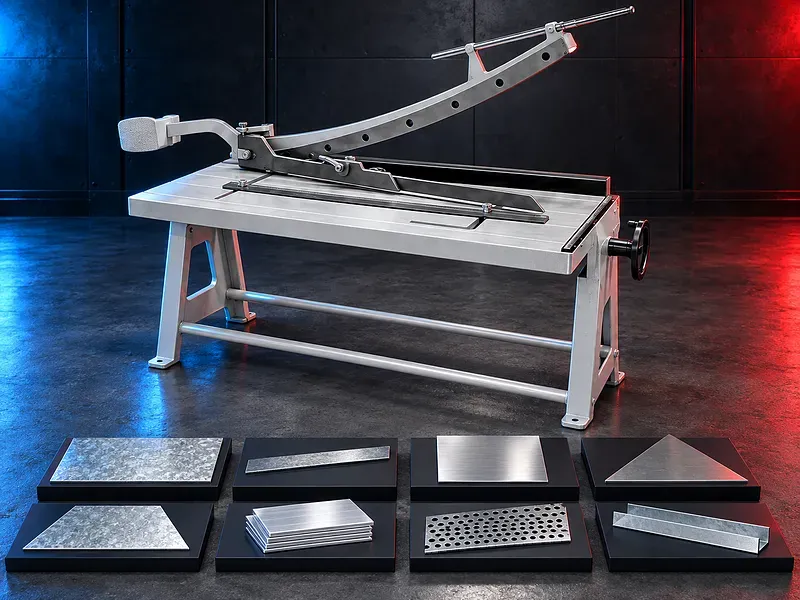
Manual guillotine shearing principle
A guillotine shear separates sheet material by passing a moving blade across a fixed blade with controlled clearance. The operator applies force through the arm and linkage to complete the cutting stroke.
Blade angle, edge condition, clearance, frame rigidity, sheet support, hold down pressure, and material properties influence cutting force and edge quality. These factors should be set according to the approved machine instructions.
Lever operated cutting stroke
The operating arm converts manual movement into blade motion through the mechanical linkage. The required effort depends on the mechanism, arm length, sheet material, thickness, cutting length, blade condition, and lubrication.
Manual operation does not mean that every sheet within the physical opening is safe to cut. The rated capacity and permitted operating method must be followed to prevent overload, blade damage, or loss of control.
Frame and work support
The frame supports the blades, linkage, table, and sheet during cutting. Rigidity and alignment help maintain the blade relationship under load, while the table and extensions support the sheet before and during the stroke.
Frame construction, table size, support arms, mounting points, floor requirements, and permissible sheet overhang require verification for the exact machine.
Cutting blades and clearance
The moving and fixed blades should have the approved material, hardness, edge geometry, straightness, and mounting condition. Sharp and correctly aligned blades reduce cutting force and help control burrs and distortion.
Blade clearance should match the sheet material and thickness where adjustment is provided. Incorrect clearance can increase burrs, roll over, deformation, operating effort, and risk of blade damage.
Sheet clamping and hold down
A hold down or clamping arrangement helps prevent the sheet from lifting or shifting as the blade enters the material. The design may be mechanical or manually adjusted depending on the verified machine configuration.
The clamping method should secure the work without unacceptable marking or deformation. Clamping range, pressure, adjustment, and safe hand position must be confirmed before use.
Gauging and cut positioning
A front scale, guide, stop, square, or angle guide may help position the sheet for repeated or angled cuts when included in the machine configuration. The operator should reference a verified datum and check the first part before continuing.
Gauge range, scale resolution, angle range, repeatability, locking method, calibration, and supported sheet size require technical confirmation. A visible scale is not proof of achieved cutting accuracy.
Cutting workflow
The process normally includes reviewing the drawing, confirming material and thickness, inspecting the sheet, checking blade and guard condition, setting the stop or guide, supporting and aligning the sheet, applying the hold down, completing the cut, and inspecting the result.
Long, flexible, heavy, narrow, or irregular sheets may require additional support or a different cutting method. Offcuts should be controlled so they cannot fall, spring, or create a sharp edge hazard.
Cut quality and inspection
The cut should be checked for length, squareness or angle, straightness, burr height, roll over, edge deformation, twist, surface marks, and consistency along the cut.
The required tolerance, inspection tool, sampling frequency, first part approval, deburring method, and handling of nonconforming parts should be defined in the work instruction. Secondary deburring or straightening may be required.
Materials and cutting capacity
Cutting capacity depends on material strength as well as thickness and length. Carbon steel, stainless steel, aluminum, copper, coated sheet, or other materials should only be listed after the rated capacity has been verified for the exact material condition.
Perforated, embossed, hardened, laminated, brittle, coated, or welded sheets may behave differently from plain sheet. Material grade, temper, coating, surface requirement, and edge condition should be reviewed before approval.
Applications
Potential applications include straight cutting and blank preparation for compatible sheet metal parts used in maintenance, light fabrication, workshops, enclosures, panels, ventilation components, and general metal products.
Suitability depends on the actual sheet, cut geometry, required tolerance, edge quality, production volume, and operator workload. High volume, long, thick, or precision work may require a powered or controlled shearing solution.
How to choose the correct shear
Provide the material grade, tensile or shear strength where available, minimum and maximum thickness, maximum cut length, smallest strip width, required angles, tolerances, edge quality, surface protection, batch size, and annual quantities.
Also define sheet dimensions and mass, loading method, available work area, required gauges, operator frequency, downstream operations, deburring method, and applicable safety requirements.
Technical information to verify
Approved documents must confirm cutting capacity by material, maximum cutting length, blade dimensions and material, clearance adjustment, hold down method, table size, gauge ranges, angular cutting capability, dimensions, weight, mounting, and included accessories.
Claims about hardened blades, precision, smooth operation, easy transport, low effort, edge quality, production speed, or suitability for small and medium sheets require confirmation from the exact machine data and approved trials.
Safety and operating risks
Risks include blade contact, crushing and pinch points, sudden arm movement, falling or springing sheet, sharp cut edges, uncontrolled offcuts, unstable material, excessive force, and unsafe lifting.
The machine should have the approved guards, blade protection, arm retention, stops, hold down, stable mounting, safe work support, operating procedure, personal protective equipment, training, and local risk assessment.
Hands must remain outside the cutting and clamping zones. Guards or safety devices must not be bypassed, and the arm should be secured against unexpected movement during setup, cleaning, transport, or maintenance.
Installation and operator setup
The site should provide a stable level floor, adequate lighting, clear access, sufficient infeed and outfeed space, safe storage for sheets and offcuts, and room for the operator to move the arm without obstruction.
Commissioning should include frame stability, blade alignment, linkage condition, fasteners, lubrication points, guards, arm movement, hold down, gauges, trial cuts, inspection of samples, and operator training.
Maintenance and lifecycle support
Preventive maintenance should follow approved instructions for blade inspection and sharpening, blade alignment, clearance, pivots, linkage, bearings or bushes, fasteners, lubrication, hold down components, scales, stops, guards, and frame condition.
Recommended spare blades, fasteners, bushes, springs, stops, measuring accessories, sharpening criteria, service tools, technical documents, and support scope should be agreed for the selected machine.
Limitations and publication status
The uploaded image identifies a generic manual arm guillotine shear and presents promotional statements, but it is not an approved technical source for capacity, precision, blade treatment, material range, quality, or included features.
The page requires an approved datasheet or manual for the exact machine, technical review, image usage approval, staging review, and final content approval before publication.
Questions we are asked
What is a manual arm guillotine shear?
It is a sheet metal cutting machine that uses a hand operated lever and mechanical linkage to move a blade past a fixed blade.
Does a manual guillotine shear need electricity?
A fully manual cutting stroke does not normally require electrical power. Any powered accessories or additional systems must be confirmed for the selected machine.
Which sheet materials can it cut?
Material compatibility depends on the rated capacity blade condition clearance and material strength. Provide the grade thickness and required cutting length for verification.
Can it make angled cuts?
Angled positioning may be possible when a suitable guide and table arrangement are included. The angle range accuracy support and safe clamping require confirmation.
What information is needed for selection?
Provide material grade strength thickness range maximum cut length sheet dimensions required angles tolerance edge quality batch size annual quantity workspace and handling method.
Tell us the part you need to make
An engineer reads every request. Usually the same working day.
Related
- CNC Hydraulic Press Brake CNC-controlled hydraulic press brakes for bending sheet metal components according to defined angles, dimensions and production requirements.
- CNC TUBE BENDING MACHINE CNC tube bending machines control the bending sequence to produce defined tube and pipe geometries. Selection depends on the material, section, diameter, wall thickness, bend radius, part geometry, accuracy, and production volume.
- CNC Gantry Plasma Cutting Machines A CNC gantry plasma cutting machine moves one or more cutting stations across a guided bridge to process suitable electrically conductive plate and supported profiles. The correct configuration depends on the material, thickness, plate size, part geometry, edge quality, bevels, secondary operations, extraction, automation, and required output.