

HYDRAULIC SHEET METAL SHEARS
Hydraulic Swing Beam Guillotine Shears
A hydraulic swing beam guillotine shear cuts compatible sheet metal through a hydraulically driven blade beam moving on a controlled arc. Correct selection depends on material strength, thickness, cutting length, edge quality, back gauge, support, anti twist requirements, output, and safety configuration.
The swing beam carries the moving blade through the sheet against a fixed lower blade while hydraulic cylinders provide the cutting stroke. A return system may use stored hydraulic energy or another verified arrangement to raise the beam after the cut. Digital back gauge control, programmable cut counters, anti twist cylinders, pneumatic sheet support, lighting alignment, protection fences, blade clearance adjustment, and other functions depend on the selected configuration. Their ranges and performance require approved technical confirmation.
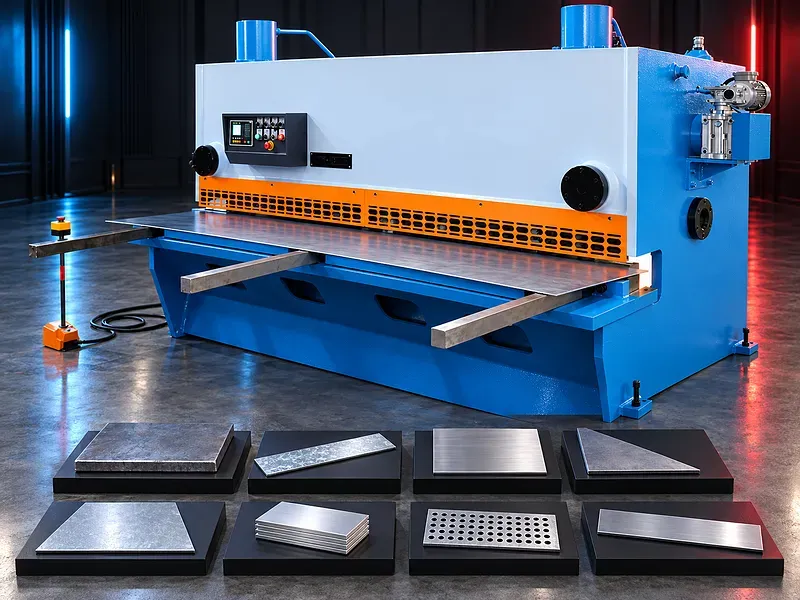
Swing beam shearing principle
The moving blade is mounted on a beam that pivots through a defined arc across the fixed lower blade. Hydraulic cylinders drive the beam downward to separate the sheet along the cutting line.
Blade geometry, rake angle, clearance, overlap, beam stiffness, guide condition, hold down force, material strength, and sheet support influence cutting force and edge quality.
Hydraulic cutting stroke
The hydraulic system supplies controlled force and movement for the cutting beam and may also operate hold downs, supports, back gauge functions, or auxiliary devices depending on the machine design.
Working pressure, cylinder arrangement, valve control, oil specification, filtration, cooling, pressure protection, leakage monitoring, stroke adjustment, and maintenance intervals require approved documentation.
Beam return and stored energy
A return system may use an accumulator or another hydraulic or mechanical arrangement to raise the swing beam after the cut. The system should provide controlled return without unexpected descent or unstable movement.
Accumulator type, precharge pressure, isolation, inspection, replacement interval, return force, safe discharge, and service procedure require technical confirmation and trained maintenance personnel.
Hold downs and sheet clamping
Hold down cylinders or pads secure the sheet close to the cutting line before the blade enters. Correct clamping helps prevent lifting, movement, and loss of dimensional control.
Hold down count, spacing, force, pad material, marking risk, clearance, pressure sequence, and safe hand position must be verified for the selected machine and sheet.
Cutting blades and clearance
The upper and lower blades need approved material, hardness, edge geometry, straightness, mounting, and condition. Sharp aligned blades and suitable clearance help control burrs, roll over, deformation, cutting load, and tool life.
Clearance varies with material type and thickness. The adjustment method, scale or display, permissible range, calibration, blade reversal, sharpening limits, and replacement criteria require approved instructions.
Back gauge positioning
The back gauge positions the sheet against stops at the programmed or manually set cut dimension. A powered gauge may use a motor drive, screw or rack system, position feedback, and a digital display.
Gauge travel, speed, positioning accuracy, repeatability, minimum cut, stop geometry, retraction, squareness, calibration, compensation, and collision protection must be confirmed.
Digital control and cut counter
A digital control may set the back gauge position, display dimensions, store cut steps, count strokes, and coordinate selected machine functions. The exact control scope and programming method depend on the configuration.
Displayed position or cut count does not prove finished part accuracy. Gauge calibration, sheet contact, blade clearance, material movement, operator setup, and inspection affect the result.
Anti twist system
An anti twist system may use controlled supports or hydraulic cylinders below the lower blade area to reduce sheet lifting or distortion during cutting. It is most relevant when sheet geometry and material behavior create twisting risk.
Supported thickness, sheet width, strip width, cylinder layout, pressure, contact method, sequence, surface marking, adjustment, and achieved reduction require validation on the actual part.
Pneumatic sheet support
A pneumatic support can hold thin or wide sheets near the back gauge and cutting zone to reduce sagging before the cut. A panel type arrangement may lower or release the material according to the cycle.
Air pressure, capacity, support surface, supported sheet range, motion, timing, control, noise, maintenance, and safety integration require confirmation. The support should not be assumed to be standard equipment.
Cut line lighting and alignment
A lighting or shadow line device may help the operator align a marked cut line with the blade position. It is an aid for setup and does not replace a calibrated gauge or dimensional inspection.
Light type, visibility, adjustment, reference accuracy, maintenance, electrical protection, and suitability for the working environment require verification.
Cutting workflow
The process normally includes reviewing the drawing, confirming material and thickness, inspecting the sheet, checking guards and blades, setting clearance, programming or setting the back gauge, supporting and aligning the sheet, applying hold downs, completing the cut, controlling the offcut, and inspecting the result.
Long, wide, thin, heavy, narrow, or irregular sheets may require front supports, rear supports, anti twist equipment, pneumatic support, lifting devices, or a different cutting method.
Cut quality and inspection
Inspection can include cut length, straightness, squareness, angle, burr height, roll over, edge deformation, bow, twist, surface marks, and consistency along the cut.
The required tolerance, measuring equipment, sampling plan, first part approval, deburring method, correction process, and nonconforming part procedure should be defined before production.
Materials and cutting capacity
Cutting capacity depends on material grade, tensile or shear strength, thickness, cutting length, blade condition, clearance, rake, support, and machine structure. Thickness alone is not a sufficient selection value.
Carbon steel, stainless steel, aluminum, copper, coated sheet, or other materials should only be listed after capacity has been checked for the exact material condition and cut length.
Applications
Potential applications include straight cutting and blank preparation for compatible sheet metal used in fabrication, enclosures, panels, ventilation, machinery, metal furniture, electrical cabinets, transport equipment, construction products, and general industrial work.
Suitability depends on sheet size, required tolerance, edge quality, production volume, downstream forming or welding, handling, and the applicable fabrication standard.
How to choose the correct shear
Provide material grade and strength, minimum and maximum thickness, maximum cut length, sheet dimensions and mass, minimum strip width, tolerance, edge requirement, batch mix, annual quantity, and target strokes or parts per shift.
Also define back gauge range, front support, anti twist need, pneumatic support need, loading and unloading method, floor space, electrical supply, compressed air, safety rules, downstream processes, and inspection method.
Technical information to verify
Approved documents must confirm cutting capacity by material, maximum length, throat or frame opening where relevant, cutting angle, strokes, blade dimensions and material, clearance range, hold downs, back gauge travel and accuracy, hydraulic pressure, motor power, oil, air supply, controls, supports, dimensions, weight, and foundation.
Options such as anti twist cylinders, pneumatic support, front gauges, lighting alignment, programmable controls, safety fencing, conveyors, special blades, and custom color require written confirmation.
Safety fence and operating risks
Risks include blade contact, hold down crushing, moving beam, back gauge motion, falling or springing sheet, sharp edges, unstable offcuts, hydraulic pressure, stored accumulator energy, pneumatic movement, electrical hazards, and unsafe lifting.
The machine should include approved front and rear protection, guards, interlocked fences where required, emergency stops, safe controls, sheet supports, exclusion zones, lockout procedures, lifting plans, personal protective equipment, training, and a documented local risk assessment.
Certification and conformity
Compliance marks and management system certificates must not be published from marketing text alone. The exact machine declaration, applicable directives or regulations, standards, certificate number, issuing body, scope, date, and validity should be reviewed.
A quality management certificate does not by itself certify machine safety or performance. Market specific conformity and local inspection responsibilities should be confirmed before delivery and publication.
Color and finish
Machine color may be selectable within the available production options. Color choice does not change capacity or safety and should be separated from technical approval.
Available colors, coating system, surface preparation, corrosion class, touch up paint, lead time, cost, and final approval require written commercial confirmation.
Installation and commissioning
Site preparation should cover access, unloading, floor loading, foundation, anchoring, leveling, electrical isolation, hydraulic service, compressed air where required, lighting, working clearances, guards, material flow, lifting equipment, scrap handling, and maintenance access.
Commissioning should include geometry, blade alignment, clearance, hydraulic tests, accumulator inspection, back gauge calibration, hold downs, supports, control functions, safety validation, trial cuts, sample inspection, operator training, maintenance training, and document handover.
Maintenance and lifecycle support
Preventive maintenance should follow approved schedules for hydraulic oil, filters, hoses, seals, cylinders, accumulator, beam pivots, guides, blades, clearance, hold downs, back gauge, supports, lubrication, sensors, controls, guards, interlocks, and emergency systems.
Recommended spare blades, seals, hoses, filters, lubricants, support components, gauge parts, calibration devices, service tools, technical support, training, and documentation should be agreed for the selected machine.
Limitations and publication status
The supplied statements do not prove anti twist performance, pneumatic support range, back gauge accuracy, control functions, certification, custom color availability, motor source, precision, reliability, or standard equipment status.
The page requires an approved datasheet for the exact machine, current conformity evidence, confirmed option list, technical review, approved images, staging review, and final content approval before publication.
Questions we are asked
What is a hydraulic swing beam guillotine shear?
It is a sheet cutting machine in which hydraulic cylinders move a blade beam on a controlled arc past a fixed lower blade.
What does an anti twist system do?
A verified anti twist system supports the sheet during cutting to reduce distortion or lifting. Its effectiveness depends on the sheet material dimensions and system settings.
When is pneumatic sheet support useful?
It may help support wide or thin sheets near the back gauge and cutting zone. Capacity air requirements and supported sheet range must be confirmed.
Does a digital back gauge guarantee cut accuracy?
No. Finished accuracy also depends on gauge calibration sheet contact blade clearance material movement clamping setup and inspection.
What information is needed for selection?
Provide material grade strength thickness cutting length sheet dimensions strip width tolerance edge quality batch quantity back gauge range support needs utilities layout and handling method.
Tell us the part you need to make
An engineer reads every request. Usually the same working day.
Related
- CNC Hydraulic Press Brake CNC-controlled hydraulic press brakes for bending sheet metal components according to defined angles, dimensions and production requirements.
- CNC TUBE BENDING MACHINE CNC tube bending machines control the bending sequence to produce defined tube and pipe geometries. Selection depends on the material, section, diameter, wall thickness, bend radius, part geometry, accuracy, and production volume.
- CNC Gantry Plasma Cutting Machines A CNC gantry plasma cutting machine moves one or more cutting stations across a guided bridge to process suitable electrically conductive plate and supported profiles. The correct configuration depends on the material, thickness, plate size, part geometry, edge quality, bevels, secondary operations, extraction, automation, and required output.