

Heavy-Duty Drilling & Tapping Solutions
Radial Drilling Machine with Servo Control
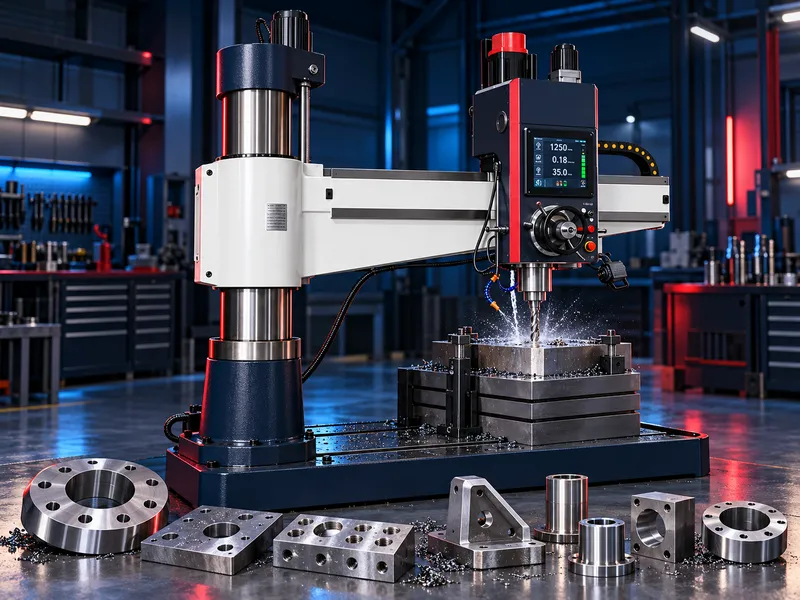
Heavy-duty radial drilling machine for drilling, tapping and hole-machining operations on large or difficult-to-position workpieces, with a movable radial arm and servo-assisted control for easier setup and operation.
Radial drilling machines are designed for machining holes in large, heavy or awkward workpieces that are easier to keep stationary while the drilling head is moved into position. The radial arm allows the spindle head to travel across the work area, reducing the need to reposition the component.
A rigid column, radial arm and geared spindle head provide the structural support required for drilling and tapping operations. Depending on configuration, servo control, touchscreen operation and powered arm or head movements can simplify positioning and improve operator convenience.
Typical applications include steel fabrication, machine building, maintenance workshops, heavy engineering, structural components, flanges, plates, castings and fabricated assemblies. Exact drilling capacity, tapping capacity, spindle speeds, travel and table dimensions must be selected from the verified specification of the required machine.
What it is for
- Drilling holes in large plates, frames, castings and fabricated parts
- Tapping threaded holes where the selected machine supports tapping
- Hole machining on workpieces that are difficult to move repeatedly
- Maintenance, repair and general engineering workshop operations
- Steel fabrication and heavy mechanical production
- Machining multiple hole positions by moving the head rather than the workpiece
Key machine features
- Radial-arm layout for wide working coverage
- Movable spindle head for positioning over different points on the workpiece
- Rigid column and arm structure for stable machining
- Geared spindle drive for drilling torque and selectable spindle speeds
- Servo-assisted control on configured machines for easier adjustment and positioning
- Touchscreen or digital control interface depending on machine configuration
- Forward and reverse spindle operation for drilling and tapping workflows
- Powered or hydraulic locking systems may be available depending on configuration
- Coolant system and worktable options depending on the selected machine
How it works
1. Position the workpiece
Secure the component on the machine base, box table or suitable fixture according to its size and machining requirement.
2. Move the radial arm and head
Adjust the arm height and move the spindle head along the arm until the spindle is aligned with the required hole position.
3. Set the machining parameters
Select the appropriate spindle speed, feed and tooling for the workpiece material and hole size.
4. Drill or tap
Perform the required drilling or tapping cycle while maintaining secure workholding and correct coolant or lubrication where required.
5. Reposition for the next hole
Move the head to the next machining position without repeatedly moving a large workpiece.
How to choose
6. Start with drilling and tapping capacity
Define the maximum hole diameter, thread size and workpiece material. These determine the required spindle torque and machine capacity.
7. Check workpiece size and reach
Confirm the distance from spindle to column, arm travel and spindle-to-base/table range so the machine can reach every required hole location.
8. Define spindle speed and feed needs
Match the spindle speed range and feed system to the materials, drill sizes and tapping operations you expect to run.
9. Choose the control level
Decide whether manual controls are sufficient or whether servo-assisted positioning, touchscreen control or powered movements would improve productivity.
10. Plan workholding and accessories
Select the appropriate box table, vice, tapping chuck, coolant equipment, lifting device or other accessories according to the application
Questions we are asked
What is a radial drilling machine?
A radial drilling machine is a drilling machine with a spindle head that moves along a radial arm, allowing the tool to be positioned over large or heavy workpieces without repeatedly moving the part.
What operations can it perform?
Its main operations are drilling and, on suitably equipped machines, tapping. Additional hole-machining operations depend on the tooling and machine configuration.
Why use a radial drill instead of a conventional drill press?
A radial drill is particularly useful when the workpiece is large, heavy or has several hole locations because the drilling head can be moved across the work area.
What does servo control add?
On machines equipped with servo control, selected movements or operating adjustments can be controlled more conveniently and consistently. The exact servo-controlled functions depend on the machine configuration.
Can it perform tapping?
Yes, when the selected machine includes the required spindle control, reversing function and tapping capacity. The maximum thread size must be confirmed from the exact machine specification.
How do I choose the correct radial drilling machine?
Confirm workpiece dimensions, maximum drilling diameter, tapping requirement, spindle reach, speed range, feed system, table or base arrangement and the desired level of automation or servo assistance.
Tell us the part you need to make
An engineer reads every request. Usually the same working day.
Related
- Heavy-Duty Gap-Bed Conventional Lathes Heavy-duty conventional lathes for turning large-diameter, long, and heavy rotational components. The gap-bed design provides additional swing near the headstock for suitable short workpieces.
- Gantry Type Milling Machine A gantry-type milling machine provides an open working area for machining suitable large or heavy components. Selection depends on workpiece dimensions, weight, material, required operations, tolerances, finish, and production requirements.
- Boring Machine for Workshop Machining A boring machine for drilling, enlarging, finishing, and aligning suitable holes in individual parts and small production batches. The correct model depends on workpiece size, material, hole diameter, depth, tolerance, surface finish, setup, tooling, and required output.