

Precision Turning with Electronic Spindle & Feed Control
High-Precision Lathe with Electronic Spindle & Feed Control
Precision lathe for turning and threading applications, combining electronically controlled spindle speed with controlled axis feeding to support flexible machining across different workpiece diameters and cutting conditions.
Designed for workshops and production environments that require controlled spindle speed and consistent feed during turning, facing, boring and threading operations.
The electronically controlled spindle drive can provide variable speed adjustment without relying solely on traditional multi-step mechanical speed changes. Feed control coordinates carriage and cross-slide movement according to the machine configuration and required operation.
Machine selection should be based on workpiece diameter and length, spindle bore, speed range, required feeds and threads, motor power, chuck and tooling requirements, and the level of electronic control provided by the exact model.
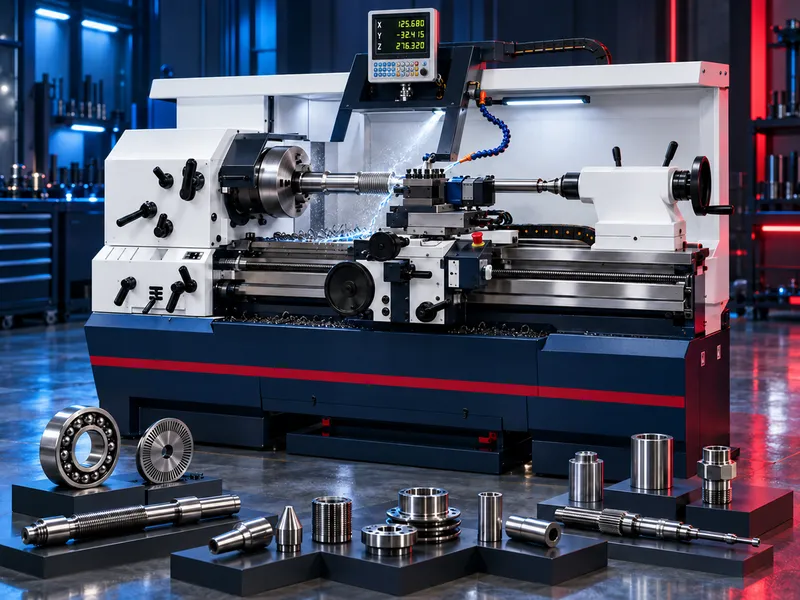
What it is for
- General precision turning and facing
- External and internal diameter machining
- Boring and drilling operations when suitably tooled
- Thread cutting according to the machine’s verified thread/feed range
- Workshop maintenance, repair and component production
- Machining shafts, sleeves, bushings, flanges and similar rotational components
Core machine concept
- Electronically controlled spindle drive for adjustable spindle speed
- Controlled longitudinal and cross feed according to the machine configuration
- Coordination between spindle rotation and feed for turning and threading operations
- Rigid lathe structure intended to support stable cutting
- Operator controls for setting spindle and feed conditions
- Conventional lathe workflow with enhanced electronic drive/control features
How to choose
- Define the workpiece envelope Confirm maximum workpiece diameter, distance between centers and the typical part dimensions before selecting the machine size.
- Check spindle capacity Specify spindle bore, chuck size, workpiece holding method and required speed range.
- Define the operations List turning, facing, boring, drilling and threading requirements so the feed and thread ranges can be verified.
- Define the required control level Confirm whether the requirement is for a conventional lathe with electronic spindle/feed control, a digital-control configuration, or a full CNC lathe.
- Verify accuracy requirements State the required dimensional tolerance and surface finish. Accuracy and repeatability must be confirmed from the exact model datasheet and acceptance conditions.
- Confirm tooling and accessories Specify chuck type, tool post, steady rest, follow rest, coolant system, DRO or other required accessories.
Information required for machine selection
- Maximum workpiece diameter and length
- Typical material and part type
- Spindle bore and chuck requirements
- Required spindle speed range
- Turning and threading operations
- Required tolerance and surface finish
- Tool post and tooling requirements
- Electrical supply
- Required accessories and optional equipment
Questions we are asked
What is an electronically controlled spindle lathe?
It is a lathe that uses an electronic spindle drive, such as a variable-frequency or servo-based system depending on the model, to regulate spindle speed while retaining the turning workflow of a lathe.
Is this the same as a CNC lathe?
Not necessarily. Electronic spindle and feed control do not by themselves make a machine a full CNC lathe. The exact control architecture must be verified for the selected model.
Can it cut threads?
Threading can be supported when the machine provides the required spindle/feed synchronization and verified thread ranges. Exact thread capability must be checked in the model datasheet.
Does it provide stepless spindle speed?
Many electronically driven spindle systems can provide variable or stepless speed control within defined ranges, but the exact speed ranges and transmission arrangement must be verified for the selected machine.
Can it maintain constant surface speed (CSS)?
Only if the exact control system provides this function. CSS should not be assumed from the presence of an electronic spindle drive alone.
What accuracy can the machine achieve?
Accuracy depends on the exact model, spindle and bearing arrangement, machine geometry, feed system, tooling, setup and operating conditions. No micron-level accuracy should be published without verified model data.
What information is needed for a quotation?
Send the workpiece dimensions, material, required operations, tolerance, thread requirements, spindle bore requirement, production pattern and any required accessories.
Tell us the part you need to make
An engineer reads every request. Usually the same working day.
Related
- Heavy-Duty Gap-Bed Conventional Lathes Heavy-duty conventional lathes for turning large-diameter, long, and heavy rotational components. The gap-bed design provides additional swing near the headstock for suitable short workpieces.
- Gantry Type Milling Machine A gantry-type milling machine provides an open working area for machining suitable large or heavy components. Selection depends on workpiece dimensions, weight, material, required operations, tolerances, finish, and production requirements.
- Boring Machine for Workshop Machining A boring machine for drilling, enlarging, finishing, and aligning suitable holes in individual parts and small production batches. The correct model depends on workpiece size, material, hole diameter, depth, tolerance, surface finish, setup, tooling, and required output.