

Industrial Drilling & Tapping Solutions
Gear-Driven Drilling Machines with Tapping Function
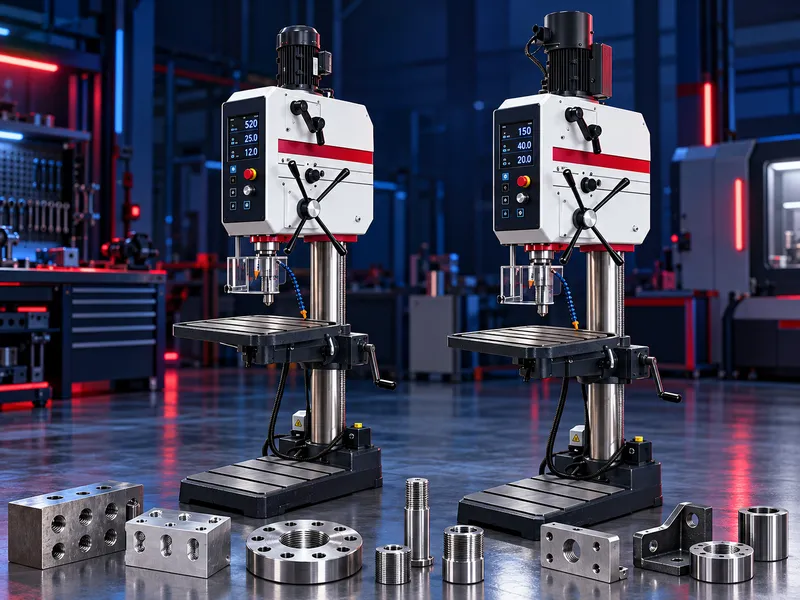
Heavy-duty drilling machines for drilling, tapping and workshop machining, with gear-driven spindle transmission, controlled spindle feed and practical operator controls for industrial production and maintenance applications.
Gear-driven drilling machines are designed for workshops and production environments that require rigid construction, controlled spindle speeds and dependable drilling performance. Depending on the machine configuration, they can combine drilling with tapping and automatic spindle sleeve feed.
A geared head provides mechanical speed ranges for different tool diameters and materials, while selected configurations can include variable-frequency speed control for additional adjustment. Automatic lubrication supports the gearbox and spindle transmission during regular operation.
The machines can be equipped with a worktable, coolant system, work light, tool protection guard and operator controls for practical day-to-day use. Tapping operation requires suitable spindle direction control and the correct tooling for the thread and material.
Machine selection should be based on the workpiece, material, required drilling diameter, thread size, spindle travel, throat depth, table capacity, spindle interface and production duty. Exact capacities and electrical data should be confirmed for the selected machine configuration.
What it is for
- Drilling holes in steel and other compatible engineering materials
- Tapping internal threads with suitable tooling and machine configuration
- Workshop machining, fabrication and maintenance operations
- Production drilling where controlled spindle feed improves consistency
- Machining medium and larger workpieces where a rigid column and table are required
Key machine features
- Heavy cast-iron machine structure for rigidity and vibration resistance
- Gear-driven headstock for mechanical spindle speed selection
- Automatic gearbox lubrication on suitable configurations
- Automatic or controlled spindle sleeve feed, depending on configuration
- Forward and reverse spindle operation for drilling and tapping functions
- Worktable with T-slots for workholding and fixtures
- Coolant system for suitable drilling and tapping operations
- Machine work light and operator control panel
- Protective chuck/tool guard and electrical safety controls
- Variable-frequency spindle motor available on selected configurations
How it works
- Secure the workpiece on the table or suitable fixture.
- Select the spindle speed, feed and cutting tool according to the material and operation.
- For drilling, the spindle rotates the tool while the sleeve is fed toward the workpiece manually or through the available feed system.
- For tapping, use the appropriate tap, spindle direction control and feed arrangement for the required thread.
- Apply suitable coolant or cutting fluid where required, then inspect the hole or thread after machining.
How to choose
- Maximum drilling diameter and required thread sizes
- Workpiece material and hardness
- Spindle taper / tool interface
- Required spindle speed range and feed options
- Spindle travel and throat depth
- Table size, T-slots and workpiece weight
- Manual, automatic or electronically controlled spindle feed requirements
- Need for tapping, coolant and reversing operation
- Electrical supply and intended daily production duty
Questions we are asked
What is a gear-driven drilling machine?
It is a drilling machine that uses a geared headstock to provide mechanical spindle speed ranges for different drilling and machining conditions.
Can the machine perform tapping?
Suitable configurations can perform tapping when they provide the required spindle direction control, feed arrangement and tooling. The exact tapping capacity must be confirmed for the selected machine.
What is automatic spindle sleeve feed?
It feeds the spindle sleeve or quill at a controlled rate during machining, reducing continuous manual feeding and helping maintain a more consistent feed in repetitive drilling operations.
Why use a geared head instead of only belt speed changes?
A geared head provides defined mechanical speed ranges and is commonly selected for heavier workshop drilling. The best drive type depends on the required speed range, torque and application.
Can spindle speed also be variable?
Some configurations combine a geared drive with variable-frequency motor control. This should be confirmed for the selected machine.
What information is needed to select the machine?
Provide the material, maximum drilling diameter, required thread sizes, workpiece dimensions and weight, spindle travel, table requirements, electrical supply and expected production duty.
Tell us the part you need to make
An engineer reads every request. Usually the same working day.
Related
- Heavy-Duty Gap-Bed Conventional Lathes Heavy-duty conventional lathes for turning large-diameter, long, and heavy rotational components. The gap-bed design provides additional swing near the headstock for suitable short workpieces.
- Gantry Type Milling Machine A gantry-type milling machine provides an open working area for machining suitable large or heavy components. Selection depends on workpiece dimensions, weight, material, required operations, tolerances, finish, and production requirements.
- Boring Machine for Workshop Machining A boring machine for drilling, enlarging, finishing, and aligning suitable holes in individual parts and small production batches. The correct model depends on workpiece size, material, hole diameter, depth, tolerance, surface finish, setup, tooling, and required output.