

Automatic Feeding, Punching, Forming & Cutting for Flat Bar Components
Flat Iron One-Step Forming Machine for Pipe Saddle Clamps & Industrial Brackets
An automated flat-bar processing system designed to feed, straighten, punch, form and cut pipe saddle clamps, U-shaped supports, anti-seismic brackets, cable brackets and related formed components in a continuous production sequence.
The Flat Iron One-Step Forming Machine combines several production stages into one integrated line for manufacturing formed components from flat iron or steel strip. Material is fed from the coil, straightened, positioned for punching, formed with dedicated tooling and cut to the programmed length or profile. The machine is intended for repetitive production of pipe saddle clamps, cable supports, U-shaped brackets, anti-seismic support components and similar flat-bar products. Its integrated process can reduce manual transfer between separate machines and helps standardize the sequence from raw strip to finished formed part. The exact strip range, tooling design, hole pattern, forming geometry, production speed and electrical configuration must be confirmed for the selected machine and finished part. The supplied reference information indicates compatibility with carbon steel, galvanized material and stainless-steel flat bar, while actual processing limits depend on material grade, width, thickness and required shape.
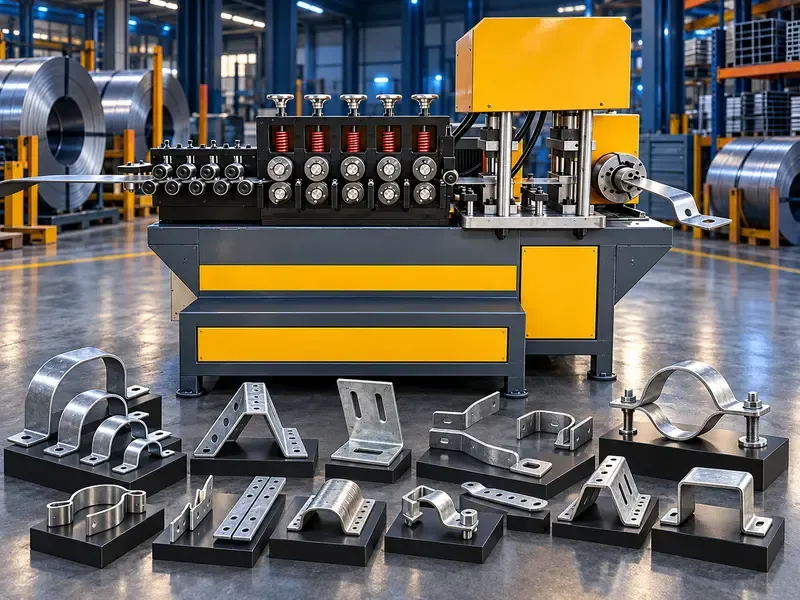
What the Machine Does
- Automatically feeds flat iron or steel strip from the coil or feeding system.
- Straightens the strip before downstream processing.
- Punches mounting or bolt holes according to the required tooling and pitch.
- Forms the strip into saddle clamps, U-shaped supports, brackets or other compatible profiles using dedicated dies.
- Cuts the finished component automatically after forming.
- Supports repeat production through an integrated control sequence.
Typical Production Sequence
- 1Material feeding — flat strip enters the production line.
- Straightening — rollers prepare the strip for consistent downstream processing.
- Positioning — the control system advances the strip to the programmed processing position.
- Punching — hydraulic or configured punching tooling produces the required holes.
- Bending / forming — dedicated tooling creates the required clamp or bracket geometry.
- Cutting — the finished part is separated automatically.
- Repeat cycle — the programmed sequence continues for batch production.
Typical Products
- Pipe saddle clamps
- U-shaped hoops and supports
- Cable brackets and cable-support components
- Anti-seismic support brackets
- Pipe-support brackets
- Mounting brackets
- Flat-bar clamps
- Custom formed flat-bar components subject to tooling feasibility
Material Compatibility
Reference information supplied for this machine type lists carbon steel, galvanized iron/steel and stainless-steel flat bars. Material compatibility must be verified against the exact strip grade, width, thickness, yield strength and required forming geometry before production.
Configuration & Features to Confirm
- PLC / CNC control and touch-screen interface
- Servo-controlled feeding where specified
- Hydraulic punching system and number of punching stations
- Forming dies and die material
- Cutting mechanism
- Automatic or powered decoiler / feeding unit
- Straightening roller arrangement
- Finished-part collection method
- Electrical supply and installed power
- Lubrication and hydraulic system configuration
- Safety guarding and interlocks
- Tooling supplied for each clamp or bracket design
How to Select the Correct Machine
- Send a drawing or dimensioned sample of the finished clamp or bracket.
- Specify flat-bar material and grade.
- Specify strip width and thickness.
- Define all hole diameters, slot dimensions and center distances.
- Define bend radii, angles and final product dimensions.
- State required pieces per hour or per shift.
- Confirm whether logo marking or stamping is required.
- Confirm coil dimensions and coil weight if automatic decoiling is required.
- Confirm factory electrical supply.
- List the different products that must be produced on the same machine.
Industries & Applications
- Pipe support and clamp manufacturing
- Cable-support and electrical installation hardware
- Anti-seismic support systems
- HVAC and MEP support components
- Construction hardware
- Metal brackets and fastening components
- Industrial support systems
- Batch and repetitive flat-bar component production
Why Integrate the Process?
- Combines multiple operations in one production sequence.
- Reduces manual movement of parts between separate processing stations.
- Supports repeatable production based on programmed dimensions and dedicated tooling.
- Can simplify production planning for high-volume clamp and bracket families.
- Allows product-specific tooling to be developed around the required finished geometry.
Information Required for Quotation
- Finished product drawing or clear sample photos with dimensions
- Material type and grade
- Strip width and thickness
- Required hole/slot details
- Required bend profile and radii
- Required production quantity / target output
- Number of different products
- Coil dimensions and weight
- Required marking or logo stamping
- Electrical supply
- Any special automation, loading or collection requirements
Technical Data — To Be Verified for the Selected Configuration
- Exact model and machine layout
- Maximum/minimum strip width
- Maximum/minimum strip thickness
- Applicable material grades and strength limits
- Feeding accuracy
- Punching force and station arrangement
- Bending/forming force
- Cutting force and method
- Installed power
- Voltage / phase / frequency
- Servo and hydraulic specifications
- Production speed by finished product
- Machine dimensions and net weight
- Decoiler capacity
- Tooling specification
- Control system and interface language
Questions we are asked
What is a flat iron one-step forming machine?
It is an integrated production machine that can combine strip feeding, straightening, punching, forming and cutting to manufacture compatible flat-bar clamps and brackets in a continuous sequence.
What products can it make?
Typical products include pipe saddle clamps, U-shaped supports, cable brackets, anti-seismic support brackets and other formed flat-bar components. The exact product range depends on tooling and machine configuration.
Can the machine process stainless steel?
The supplied reference information lists stainless steel among the applicable materials. The exact grade, thickness and width must be checked against the selected configuration and tooling.
Can one machine produce different clamp sizes?
Potentially yes, but the required tooling, setup changes and programmable range depend on the product family. Send drawings for each size so the configuration can be evaluated.
Does the machine punch holes automatically?
The described production concept includes automatic punching as part of the integrated sequence. Hole size, pitch and pattern depend on the selected punching tooling and product drawing.
Can it add a logo or marking?
Some configurations may incorporate stamping or marking. This should be specified at quotation stage and confirmed for the selected machine.
What determines production speed?
Output depends on material, strip dimensions, number of holes, forming complexity, cut sequence, tooling and the exact machine configuration.
What should I send to receive a quotation?
Send the finished-part drawing or sample, material grade, strip width and thickness, hole pattern, forming dimensions, required output, coil details and factory electrical supply.
Tell us the part you need to make
An engineer reads every request. Usually the same working day.
Related
- Heavy-Duty Gap-Bed Conventional Lathes Heavy-duty conventional lathes for turning large-diameter, long, and heavy rotational components. The gap-bed design provides additional swing near the headstock for suitable short workpieces.
- Gantry Type Milling Machine A gantry-type milling machine provides an open working area for machining suitable large or heavy components. Selection depends on workpiece dimensions, weight, material, required operations, tolerances, finish, and production requirements.
- Boring Machine for Workshop Machining A boring machine for drilling, enlarging, finishing, and aligning suitable holes in individual parts and small production batches. The correct model depends on workpiece size, material, hole diameter, depth, tolerance, surface finish, setup, tooling, and required output.