

Bidirectional Miter Cutting for Metal Profiles & Structural Sections
Double-Miter Band Saw Machines for Straight & Angled Metal Cutting
Double-miter band saw machines are designed for accurate straight and angled cutting in both directions without repeatedly repositioning long or heavy workpieces. The range supports bars, tubes, profiles, beams and structural sections for fabrication and general metal-processing applications.
Double-miter band saw machines combine a rotating saw head with a rigid cutting structure to perform 90° cuts and miter cuts to the left and right. This is particularly useful when long sections, beams or profiles require several cutting angles while material handling must be minimized. Depending on the selected configuration, machines may be manual, semi-automatic or NC-controlled. Available equipment can include hydraulic clamping, adjustable blade speed, controlled cutting pressure, digital angle indication, blade tensioning systems and material roller tables. The appropriate machine should be selected according to the material profile, maximum section size, required cutting angles, material grade, production volume and preferred level of automation. Cutting capacity reduces at angled positions, so the required angle and cross-section should always be confirmed before quotation.
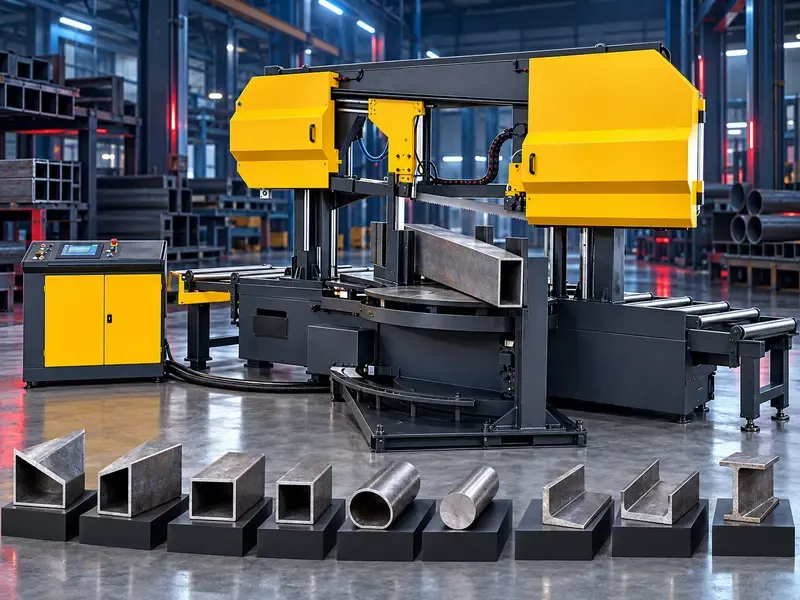
What Is a Double-Miter Band Saw?
A double-miter band saw is a horizontal band sawing machine designed to perform straight cuts and angled cuts in both directions by rotating the saw head. The concept reduces the need to turn or reposition long workpieces when alternating between left-hand and right-hand miter cuts.
Typical Workpieces
- Solid metal bars
- Round and square tubes
- Rectangular and structural profiles
- Beams and structural steel sections
- Fabricated sections requiring repeated angle cuts
Operating Configurations
- Manual configurations for flexible workshop cutting
- Semi-automatic configurations with hydraulic functions to simplify the cutting cycle
- NC-controlled configurations for applications requiring programmable or more repeatable operation
- Exact automation level and functions depend on the selected machine configuration
Key Functions & Available Equipment
- Rotating saw head for straight and bidirectional miter cutting
- Hydraulic clamping on applicable configurations
- Adjustable blade speed according to material and blade requirements
- Controlled cutting pressure / feed for stable sawing
- Digital angle indication on selected configurations
- Blade tensioning system depending on configuration
- Material roller tables for handling long sections
- Additional options can be selected according to the production application
Why Double-Miter Cutting?
- Allows left- and right-hand angle cuts without repeatedly turning long workpieces
- Supports fabrication jobs that require multiple angles
- Helps simplify handling of beams, profiles and structural sections
- Suitable for mixed straight and miter-cut production
Typical Applications
- Structural steel fabrication
- Steel service centers
- Frames and fabricated structures
- Machinery and equipment manufacturing
- General metal fabrication
- Profile, tube and beam processing
How to Select the Correct Machine
- Define the workpiece type: solid bar, tube, profile, beam or structural section.
- Confirm the maximum material dimensions at 90°.
- Specify the required left- and right-hand cutting angles.
- Confirm the material grade and wall thickness where applicable.
- Define required production volume and cutting frequency.
- Choose manual, semi-automatic or NC-controlled operation.
- Specify material handling requirements such as infeed/outfeed roller tables.
- Confirm optional equipment such as digital angle indication, hydraulic clamping or blade tensioning.
Information Required for a Quotation
- Material shape/profile
- Maximum and minimum dimensions
- Material grade
- Wall thickness for hollow sections
- Required cutting angles in both directions
- Required cut lengths
- Estimated daily or monthly production quantity
- Preferred automation level
- Material input length and handling requirements
- Any required options or special fixtures
Questions we are asked
What is the main advantage of a double-miter band saw?
It can perform straight and angled cuts in both directions by rotating the saw head, reducing the need to reposition long or heavy workpieces.
What materials and profiles can it cut?
The range is intended for solid bars, tubes, profiles, beams and structural metal sections. The exact material grade and section must be matched to the blade and selected machine configuration.
What is the available capacity at 90°?
Across the described range, round capacity is approximately Ø230 to Ø750 mm, rectangular capacity is approximately 310 × 130 mm up to 1,300 × 750 mm, and square capacity is 230 × 230 mm up to 750 × 750 mm.
Can it cut angles in both directions?
Yes. Double-miter configurations are intended for left- and right-hand miter cutting. Available angles can reach up to 60° in one direction and 45° in the opposite direction depending on the selected configuration.
Is the angled cutting capacity the same as the 90° capacity?
No. Cutting capacity decreases at angled positions and must be checked against the required profile and angle.
Are automatic versions available?
The described range can include manual, semi-automatic and NC-controlled configurations. The exact functions depend on the selected machine.
What should I send to request a quotation?
Send the material profile, dimensions, grade, required angles, cut lengths, production quantity and preferred automation level.
Tell us the part you need to make
An engineer reads every request. Usually the same working day.
Related
- Heavy-Duty Gap-Bed Conventional Lathes Heavy-duty conventional lathes for turning large-diameter, long, and heavy rotational components. The gap-bed design provides additional swing near the headstock for suitable short workpieces.
- Gantry Type Milling Machine A gantry-type milling machine provides an open working area for machining suitable large or heavy components. Selection depends on workpiece dimensions, weight, material, required operations, tolerances, finish, and production requirements.
- Boring Machine for Workshop Machining A boring machine for drilling, enlarging, finishing, and aligning suitable holes in individual parts and small production batches. The correct model depends on workpiece size, material, hole diameter, depth, tolerance, surface finish, setup, tooling, and required output.