

Programmable Precision Pressing & Assembly
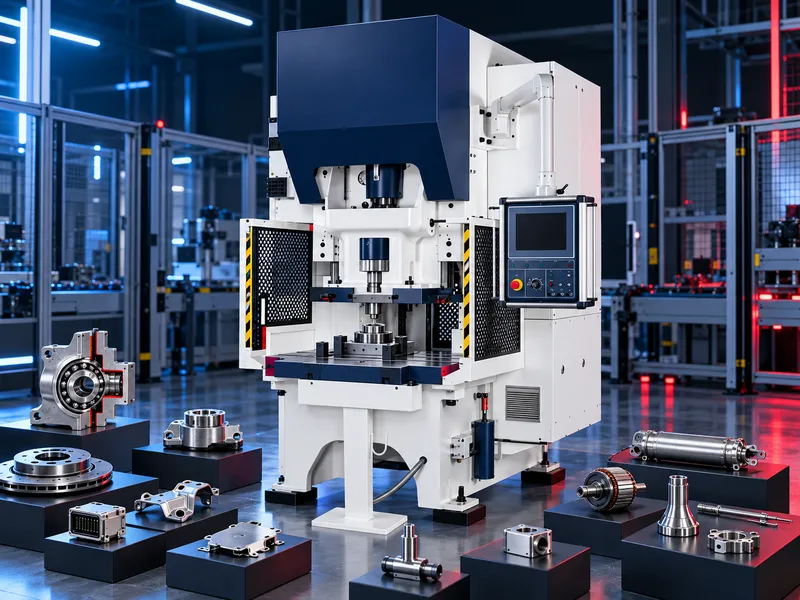
CNC Servo Press Machine for Precision Forming & Assembly
Programmable servo-driven press for controlled pressing, press-fitting, insertion, assembly, stamping and forming applications where ram motion, position and force control are important.
A CNC servo press uses an electronically controlled servo motor to drive the ram, allowing the motion profile to be programmed around the production process rather than relying on a fixed mechanical cycle. The technology is suitable for applications that require controlled pressing, accurate positioning, repeatable assembly or forming sequences, and process monitoring when the selected machine is equipped with the required sensors and control functions. Typical applications include press-fitting, component insertion, assembly, stamping and forming in automotive, electronics, precision manufacturing and other industrial production environments. Machine selection should be based on required force, stroke, working height, speed, tooling, part geometry, production cycle and the required level of position/force monitoring. Exact accuracy, force capacity, speed and sensor resolution must be verified for the selected model.
What it is for
- Press-fitting bearings, bushes and similar components
- Controlled component insertion and assembly
- Precision pressing operations
- Stamping and forming where programmable ram motion is required
- Automotive component assembly
- Electronics and precision-component assembly
- Process development requiring programmable stroke profiles
Core Functions
- Servo motor driven ram motion
- Programmable stroke and motion profile
- Programmable position and speed settings
- Force and position monitoring when equipped with the required sensing system
- Recipe-based operation for different parts when supported by the control
- Controlled approach, pressing and return sequences
- Production data or quality monitoring when supported by the selected control package
Why choose a servo press?
- Programmable ram motion can adapt the press cycle to different processes
- Electric servo drive avoids the hydraulic power unit used by conventional hydraulic presses
- Controlled motion can support sensitive assembly and insertion processes
- Process monitoring can help identify deviations when force/position sensing is included
- Multiple product recipes can reduce mechanical setup changes in suitable applications
How to choose
- Define the pressing process — Specify whether the job is press-fitting, insertion, assembly, stamping, forming or another controlled pressing operation.
- Determine force and stroke — Provide the maximum required pressing force, working stroke, daylight/open height and part dimensions.
- Define control requirements — State whether the process needs position control, force monitoring, force-displacement curves, pass/fail limits or production data recording.
- Define tooling and workpiece — Provide drawings, material, tooling concept, fixture requirements and loading method.
- Define production output — Provide target cycle time, parts per shift and whether manual, semi-automatic or automated loading is required.
Information required for selection
- Workpiece drawing and material
- Required pressing force
- Required stroke and working height
- Part and tooling dimensions
- Target position/force control requirements
- Required cycle time and production volume
- Manual or automated loading requirement
- Electrical supply and installation conditions
Questions we are asked
What is a CNC servo press?
A CNC servo press uses a servo motor and electronic control to drive and program the ram movement for controlled pressing and assembly operations.
What is the main difference between a servo press and a conventional mechanical press?
A servo press allows the ram motion profile to be programmed. Conventional crank presses generally follow a mechanically defined motion linked to the crank mechanism.
Can a servo press monitor pressing force?
It can when the selected machine is equipped with the required load sensing and control system. The exact monitoring functions must be confirmed for the model.
Can it be used for press-fitting?
Yes. Press-fitting, insertion and controlled assembly are common servo-press applications when force, stroke and tooling are correctly selected.
Can the stroke profile be changed for different parts?
Programmable motion profiles are a core advantage of servo-driven presses, subject to the control capabilities of the selected machine.
Is micron-level positioning guaranteed?
No general accuracy value should be assumed. Positioning accuracy and repeatability depend on the specific press, feedback system, tooling and application and must be verified from the model datasheet.
Is a servo press suitable for cleanroom production?
Potential suitability depends on the complete machine design, lubrication, enclosure and required cleanroom class. Cleanroom compatibility should be verified for the specific configuration.
What information is needed for a quotation?
Send the workpiece drawing, material, required force, stroke, working height, tooling details, target cycle time and required force/position monitoring.
Tell us the part you need to make
An engineer reads every request. Usually the same working day.
Related
- Heavy-Duty Gap-Bed Conventional Lathes Heavy-duty conventional lathes for turning large-diameter, long, and heavy rotational components. The gap-bed design provides additional swing near the headstock for suitable short workpieces.
- Gantry Type Milling Machine A gantry-type milling machine provides an open working area for machining suitable large or heavy components. Selection depends on workpiece dimensions, weight, material, required operations, tolerances, finish, and production requirements.
- Boring Machine for Workshop Machining A boring machine for drilling, enlarging, finishing, and aligning suitable holes in individual parts and small production batches. The correct model depends on workpiece size, material, hole diameter, depth, tolerance, surface finish, setup, tooling, and required output.