

METAL SAWING MACHINES
High Performance Circular Saw Cutting Machine
A circular saw cutting machine for controlled cut off and miter cutting of supported metal profiles. The correct configuration depends on the material, profile shape, section size, cut angle, cut quality, batch size, and required output
This metal sawing machine is intended for supported cut off work on round tube, shaped tube, angle sections, flat bar, and other compatible profiles. A swiveling saw head or table may support angled cuts when the exact model provides the required range and secure position locking. The supplied description mentions both a circular saw and an abrasive cutting tool. These are different cutting systems, so the exact blade or wheel type, drive, speed, guarding, material range, and cutting capacity must be confirmed from the approved model documentation before publication or selection.
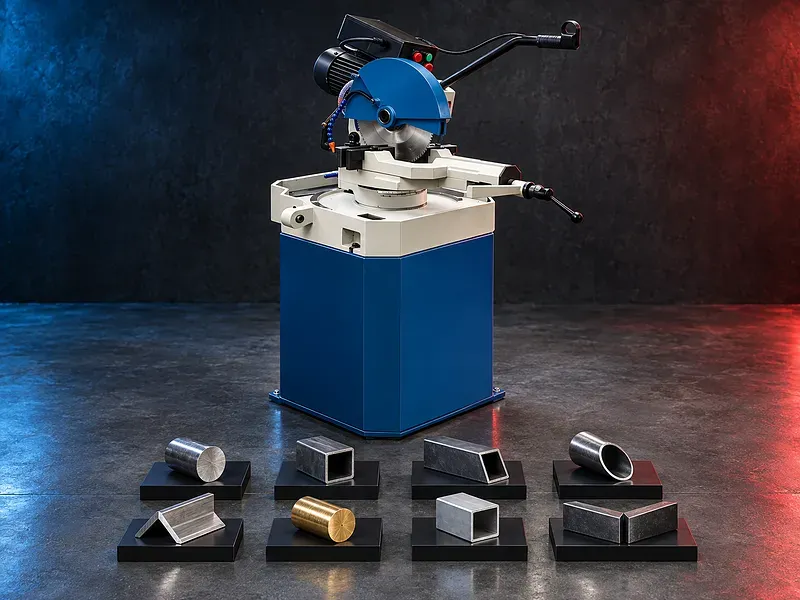
Metal cut off and miter cutting
The machine positions a supported profile in a vice and brings the selected cutting tool through the material to produce a cut off or angled end. The operating sequence and feed method depend on the exact machine design.
Miter cutting can support frames, fabricated assemblies, pipework, railings, furniture, and other products that need controlled end angles. The available swivel range and locking positions require model verification.
Supported profile shapes
Potential workpieces include round tube, square or rectangular tube, special profiles, angle sections, flat bar, and other compatible metal stock when the machine, tool, vice, and cutting data support the section.
Maximum solid and hollow capacities differ by profile shape, wall thickness, material grade, cut angle, bundle arrangement, and blade or wheel type. They must be taken from the approved capacity chart.
Swiveling for angled cuts
The supplied description states that the machine can swivel to 45 degrees in each direction. This function can support left and right miter cuts when the exact model provides the stated movement, angle scale, positive stops, and secure locking.
The usable cutting capacity normally changes with the angle. The capacity at straight and angled positions should be confirmed separately from the manufacturer chart.
Vice and rapid workpiece clamping
A suitable vice should locate and restrain the profile against cutting forces while preserving tool clearance and supporting the offcut. Rapid clamping may reduce setup time when the mechanism provides reliable pressure and repeatable positioning.
Clamping method, jaw opening, jaw height, stock stop, quick action mechanism, anti burr device, and support roller requirements vary by model and application.
Anti burr support and cut quality
The supplied description refers to a vice with an anti burr device. Its construction and function must be verified, because burr formation also depends on tool condition, tooth or abrasive specification, speed, feed, clamping, material, section geometry, cooling, and exit support.
The acceptance plan should define squareness, angle, length, burr condition, heat effect, deformation, finish, and any allowance for downstream deburring, machining, welding, or assembly.
Circular blade or abrasive wheel
A toothed circular saw blade and an abrasive cut off wheel use different cutting principles and need different speeds, drives, guards, consumables, cooling, spark control, and maintenance procedures.
The exact machine category must be confirmed before content approval. Do not select a blade or wheel from the page title alone. Use the approved model manual and tooling specification.
Cutting tool selection
Tool selection should consider the verified machine interface, tool diameter, arbor, speed rating, material grade, section shape, wall thickness, tooth form or abrasive type, required finish, and production duty.
Only approved tools within the machine speed and dimensional limits should be used. Tool condition, correct mounting, flange condition, runout, direction of rotation, and replacement criteria should be controlled.
Blade guard and access control
The supplied description states that the safety hood opens and closes with the cutting requirement. The exact guard design, coverage, interlock status, return action, inspection method, and permitted access must be verified for the selected model.
A moving hood does not replace secure clamping, correct tool mounting, emergency stopping, safe distance, suitable personal protection, and an approved site risk assessment.
Low voltage hand control
The supplied description refers to a 24 V low voltage hand switch. The control voltage, enclosure rating, cable protection, control logic, start prevention, emergency stop relationship, and compliance documentation must be confirmed from the electrical drawings and model manual.
The hand control should be positioned and used according to the approved operating procedure so the operator remains clear of the active cutting zone and moving components.
Speed feed and productivity
Cutting speed and feed should match the material, section, blade or wheel, tool condition, cooling method, clamping, and required cut quality. Incorrect settings can increase heat, burrs, noise, tool wear, breakage, or workpiece movement.
Claims for quick cutting, high efficiency, cycle time, output, tool life, and cost per cut require testing on the actual component with an approved acceptance method.
Material handling and length control
Long stock may require infeed and outfeed roller supports, length stops, measuring systems, lifting equipment, and a clear material path. The offcut must remain supported and controlled during and after the cut.
Roller height, stock weight, center of gravity, straightness, bundle handling, minimum remnant length, and operator reach should be included in the production review.
How to choose the correct machine
Provide the material grade, solid or hollow section, profile shape, outside dimensions, wall thickness, maximum stock length and weight, required cut lengths and angles, tolerances, finish, quantities, batch sizes, and target output.
Selection should also review cutting system, capacity chart, tool size, tool speed, motor power, feed method, vice design, swivel mechanism, cooling, guarding, controls, chip or dust extraction, material supports, floor space, and utilities.
Technical information to verify
The approved exact model source must confirm the manufacturer, model, whether the machine uses a toothed circular blade or abrasive wheel, compatible tool specification, arbor, cutting capacities by profile and angle, swivel range, locking method, vice opening, and feed system.
It must also confirm tool speeds, motor power, electrical supply, stated control voltage, cooling, guard construction, emergency stops, dimensions, weight, noise test basis, included accessories, optional supports, consumables, and installation requirements.
Safety and operating risks
The risk assessment should cover rotating tools, tool breakage, sparks where applicable, sharp stock, burrs, hot material, ejected chips or particles, pinch points, clamping forces, unsupported stock, manual handling, noise, coolant, dust, electrical hazards, and maintenance isolation.
Required controls may include guarding, emergency stops, secure workholding, approved tooling, suitable extraction, safe material support, face and eye protection, hearing protection, training, housekeeping, and documented lockout procedures.
Installation maintenance and lifecycle support
Site planning should cover floor capacity, machine stability, electrical supply, lighting, access, stock flow, infeed and outfeed supports, offcut handling, spark or chip control, cooling, ventilation, maintenance clearance, and operator training.
Preventive maintenance should follow approved manufacturer documents for the spindle or wheel shaft, bearings, drive, vice, swivel mechanism, guards, electrical controls, lubrication, coolant, alignment, tool mounting surfaces, and wear inspection.
Limitations and alternatives
A manual or semi automatic saw may need operator loading, positioning, clamping, feeding, and unloading. It may not suit unattended production, complex compound angles, very large sections, or tight finished dimensions without secondary machining.
Depending on the part and output, alternatives may include a band saw, cold saw, abrasive cut off saw, automatic circular saw, laser tube cutter, plasma system, or dedicated production line.
Technical review and next step
Send section drawings, material grades, dimensions, wall thicknesses, cut lengths and angles, tolerance and burr limits, annual and batch quantities, target output, available utilities, floor plan, and handling method to SAKKARY MACHINERY.
The technical review will compare the application with approved model data and identify the suitable cutting system, capacity, tooling, clamping, supports, guarding, inspection plan, and any sample cutting requirement.
Questions we are asked
What materials and profiles can the machine cut?
Potential work includes supported metal tubes angles flat bar and shaped profiles. Exact materials sizes wall thicknesses and solid capacities depend on the approved model and tool.
Can the machine cut at an angle?
The supplied description states a swivel range to 45 degrees in each direction. The exact range locking method and cutting capacity at each angle require model verification.
Does the machine use a saw blade or an abrasive wheel?
The supplied text contains both descriptions. The exact cutting system must be confirmed from the approved model manual before publication or tooling selection.
What is the purpose of the vice?
The vice locates and secures the profile against cutting forces. Jaw range clamping pressure quick action and anti burr features are model dependent.
Does a guard make operation automatically safe?
No. Safe operation also requires approved tooling secure clamping emergency stopping material support training personal protection and a site risk assessment.
What information is required for selection?
Provide material grades profile drawings dimensions wall thicknesses cut lengths and angles tolerances quantities target output utilities floor space and handling method.
Tell us the part you need to make
An engineer reads every request. Usually the same working day.
Related
- Heavy-Duty Gap-Bed Conventional Lathes Heavy-duty conventional lathes for turning large-diameter, long, and heavy rotational components. The gap-bed design provides additional swing near the headstock for suitable short workpieces.
- Gantry Type Milling Machine A gantry-type milling machine provides an open working area for machining suitable large or heavy components. Selection depends on workpiece dimensions, weight, material, required operations, tolerances, finish, and production requirements.
- Boring Machine for Workshop Machining A boring machine for drilling, enlarging, finishing, and aligning suitable holes in individual parts and small production batches. The correct model depends on workpiece size, material, hole diameter, depth, tolerance, surface finish, setup, tooling, and required output.