

Mechanical Stamping & Forming Solutions
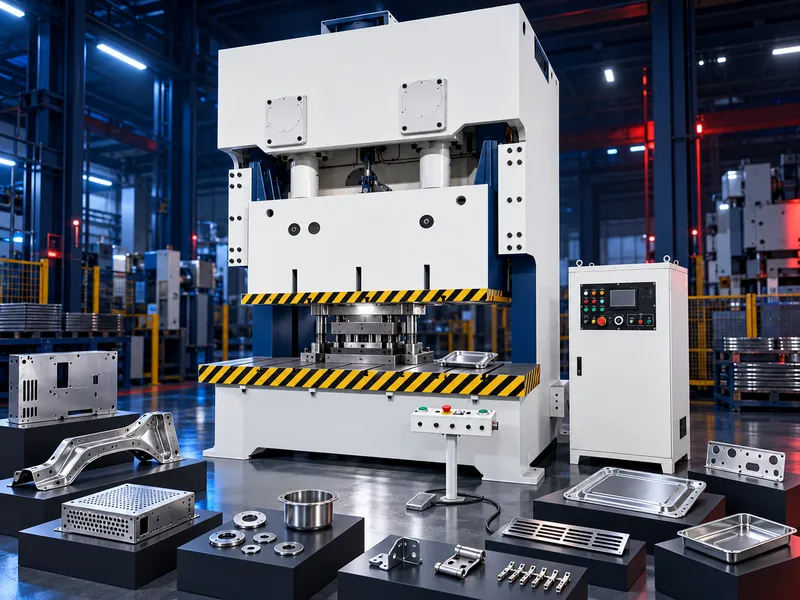
C-Frame Gap Frame Crank Press for Sheet Metal Stamping
Open-front mechanical crank press for punching, blanking, bending and forming sheet metal parts, with accessible C-frame construction and options for automated feeding and production support.
The C-Frame Gap Frame Crank Press is designed for industrial sheet metal stamping operations where open access to the die area, repeatable ram motion and efficient production are required.
Its C-frame structure provides convenient access to the workpiece and tooling, making the press suitable for a wide range of general stamping, punching, blanking, bending and forming jobs.
Power is transmitted from the motor through the mechanical drive to the crankshaft, converting rotary motion into the reciprocating movement of the ram. The required die is selected according to the part geometry and forming operation.
Machine selection should be based on required press force, workpiece and material, die dimensions, stroke requirements, production rate, feeding method and required automation level.
What it is for
- Sheet metal punching
- Blanking and cut-off operations
- Bending and forming
- Stamping of metal components
- Production with progressive or dedicated dies where compatible
- Automotive component production
- Electrical and electronics metal parts
- General metal fabrication and manufacturing
Machine structure and operation
- Open C-frame / gap-frame structure for workpiece and die access
- Mechanical crankshaft drive converts rotary motion into ram reciprocation
- Steel frame construction with rigidity and stability dependent on the selected model
- Guided ram movement for repeatable press operation
- Control system for operating parameters and machine status, depending on configuration
- Lubrication and safety devices according to the selected machine specification
Source-supplied technical range
- Nominal force: 160-4000 kN
- Strokes per minute: 25-135 min-1
- Stroke length: 2-10 mm - source supplied; verify against the exact model datasheet before publication
Optional configurations
- Automatic feeding system
- Air cushion
- Speed options, subject to model and configuration
How to choose
- Define the stamping operation Identify whether the job is punching, blanking, bending, forming or another die-based operation.
- Confirm material and part dimensions Provide material grade, thickness, blank dimensions and finished-part drawing.
- Calculate the required press force Press capacity must be selected from the actual operation, material, perimeter and die design rather than from part size alone.
- Match the die and working area Confirm die dimensions, shut height, required stroke and access around the tooling.
- Set the production target Required strokes per minute, batch size and shift pattern affect the appropriate machine and automation level.
- Plan feeding and automation
For repetitive production, evaluate coil or blank feeding, automatic feeder, die protection and part handling according to the application.
Information required for selection
- Material and thickness
- Part drawing and dimensions
- Required operation
- Required press force if already calculated
- Die dimensions and weight
- Required stroke and shut height
- Target strokes per minute / output
- Manual, semi-automatic or automatic feeding
- Available electrical supply and installation conditions
Questions we are asked
What is a C-frame gap frame crank press?
It is a mechanical press with an open C-shaped frame and crankshaft-driven ram, used for die-based operations such as punching, blanking, bending and forming.
What are the main advantages of the C-frame design?
The open structure provides convenient access to the die and workpiece and is practical for many general sheet metal stamping applications.
Can the press be connected to an automatic feeder?
Automatic feeding is listed as an optional configuration. The feeder type and integration should be selected according to the material, die and production process.
What press force is available?
The supplied source states a nominal force range of 160-4000 kN across the product range. The exact capacity must be confirmed for the selected model.
What is the available production speed?
The supplied source states 25-135 strokes per minute across the range. Actual speed depends on the selected model, stroke, tooling, feeding method and application.
Is the 2-10 mm stroke length confirmed?
No. This value appears in the supplied source but should be verified against the exact manufacturer datasheet before it is published as a technical specification.
How do I choose the correct press?
Send the material, thickness, part drawing, die information, required operation, production target and feeding method so the press capacity and configuration can be selected correctly.
Tell us the part you need to make
An engineer reads every request. Usually the same working day.
Related
- Heavy-Duty Gap-Bed Conventional Lathes Heavy-duty conventional lathes for turning large-diameter, long, and heavy rotational components. The gap-bed design provides additional swing near the headstock for suitable short workpieces.
- Gantry Type Milling Machine A gantry-type milling machine provides an open working area for machining suitable large or heavy components. Selection depends on workpiece dimensions, weight, material, required operations, tolerances, finish, and production requirements.
- Boring Machine for Workshop Machining A boring machine for drilling, enlarging, finishing, and aligning suitable holes in individual parts and small production batches. The correct model depends on workpiece size, material, hole diameter, depth, tolerance, surface finish, setup, tooling, and required output.