

Automatic Straight & Angled Metal Cutting Solutions
Fully Automatic Miter-Cutting Band Saw Machines
Fully automatic miter-cutting band saw machines combine automatic material feeding, programmable cutting cycles and adjustable straight or angled cutting for repetitive production of bars, tubes, profiles, beams and structural metal sections. Available configurations cover applications from medium-size production cutting to large structural sections.
Fully automatic miter-cutting band saw machines are designed for production environments that require repeated cut-to-length parts together with straight and angled cutting capability. Automatic material feeding and programmable cutting jobs help reduce manual handling and support production of different lengths and quantities. A rigid machine structure, hydraulic clamping, adjustable blade speed and controlled cutting pressure support stable sawing across a range of metal sections. Depending on the selected configuration, the machine can perform 90° straight cuts and miter cuts for structural fabrication and other applications requiring controlled cutting angles. Machine capacity, available cutting angles, automation level and accessories vary by configuration. The required model should therefore be selected according to material profile, maximum section size, cutting angle, material grade, production quantity and required automation.
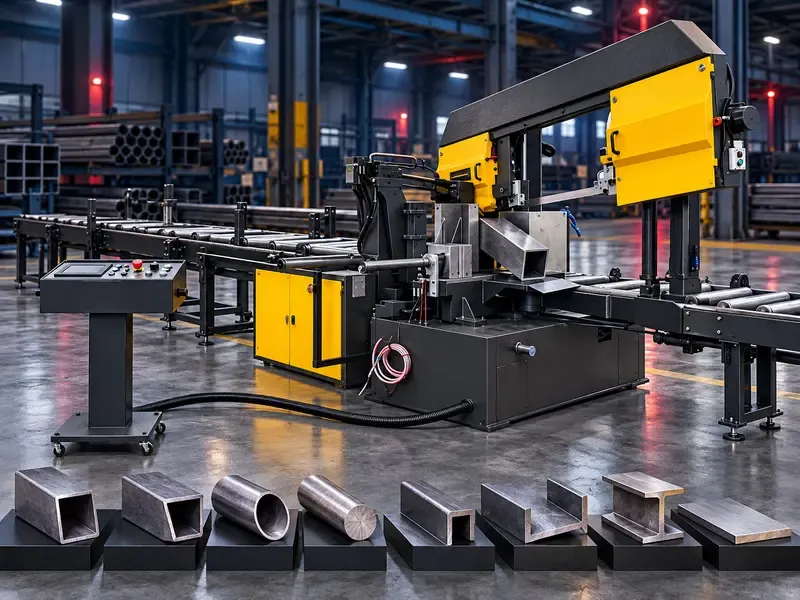
What Is a Fully Automatic Miter-Cutting Band Saw?
It is a horizontal band saw system that combines an automatic feeding cycle with programmable sawing and a miter-cutting arrangement. The machine is intended for repetitive production where material must be fed to a defined length, clamped and cut automatically, while selected configurations also allow the saw to be positioned for angled cuts.
Typical Workpieces
- Solid bars
- Round and square tubes
- Profiles and extrusions
- Beams
- Structural steel sections
- Fabricated metal sections
Core Production Functions
- Automatic material feeding for repetitive cut lengths
- Programmable cutting cycles for different lengths and quantities
- Hydraulic workpiece clamping
- Adjustable blade speed to suit the application
- Controlled cutting pressure / feed
- Straight cutting at 90°
- Miter cutting on selected configurations
- Production-oriented operation for repeated batches
Available Equipment & Options
- Servo-controlled material feeding
- PLC or CNC control, depending on configuration
- Programmable cutting jobs
- Digital angle indication
- Hydraulic blade tensioning
- Chip conveyor
- Top clamping for suitable profiles
- Material roller tables / infeed and outfeed support
Option availability must be confirmed for the selected machine configuration.
Why Use Automatic Miter Cutting?
- Combines repetitive cut-to-length production with angled cutting capability
- Reduces repeated manual positioning during production batches
- Supports multiple part lengths and quantities through programmable jobs
- Suitable for structural sections that require straight and miter cuts
- Allows the machine configuration to be matched to material size, profile and production volume
Typical Applications
- Steel construction and structural fabrication
- Heavy fabrication workshops
- Steel service centers
- General metal-processing facilities
- Production of frames and fabricated assemblies
- Cut-to-length preparation before welding or machining
How to Select the Correct Machine
- Define the workpiece form: solid bar, tube, profile, beam or structural section.
- Confirm the maximum dimensions at 90° and at every required miter angle.
- Specify the material grade and whether the section is solid or hollow.
- Define required cutting angles and the frequency of angled cuts.
- Specify cut lengths, tolerances, quantities and expected production volume.
- Determine the required automation level and control type.
- Confirm material feeding, clamping and support requirements.
- Select blade type, blade speed range and cutting parameters according to the material.
- Define chip handling, coolant and roller-table requirements.
- Confirm factory utilities, floor space and material-handling arrangement before ordering.
Information Required for a Quotation
- Material type and grade
- Workpiece shape / profile
- Maximum and minimum section dimensions
- Solid or hollow material
- Required cutting angles
- Required cut lengths and tolerances
- Batch quantities / production target
- Raw material bar length
- Required automation and control level
- Required options such as top clamp, chip conveyor and roller tables
Technical Data to Confirm for the Selected Configuration
- Exact cutting capacity at 90°
- Cutting capacity at each miter angle
- Available angle range
- Blade dimensions
- Blade speed range
- Main motor power
- Hydraulic system data
- Feeding stroke and repeat feeding method
- Feed positioning system
- Clamping arrangement
- Machine dimensions and weight
- Electrical supply
- Coolant system
- Standard equipment and optional accessories
Questions we are asked
What is a fully automatic miter-cutting band saw?
It is a band saw that combines automatic material feeding and programmable cutting cycles with straight and, on suitable configurations, angled cutting capability.
What materials can it cut?
The machine series is intended for metal bars, tubes, profiles, beams and structural sections. The correct blade and cutting parameters must be selected for the material grade and section.
What is the available round cutting capacity?
Across the available range, round capacity at 90° is approximately Ø320 to Ø1,020 mm. The exact capacity depends on the selected configuration.
Does the same capacity apply when cutting at an angle?
No. Cutting capacity normally decreases at angled positions and must be checked for the required profile and cutting angle.
Can the machine produce different lengths automatically?
Yes. Automatic feeding and programmable cutting cycles are intended for repetitive production of specified lengths and quantities, subject to the selected control and feeding configuration.
Is CNC control standard on every machine?
Not necessarily. PLC or CNC control and servo feeding are configuration-dependent and should be confirmed for the selected machine.
What information should I send for machine selection?
Send the material grade, profile shape, maximum section size, required angles, cut lengths, tolerances, raw bar length, quantities and required automation/options.
Tell us the part you need to make
An engineer reads every request. Usually the same working day.
Related
- Heavy-Duty Gap-Bed Conventional Lathes Heavy-duty conventional lathes for turning large-diameter, long, and heavy rotational components. The gap-bed design provides additional swing near the headstock for suitable short workpieces.
- Gantry Type Milling Machine A gantry-type milling machine provides an open working area for machining suitable large or heavy components. Selection depends on workpiece dimensions, weight, material, required operations, tolerances, finish, and production requirements.
- Boring Machine for Workshop Machining A boring machine for drilling, enlarging, finishing, and aligning suitable holes in individual parts and small production batches. The correct model depends on workpiece size, material, hole diameter, depth, tolerance, surface finish, setup, tooling, and required output.