

Automatic 2D & 3D Wire Forming from Coil
Auto Link 3D CNC Wire Bending Machine
Automatic CNC wire forming solution for producing precise 2D and 3D wire components directly from coil. The machine straightens, feeds, bends and cuts wire in one programmed production cycle for complex industrial wire forms
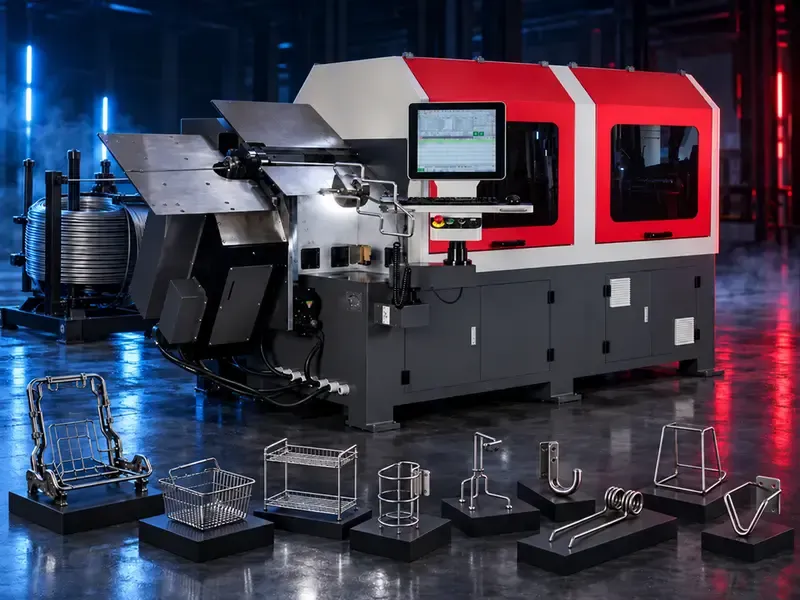
The Auto Link 3D CNC Wire Bending Machine is designed for automatic production of complex wire forms from coil. Wire is fed through the straightening and feeding system, formed through CNC-controlled bending movements, and cut after the programmed geometry is completed. The machine supports both 2D and 3D wire-forming applications. A rotary wire-forming mechanism and programmable bending tools allow the system to create multiple bend directions and radii, including inner and outer bends, according to the selected tooling and wire specification. It is suitable for industrial manufacturers producing repeated wire components for automotive, furniture, kitchen and bathroom products, medical equipment, gym equipment, agricultural equipment and other fabricated-wire applications
Automatic Wire Forming Process
The production sequence integrates the main wire-forming operations into one CNC-controlled workflow:
- Coil loading — wire is supplied from a decoiler.
- Straightening — the wire passes through the straightening system before forming.
- Servo feeding — the programmed wire length is advanced through the feeding rollers.
- 3D bending — the bending system forms the programmed geometry using rotary positioning and suitable bending tools.
- Cutting — the finished component is separated automatically after the bending cycle.
Key Features
- CNC-controlled production of 2D and 3D wire shapes.
- Automatic processing directly from coil.
- Integrated straightening, feeding, bending and cutting sequence.
- 360-degree rotary wire-forming capability for multi-directional bends.
- Multiple R-angle / bend-radius possibilities subject to tooling and wire specification.
- Bending tools designed for inner and outer bending operations.
- Servo-driven motion coordinated by the CNC programming system.
- Built-in software for programming and production control.
- Operator interface available in English and Chinese according to the supplied manufacturer information.
- Decoiler options referenced with 500–1000 kg loading capacity; exact configuration must be confirmed for the selected model.
Input Materials
The supplied manufacturer content lists the following wire materials as applicable, subject to diameter, temper, tensile strength and tooling compatibility:
- Stainless steel
- Aluminum
- Brass
- Bronze
- Carbon steel
- Cold-rolled steel
- Copper
- Nickel
- Titanium
- Other compatible wire materials after technical confirmation
Typical Applications
- Automotive wire components and formed wire parts.
- Kitchen and bathroom accessories.
- Medical equipment wire components.
- Gym and fitness equipment components.
- Agricultural equipment wire forms.
- Furniture and metal-furniture components.
- Steel V-hooks and similar formed-wire products.
- Custom 2D and 3D industrial wire forms.
Why Use a 3D CNC Wire Bending Machine?
- Combines multiple forming stages in one automated process.
- Reduces manual handling between straightening, bending and cutting operations.
- Allows repeatable programmed geometries for batch production.
- Supports complex wire forms that require bends in multiple planes.
- Programs can be adjusted for different part geometries within the machine capability and tooling range.
How to Select the Correct Machine
- Wire material and grade.
- Minimum and maximum wire diameter required.
- Wire tensile strength / hardness condition.
- 2D or 3D part geometry.
- Minimum bend radius and required bend angles.
- Part dimensions and maximum developed wire length.
- Required production rate and batch size.
- Coil weight and preferred decoiler capacity.
- Part drawings, STEP/DXF files or physical samples when available.
- Required electrical supply and factory installation conditions.
Information Required for Quotation
- Part drawing or clear product photo.
- Wire material.
- Wire diameter or diameter range.
- Part dimensions and bend details.
- Expected quantity / production target.
- Coil weight if known.
- Any special tolerance or surface requirements.
- Required destination and electrical supply.
Technical Data — To Be Verified by Exact Model
Auto Link offers multiple configurations. The following values should be confirmed from the exact model datasheet before publication or quotation:
- Applicable wire diameter range
- Number of servo axes
- Feeding accuracy
- Bending accuracy
- Maximum feeding speed
- Maximum bending speed
- Maximum wire feed length
- Bending radius range
- Decoiler loading capacity
- Motor power
- CNC/controller specification
- Machine dimensions and weight
- Electrical supply
- Tooling package
- Supported file/program formats
- Optional accessories and safety equipment
Suggested Page Sections / Media
- Hero image: complete Auto Link 3D CNC wire bending machine.
- Process graphic: Coil → Straightening → Feeding → 3D Bending → Cutting.
- Close-up images: feeding rollers, straightener, bending head, cutting tool and CNC screen.
- Application gallery: automotive, furniture, kitchen/bathroom, medical, gym, agricultural and V-hook samples.
- Video: automatic 3D wire-forming cycle from coil to finished component.
- CTA: Request a Quotation / Send Your Wire Part Drawing.
Questions we are asked
What is a 3D CNC wire bending machine?
It is an automatic CNC machine that straightens wire from coil, feeds the programmed length, bends the wire in multiple planes and cuts the finished component according to the programmed geometry.
Can the machine produce both 2D and 3D wire parts?
Yes. The supplied manufacturer description states that the machine is intended for both 2D and 3D wire-forming applications.
How is the wire supplied to the machine?
Wire is supplied from a coil through a decoiler, then passes through the straightening and feeding system before bending and cutting.
What materials can be processed?
The supplied information lists stainless steel, aluminum, brass, bronze, carbon steel, cold-rolled steel, copper, nickel and titanium. The exact usable diameter and material condition must be matched to the selected machine model.
Can it make bends in different directions?
The described system uses a 360-degree rotary forming mechanism and bending tooling for multi-directional 3D forms. Exact movement limits depend on the selected configuration.
What industries use this machine?
Typical applications include automotive, kitchen and bathroom products, medical equipment, gym equipment, agricultural equipment, furniture and custom formed-wire components.
What should I send to receive a quotation?
Send the part drawing or photo, wire material, wire diameter, main dimensions, bend details and required production quantity. A sample or 3D file can also help with technical evaluation.
Can the machine configuration be customized?
Configuration depends on the required wire range, part geometry, tooling, decoiler and control requirements. Custom requirements should be confirmed against the manufacturer’s available model options.
Tell us the part you need to make
An engineer reads every request. Usually the same working day.
Related
- Heavy-Duty Gap-Bed Conventional Lathes Heavy-duty conventional lathes for turning large-diameter, long, and heavy rotational components. The gap-bed design provides additional swing near the headstock for suitable short workpieces.
- Gantry Type Milling Machine A gantry-type milling machine provides an open working area for machining suitable large or heavy components. Selection depends on workpiece dimensions, weight, material, required operations, tolerances, finish, and production requirements.
- Boring Machine for Workshop Machining A boring machine for drilling, enlarging, finishing, and aligning suitable holes in individual parts and small production batches. The correct model depends on workpiece size, material, hole diameter, depth, tolerance, surface finish, setup, tooling, and required output.