

HIGH POWER FIBER LASER MACHINES
High Power Fiber Laser Cutting Machine 12 20 30 40 kW
High power fiber laser cutting configurations for suitable metal sheets and plates. Selecting 12 kW, 20 kW, 30 kW, or 40 kW depends on the material, thickness range, part geometry, edge requirements, cutting gas, machine design, automation, and production target.
A high power fiber laser cutting machine uses a concentrated laser beam to produce programmed contours, holes, slots, and other supported features in suitable metal sheets and plates. Higher rated power can expand process options or improve output for selected materials and thicknesses, but the result depends on the complete machine and cutting process. Power should not be selected from the kilowatt rating alone. The review must include the laser source, optical chain, cutting head, motion system, bed and load capacity, piercing strategy, gas system, extraction, cooling, automation, part mix, quality requirement, and verified cutting data for the exact model.
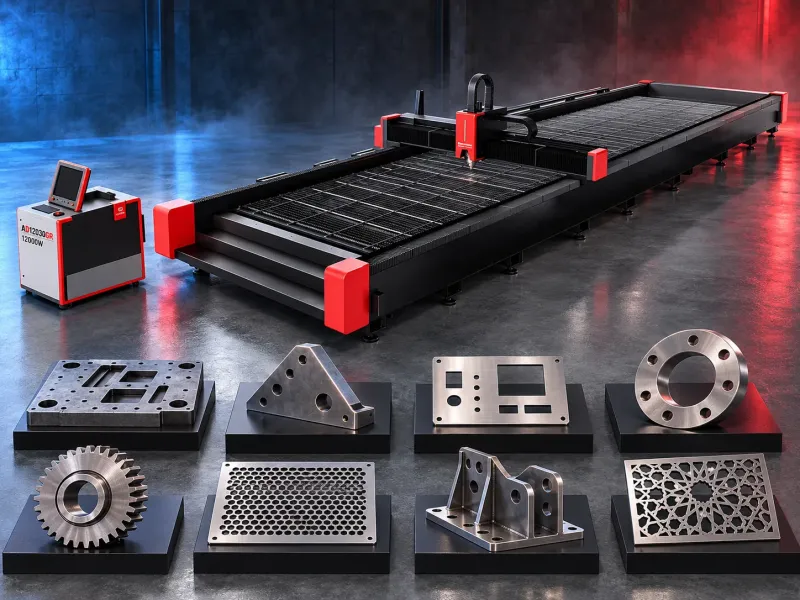
High power fiber laser cutting
The machine coordinates the laser source, cutting head, axes, height control, gas delivery, nesting software, and process data to cut suitable metal sheets and plates. The complete optical and mechanical system must be designed for the selected rated power.
The requested 12 kW, 20 kW, 30 kW, and 40 kW configurations must be confirmed against the exact manufacturer, model, laser source, country version, and approved technical documentation.
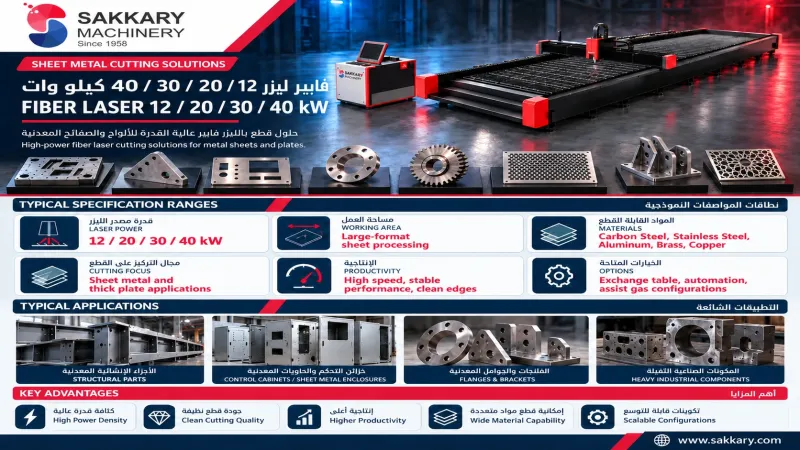
Choosing between 12 20 30 and 40 kW
The suitable power depends on the material families, minimum and maximum thicknesses, percentage of thin medium and thick work, part geometry, hole sizes, piercing requirements, edge quality, cutting gas, batch profile, and target output.
A higher kilowatt rating does not automatically provide the best cut quality, lowest cost, or highest useful output for every job. The machine dynamics, cutting data, gas delivery, cooling, extraction, uptime, and production balance must support the power.
Suitable production applications
Potential applications include machinery frames, construction components, agricultural equipment, vehicle and transport components, heavy fabrication, energy equipment, industrial enclosures, cabinets, plates, brackets, covers, and general sheet metal assemblies.
Application suitability must be confirmed from the actual drawing, material grade, thickness, feature size, tolerance, edge requirement, downstream forming or welding, and production volume.
Materials and thickness range
Potential materials may include suitable grades of carbon steel, stainless steel, aluminum, copper, brass, and other metals compatible with the verified laser source, cutting head, gas system, and process data.
Maximum and minimum thicknesses cannot be inferred from laser power alone. They depend on the machine, material grade, gas, nozzle, focus strategy, piercing method, quality criteria, and test conditions stated by the manufacturer.
Potential production value
A suitable high power system may increase cutting options, reduce cycle time for selected parts, and support thicker work or higher throughput when the complete machine and process are matched to the application.
Actual productivity, accuracy, gas consumption, material utilization, setup time, cost per part, uptime, and secondary operation reduction depend on the part mix, nesting, cutting strategy, automation, maintenance, and acceptance criteria.
Cut quality and process stability
The production plan should define contour dimensions, hole and slot sizes, corner quality, kerf condition, burr limits, dross, heat effect, taper, surface protection, part identification, and inspection method.
High power does not remove the need for controlled material quality, correct nozzles, clean optics, stable focus, calibrated height control, suitable gas purity and pressure, good extraction, preventive maintenance, and validated cutting parameters.
How to choose the correct machine
Provide finished part drawings and CAD files, material grades, sheet formats, minimum and maximum thicknesses, sheet weights, feature details, tolerances, edge requirements, quantities, batch sizes, shift pattern, and target output.
Selection should compare the 12 kW, 20 kW, 30 kW, and 40 kW options through sample parts, verified cutting data, cycle studies, gas consumption, loading plan, utilization, operating inputs, and future product requirements.
Technical information to verify
The approved manufacturer documents must confirm the brand, model, laser source, rated output, optical system, supported materials, sheet dimensions, thickness capacity, maximum sheet load, axis travels, cutting speed, positioning accuracy, repeatability, and stated test conditions.
They must also confirm the cutting head rating, automatic focus, height control, collision protection, piercing functions, table system, automatic loading options, unloading, sorting, software, nesting, extraction, cooling, gas requirements, electrical supply, compressed air, dimensions, weight, and foundation requirements.
Cutting gases and operating inputs
The process may use oxygen, nitrogen, compressed air, mixed gas, or another approved gas depending on the material, thickness, edge requirement, and verified process package.
Gas type, purity, pressure, flow, piping, storage, booster requirements, safety controls, and consumption must be confirmed for the exact machine and production mix. Electricity, cooling, extraction, and consumables must also be included in the operating assessment.
Enclosure extraction and safety
The machine design should be reviewed for enclosure construction, controlled access, interlocks, laser viewing windows, warning indicators, emergency stops, fire precautions, beam protection, and the documented safety classification of the exact model.
Fume and dust extraction must be selected for the materials, coatings, laser power, gases, duty cycle, and local requirements. Extraction and filtration performance claims require documented evidence.
Automation and material flow
Depending on the verified model, the machine may use a single bed, exchange tables, manual loading, automatic loading, unloading, sorting, part identification, or integration with sheet storage and production software.
Automation should be chosen from sheet size and weight, part mix, batch frequency, operator availability, shift pattern, floor space, unloading method, scrap handling, and traceability requirements.
Installation and lifecycle support
Site planning should cover machine footprint, material flow, loading access, unloading space, foundation, electrical supply, grounding, cooling, cutting gases, compressed air, extraction, ventilation, fire precautions, guarding, software connectivity, and operator training.
The exact supply scope, commissioning, training, preventive maintenance, consumables, optics care, spare parts, warranty, and service commitments require confirmation in the approved technical and commercial offer.
Limitations and alternatives
High power fiber laser cutting is not automatically the best solution for every material, thickness, tolerance, edge requirement, or production volume. Plasma, waterjet, oxyfuel, punching, machining, or a lower power laser may be more suitable for some parts.
The decision should be based on the complete production route, verified sample quality, useful throughput, utilities, gas supply, operating cost inputs, maintenance capability, and future product mix rather than the highest available power.
Technical review and next step
Send the part drawings with material specifications, sheet dimensions, thickness range, tolerances, quantities, edge requirements, automation needs, and target output.
SAKKARY MACHINERY will compare the required process with the verified 12 kW, 20 kW, 30 kW, and 40 kW configurations before recommending a machine.
Questions we are asked
Does higher laser power always provide a better result?
No. The useful result depends on the material thickness part geometry cutting gas machine dynamics process data quality requirement automation and production balance.
How do I choose between 12 20 30 and 40 kW?
Compare the actual part mix thickness distribution target output sample quality gas consumption utilities automation and operating inputs for each verified configuration.
Which materials and thicknesses can be cut?
Supported materials and thicknesses must be confirmed for the exact machine laser source cutting head gas system and approved process data. Power alone is not sufficient evidence.
Which cutting gas is required?
The gas depends on the material thickness edge requirement and verified cutting process. Purity pressure flow storage piping safety and consumption must be reviewed.
Does a high power machine require special site planning?
The site plan must verify electrical supply cooling gas delivery compressed air extraction ventilation fire precautions foundation material flow and service access for the exact model.
What information is required for technical selection?
Provide part drawings material grades sheet sizes thickness distribution tolerances edge requirements quantities batch profile shifts automation needs and target output.
Tell us the part you need to make
An engineer reads every request. Usually the same working day.
Related
- Fiber Laser Cutting Machines Industrial fiber laser solutions for cutting metal sheets with a configuration selected according to the material, thickness, part dimensions, required cut quality, and production target.
- Integrated Fiber Laser Processing Machine An integrated CNC solution designed to combine compatible sheet-metal operations such as fiber laser cutting, punching, forming, and marking. Actual functions depend on the selected model and configuration.
- Tube Fiber Laser Cutting Machine A fiber laser cutting solution for suitable tubes and metal profiles. Machine selection depends on the material, section type, dimensions, wall thickness, part geometry, cutting requirements, loading method, and production target.