

FIBER LASER MACHINES
Integrated Fiber Laser Processing Machine
An integrated CNC solution designed to combine compatible sheet-metal operations such as fiber laser cutting, punching, forming, and marking. Actual functions depend on the selected model and configuration.
Why distribute compatible production stages across several machines when an integrated CNC solution may perform multiple operations in one platform? Combining processes can reduce part transfers, repeated setup, handling, and work-in-progress when the application is suitable.
The correct solution must be selected from the sheet material, thickness, part geometry, required processes, tolerances, batch size, and production target. Explore related fiber laser machines or send your part drawing for a technical application review.
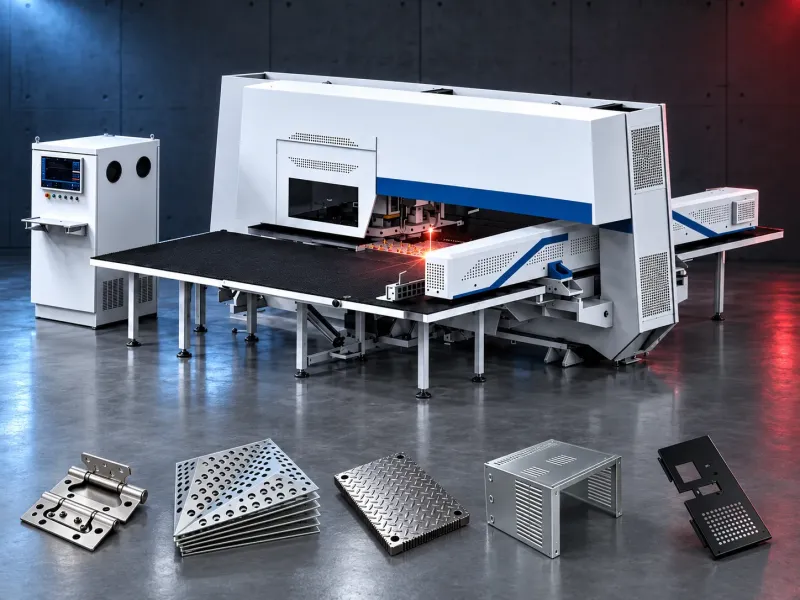
What is an integrated fiber laser processing machine?
It is a CNC sheet-metal processing solution designed to combine fiber laser cutting with other supported operations on one platform. Depending on the verified model, these operations may include punching, localized forming, marking, tapping, or other functions.
The exact process combination, working sequence, material compatibility, and production limits must be verified from the official model documentation.
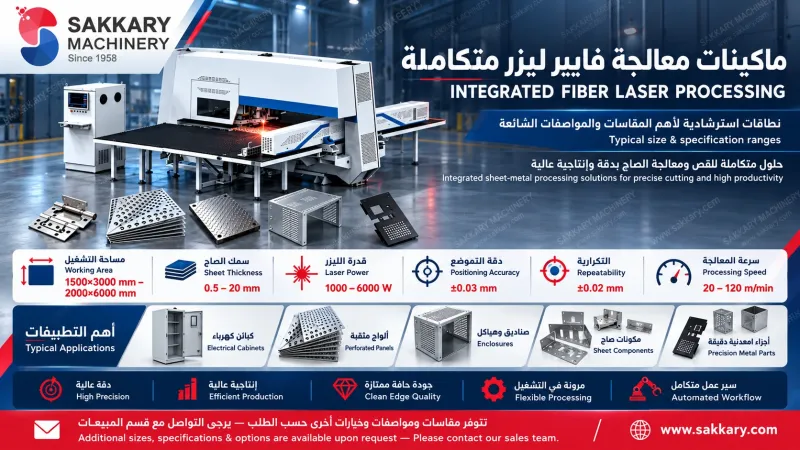
Processes that may be integrated
- Fiber laser cutting
- CNC punching
- Supported sheet-metal forming
- Part identification or marking
- Tapping or related operations where equipped
- Automatic loading, unloading, and sorting where available
- Only functions included in the selected machine’s approved configuration should appear on the published page.
Typical applications
- Sheet-metal parts requiring cut profiles and punched features
- Components combining holes, slots, and formed details
- Panels, covers, cabinets, and enclosures
- Parts requiring identification or traceability marks
- Repeated sheet-metal components with several compatible operations
- Custom components manufactured from approved drawings
- Application suitability depends on the material, thickness, feature geometry, tooling, required quality, and machine configuration.
Potential production benefits
- Combine compatible processes on one CNC platform
- Reduce transfers between separate machines
- Reduce repeated loading and part alignment
- Lower work-in-progress between supported operations
- Use factory floor space more efficiently
- Simplify production routing for suitable components
- Support traceability where integrated marking is available
- Reduce manual handling through compatible automation
- These benefits are potential outcomes, not guaranteed results. Productivity must be calculated from the actual part, process sequence, setup time, cycle time, batch size, and automation level.
How to evaluate the solution
- Provide complete part drawings and CAD files
- Confirm material grade and sheet condition
- Define sheet dimensions and thickness range
- List every cutting, punching, forming, and marking operation
- Identify holes, slots, louvers, embossing, or formed features
- State dimensional and geometric tolerances
- Confirm edge-quality and surface-finish requirements
- Define marking content, size, position, and permanence
- Identify tooling and changeover requirements
- Define batch size, product mix, and target output
- Compare the integrated route with the current production route
- Review loading, unloading, sorting, and material-flow needs
- Confirm software, nesting, and production-data requirements
- Review power, gases, air, extraction, space, and safety requirements
Technical data to verify
- Manufacturer, brand, model, and country of origin
- Integrated processes included in the selected configuration
- Fiber laser source type and verified power
- Supported materials and thickness ranges
- Sheet dimensions and working area
- Punching force and punching-tool system
- Supported forming operations and limits
- Marking method and verified capabilities
- Positioning accuracy and repeatability
- Cutting, punching, forming, and marking quality conditions
- CNC control and production software
- Nesting and CAD/CAM compatibility
- Tool capacity and automatic tool-change functions
- Loading, unloading, sorting, and automation systems
- Assist-gas, compressed-air, extraction, and cooling requirements
- Dimensions, weight, foundation, electrical supply, and safety systems
Does one machine replace four machines?
Not automatically. An integrated machine can replace or reduce selected production stages only when its verified functions, capacity, quality, and cycle time meet the requirements of the parts being produced. Some components may still need separate bending, machining, deburring, welding, finishing, or inspection operations.
Productivity claim
The statement “productivity up to double” must not be published as a general claim. It requires a documented comparison based on the same part, material, quantity, quality requirements, current process route, integrated process route, setup time, cycle time, and handling time.
Installation and lifecycle support
Installation planning must cover electrical supply, laser safety, assist gases, compressed air, cooling, extraction, tooling, material handling, software, operator training, and production-data management. Installation, commissioning, training, maintenance, spare parts, consumables, and warranty scope must be confirmed in the approved offer.
Build a smarter production route
Send your drawings, materials, thicknesses, required processes, and production targets. SAKKARY MACHINERY will review whether an integrated solution is technically and commercially suitable for your application.
Questions we are asked
Which processes can the machine combine?
Depending on the verified configuration, it may combine fiber laser cutting with punching, supported forming, marking, tapping, or automation functions.
Does one integrated machine replace four separate machines?
Only when its functions, capacity, quality, and cycle time meet the requirements of the actual parts. Separate processes may still be required.
Can the machine double productivity?
This cannot be claimed without a documented comparison of the current and proposed production routes using the same part and quality requirements.
Which materials and thicknesses can it process?
Material types and thickness ranges must be verified from the exact model’s official datasheet and application testing where necessary.
What information is required for machine selection?
Provide part drawings, material grades, thicknesses, required operations, tolerances, batch sizes, current process times, and production targets.
Tell us the part you need to make
An engineer reads every request. Usually the same working day.
Related
- Fiber Laser Cutting Machines Industrial fiber laser solutions for cutting metal sheets with a configuration selected according to the material, thickness, part dimensions, required cut quality, and production target.
- Tube Fiber Laser Cutting Machine A fiber laser cutting solution for suitable tubes and metal profiles. Machine selection depends on the material, section type, dimensions, wall thickness, part geometry, cutting requirements, loading method, and production target.
- Fiber Laser Sheet and Tube Cutting Machine A combined fiber laser solution for cutting suitable metal sheets, tubes, and profiles on one machine platform. The correct configuration depends on the materials, dimensions, thicknesses, part geometry, required quality, and production mix.