

FIBER LASER MACHINES
Tube Fiber Laser Cutting Machine
A fiber laser cutting solution for suitable tubes and metal profiles. Machine selection depends on the material, section type, dimensions, wall thickness, part geometry, cutting requirements, loading method, and production target.
A tube fiber laser cutting machine rotates, feeds, and positions suitable tubes or profiles while the laser cutting head produces programmed contours, holes, slots, notches, and end cuts. The actual capabilities depend on the selected machine and configuration. The correct solution starts with the part drawing, material, section, diameter or outer dimensions, wall thickness, finished length, tolerances, batch size, and automation requirements. Review the related fiber laser machines or send your parts for a technical application assessment.
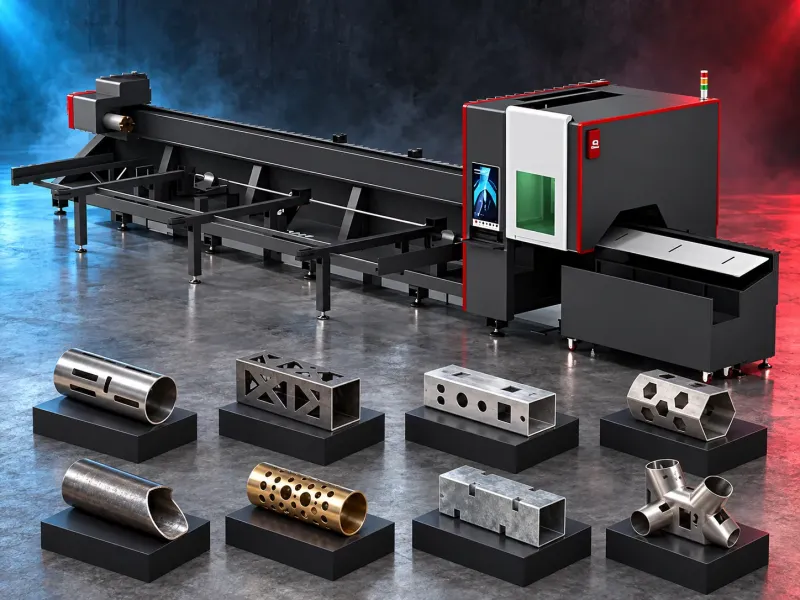
Tube fiber laser cutting
A tube fiber laser cutting machine uses a focused laser beam to cut suitable tubes and profiles without a conventional cutting tool. The workpiece is positioned and rotated by the machine while the control system coordinates the cutting path.
Machine architecture, chucks, loading system, laser source, cutting head, supported sections, dimensional range, wall thickness, software, and automation vary by manufacturer and model.
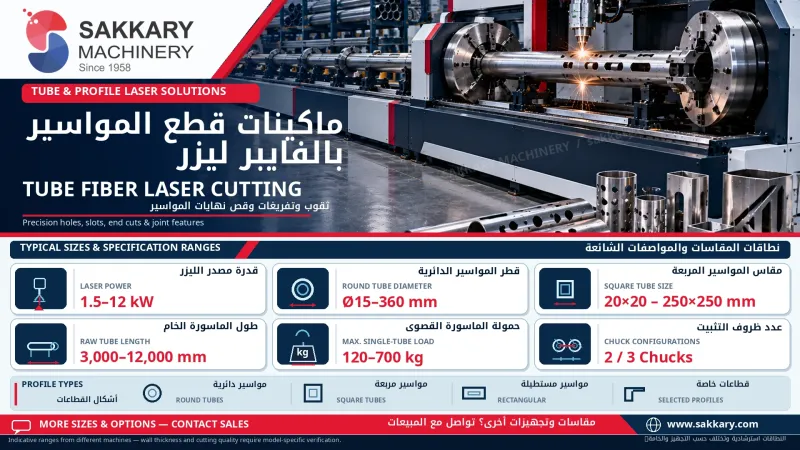
Suitable applications
Potential applications include tubular frames, furniture components, display systems, fitness equipment, agricultural machinery components, vehicle structures, HVAC parts, industrial fabrications, and custom assemblies produced from approved drawings.
Application suitability must be confirmed from the exact material, section geometry, wall thickness, joint design, tolerances, surface condition, and selected machine capacity.
Tube and profile types
Depending on the verified machine, the system may process round tubes, square tubes, rectangular tubes, oval sections, and selected open or special profiles. Each section requires confirmed clamping, support, rotation, cutting-head access, and software capability.
Bent tubes, distorted sections, inconsistent weld seams, heavy profiles, or open sections may require special fixtures, sensing, correction functions, or a different machine configuration.
Cutting features
The machine may produce straight or angled end cuts, holes, slots, notches, tabs, locating features, and connection details when supported by the cutting head, axes, software, and workpiece geometry.
Bevel cutting, three dimensional cutting, tapping, marking, weld preparation, or cutting in bent tubes must not be assumed unless these functions are documented for the exact model.
Potential production value
A suitable system may combine cutting to length with programmed holes and contours in one controlled process. This can reduce separate sawing, drilling, milling, manual marking, and repeated handling for compatible parts.
Actual output, accuracy, material use, secondary-operation reduction, and cost per part depend on the component, nesting, material, loading, cutting data, machine configuration, automation, and acceptance requirements.
Machine selection
Provide the finished-part drawing and CAD model, material grade, section type, outer dimensions, wall thickness, raw length, finished length, cut features, tolerances, surface condition, quantity, and target output.
Selection must also consider the maximum and minimum section size, part weight, chuck arrangement, support method, remnant length, loading and unloading, cutting gas, extraction, software, inspection, and future product range.
Technical information to confirm
The approved catalog must confirm the manufacturer, model, laser source, laser power, supported materials, section range, wall thickness, raw length, finished-part length, maximum part weight, chuck configuration, cutting-head movement, axis travels, accuracy, repeatability, and test conditions.
The catalog must also confirm loading capacity, automatic bundle loading, unloading, sorting, remnant handling, weld-seam detection, probing, bevel cutting, three dimensional capability, software, nesting, extraction, cooling, cutting gases, dimensions, weight, power supply, compressed air, and safety systems.
Materials and cutting trials
Potential materials may include suitable grades of carbon steel, stainless steel, aluminum, copper, brass, and other metals compatible with the verified laser source and cutting process.
Every material, surface condition, wall thickness, coating, reflective property, and required edge quality needs technical review. A sample cutting trial may be required before confirming suitability, speed, gas use, edge condition, or downstream weld quality.
Loading, clamping, and support
Reliable cutting depends on suitable loading, centering, clamping, rotation, and support of the tube. Long, thin, heavy, flexible, or irregular sections may require additional supports and controlled handling.
Chuck pressure and support positions must avoid workpiece deformation while maintaining stable rotation. The method must be verified for each section and product family.
Cutting gas and extraction
The cutting process may require oxygen, nitrogen, compressed air, or another approved gas depending on the material, thickness, quality requirement, and laser configuration. Gas type, purity, pressure, flow, storage, and safety requirements must follow the approved process documentation.
The installation must include appropriate fume and dust extraction, spark control, fire precautions, ventilation, and waste handling for the processed materials and coatings.
Quality and inspection
The production plan should define part datums, cut position, length, angle, hole dimensions, profile condition, dross limits, heat effect, burr condition, surface protection, and inspection method.
Critical connection features and welded assemblies may require sample fitting, dimensional inspection, code verification, and downstream welding trials before production approval.
Limitations and alternatives
A tube fiber laser machine is not automatically suitable for every material, profile, wall thickness, length, weight, tolerance, or three dimensional feature. Sawing, drilling, milling, plasma cutting, machining, or another laser configuration may be more suitable for some parts.
The decision should be based on the complete production route and finished component, not only on laser power or maximum tube diameter.
Installation and application review
Site planning must cover machine space, material flow, loading access, foundation, electrical supply, grounding, cooling, cutting gases, compressed air, extraction, fire safety, guarding, software, and operator training.
Send the part drawings, material specifications, section dimensions, wall thicknesses, lengths, cut features, tolerances, quantities, and target output. SAKKARY MACHINERY will review the application before recommending a machine configuration.
Questions we are asked
Which tube fiber laser machine is suitable for my production?
Selection depends on the material, section, dimensions, wall thickness, part weight, cut features, tolerances, batch size, loading method, and target output.
Which tube and profile shapes can be cut?
The supported shapes depend on the machine and chuck system. Round, square, rectangular, oval, open, and special profiles require separate verification.
Which materials can the machine cut?
Potential materials include suitable grades of carbon steel, stainless steel, aluminum, copper, and brass. Compatibility and thickness must be confirmed for the exact model.
Can the machine replace sawing and drilling?
It may combine cutting to length with holes and contours for suitable parts. The result depends on the component, machine capability, edge requirements, and complete production route.
Does the machine support bevel or three dimensional cutting?
Only models equipped and documented for the required cutting-head movement, axes, software, and sensing functions should be presented as supporting these operations.
What information is required for technical selection?
Provide the finished-part drawing, material, section, dimensions, wall thickness, raw and finished lengths, cut features, tolerances, quantity, and target output.
Tell us the part you need to make
An engineer reads every request. Usually the same working day.
Related
- Fiber Laser Cutting Machines Industrial fiber laser solutions for cutting metal sheets with a configuration selected according to the material, thickness, part dimensions, required cut quality, and production target.
- Integrated Fiber Laser Processing Machine An integrated CNC solution designed to combine compatible sheet-metal operations such as fiber laser cutting, punching, forming, and marking. Actual functions depend on the selected model and configuration.
- Fiber Laser Sheet and Tube Cutting Machine A combined fiber laser solution for cutting suitable metal sheets, tubes, and profiles on one machine platform. The correct configuration depends on the materials, dimensions, thicknesses, part geometry, required quality, and production mix.