

DUCT FORMING MACHINES
Spiral Duct Forming Machine
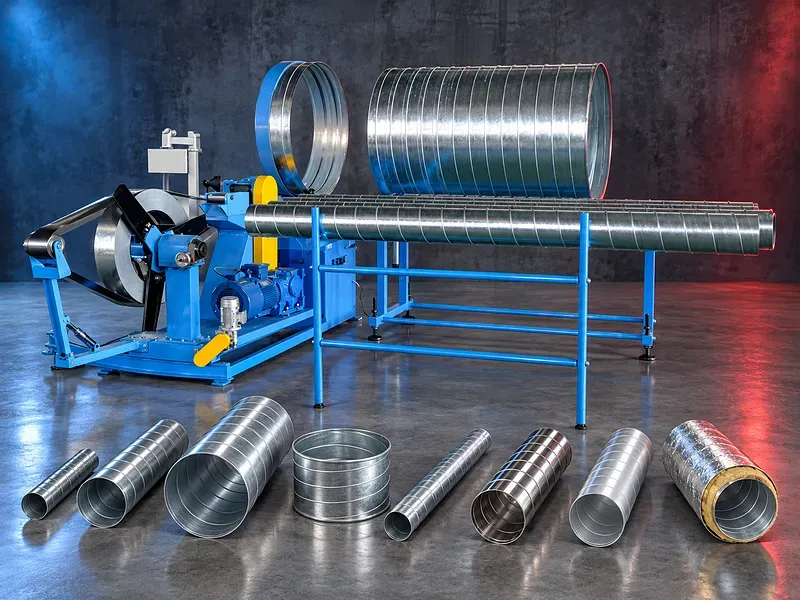
A forming machine for producing round spiral air ducts from compatible metal strip. Machine selection depends on duct diameter, material, strip thickness and width, seam type, cut length, and production target.
A spiral duct forming machine feeds metal strip through forming and seaming components to produce a helically wound round duct. Depending on the verified configuration, the machine may automatically form the duct and cut it to a programmed or defined length.
Different duct diameters may require suitable forming tooling and machine adjustments. The correct configuration must be selected from the duct drawing, material, thickness, diameter range, seam requirement, finished length, and production volume. Explore related duct forming machines or send your production requirements for technical review.
What is a spiral duct forming machine?
A spiral duct forming machine converts compatible metal strip into round duct with a continuous helical seam. The strip is guided, formed, and joined while the duct advances through the machine.
The forming method, tooling, seam system, supported materials, diameter range, cutting system, and output vary by manufacturer and model.
Typical applications
- Round spiral ducts for HVAC systems
- Ventilation and air-distribution ductwork
- Extraction and air-transfer systems
- Industrial duct sections produced to approved specifications
- Straight spiral duct sections in different verified diameters and lengths
- Suitability for pressure, leakage, structural, hygiene, fire, acoustic, or regulatory requirements must be assessed by the responsible project engineer.
Potential production benefits
- Automated forming of straight round spiral ducts
- Production of different lengths within the machine’s capability
- Repeatable duct diameter after correct setup
- Automatic cutting where the selected model supports it
- Reduced manual forming and handling
- Continuous production from compatible metal strip
- Support for different diameters through approved tooling and adjustment
- Output is not fixed. It may vary with diameter, material, thickness, strip width, seam, cut length, tooling condition, setup, and machine configuration.
How to choose the machine
- Define the required duct-diameter range
- Confirm the metal type and grade
- Define minimum and maximum strip thickness
- Confirm the required strip width
- Identify the seam and forming method
- Define standard and maximum finished lengths
- State dimensional and appearance requirements
- Confirm applicable ductwork standards
- Define batch sizes and target output
- Review tooling required for every diameter range
- Confirm the cutting method and cut-quality requirement
- Review coil handling and strip-feeding requirements
- Determine floor space and material-flow needs
- Confirm power, compressed air, and site requirements
- Technical data to verify
- Manufacturer, brand, model, and country of origin
- Supported duct-diameter range
- Supported materials and material grades
- Minimum and maximum strip thickness
- Supported strip-width range
- Forming and seam-locking method
- Tooling or mold requirements for diameter changes
- Diameter-setting and changeover procedure
- Forming speed and its applicable conditions
- Verified production output by diameter and material
- Duct length range
- Cutting system and cut-length accuracy
- Diameter accuracy, seam consistency, and test conditions
- Coil or strip-feeding system
- Maximum coil weight where applicable
- CNC, PLC, or operator-control configuration
- Electrical supply and compressed-air requirements
- Machine dimensions, weight, guarding, and safety systems
Diameter and production speed
The statement that smaller diameters always produce faster and larger diameters always produce slower must not be published as a universal rule. Production speed and machine load should be confirmed for each diameter, material, thickness, tooling set, and model.
Related duct-production equipment
- A spiral duct machine mainly produces straight round duct sections. A complete duct-production process may also require:
- Round elbow forming equipment
- Flanging or beading equipment
- Connector and fitting equipment
- Cutting and notching machines
- Angle or profile rolling equipment
- Seaming and closing equipment
- Leakage testing and inspection tools
- Material handling and packing equipment
- The required equipment depends on the duct design, project specification, and production scope.
Quality considerations
Production control should cover duct diameter, roundness, seam engagement, seam consistency, finished length, cut condition, surface marks, leakage requirements, and material traceability. Acceptance criteria must follow the approved project specification and applicable standards.
Limitations
The machine does not automatically produce elbows, branches, reducers, flanges, connectors, or complete installed duct systems unless additional equipment or integrated functions are explicitly included.
Installation and lifecycle support
Installation planning must consider machine leveling, electrical supply, compressed air where required, coil handling, strip storage, safe loading, cutting-zone guarding, sharp-edge control, finished-duct handling, and operator training. Installation, commissioning, maintenance, spare parts, tooling, consumables, and warranty scope must be confirmed in the approved offer.
Request a production review
Send the required duct diameters, material grades, thicknesses, strip widths, seam specifications, finished lengths, and target output. SAKKARY MACHINERY will review the application before recommending a machine and tooling configuration.
Questions we are asked
What does a spiral duct forming machine produce?
It primarily produces straight round duct sections with a continuous helical seam from compatible metal strip.
Can one machine produce different duct diameters?
Some machines support several diameters through approved tooling and setup changes. The verified range and changeover method depend on the model.
Does a different diameter require different tooling?
It may require a suitable forming tool or mold and machine adjustment. Exact requirements must be confirmed for every model and diameter range.
What determines production speed?
Output depends on diameter, material, thickness, strip width, seam, cut length, tooling condition, machine configuration, and operator setup.
Does the machine also produce elbows and fittings?
Not normally. Elbows, branches, reducers, flanges, and connectors generally require additional equipment unless explicitly included.
Tell us the part you need to make
An engineer reads every request. Usually the same working day.
Related
- U Shape Automatic Duct Production Line A U shape automatic duct production line converts approved sheet metal coils into prepared duct sections through a coordinated sequence that may include uncoiling leveling beading punching shearing locking flange forming and folding. The correct configuration depends on duct type material thickness dimensions flange system output target and factory layout.
- Automatic Duct Production Line for Rectangular HVAC Ducts An automatic duct production line converts approved sheet metal coils into prepared rectangular HVAC duct blanks and folded sections through a coordinated linear workflow. Depending on the verified configuration it may integrate uncoiling leveling beading punching shearing transfer locking flange forming and folding
- Automatic Duct Blanking and Folding Production Line An automatic duct blanking and folding line converts approved sheet metal coils into prepared rectangular HVAC duct blanks and folded sections. The verified configuration may combine decoiling leveling beading corner notching shearing and hydraulic folding under CNC control.