

Cold Joining Technology for Sheet Metal
: Rivetless Sheet Metal Clinching & Joining Machine
: Cold-forming sheet metal joining machine for creating permanent mechanical joints without separate rivets or screws, suitable for automotive, appliance, light-industry, precision machinery, electronics and hardware applications
Rivetless clinching is a cold-forming joining process used to permanently connect sheet metal without adding separate joining elements such as rivets or screws. The machine forms the overlapping sheets locally using dedicated tooling to create a mechanical interlock. This makes clinching suitable for production environments where repeatable sheet-metal joining is required without conventional riveting hardware. Available drive concepts in the supplied product information include Spin Rivetless Riveting Machine, Hydraulic Boosting Rivetless Riveting Machine and Air-Hydraulic Boosting Rivetless Riveting Machine. The correct configuration should be selected according to the material, sheet thickness, joint geometry, access and required production cycle.
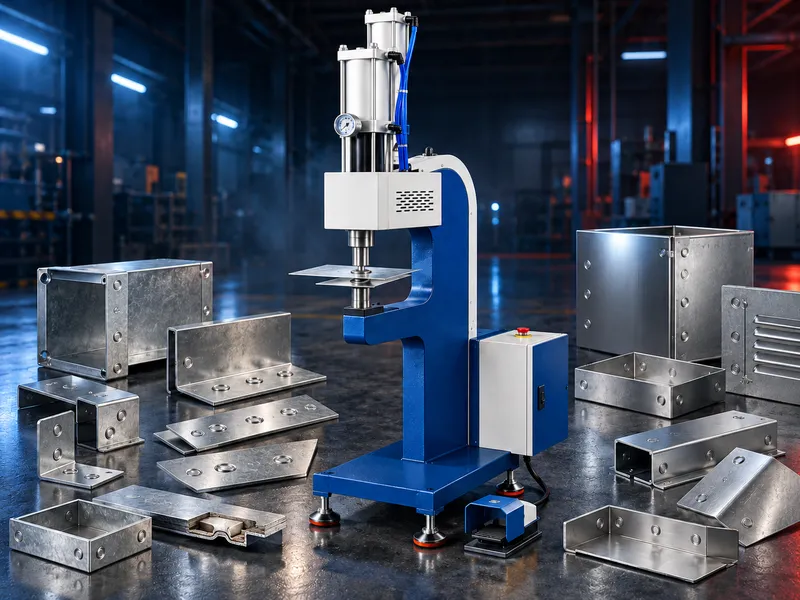
What it is for
- Permanent joining of overlapping sheet-metal components
- Joining without separate rivets, screws or other added fasteners
- Automotive sheet-metal assemblies
- Appliance housings and panels
- Light-industry fabricated components
- Precision machinery sheet-metal parts
- Electronics and electrical appliance housings
- General hardware and fabricated sheet-metal products
How Clinching Works
- Position the overlapping sheet-metal parts in the tooling.
- Apply the clinching force through the selected machine and tooling system.
- The sheets are locally cold-formed to create a mechanical interlock.
- Release the tooling and continue with the next joint or production step.
Available Drive Types
- Spin Rivetless Riveting Machine
- Hydraulic Boosting Rivetless Riveting Machine
- Air-Hydraulic Boosting Rivetless Riveting Machine
Typical Applications
- Automotive components such as selected body, door, cover, frame and exhaust-related sheet-metal assemblies
- Refrigerator doors and sheet-metal panels
- Washing-machine housings
- Fan housings
- Equipment and machinery covers
- Dental or medical-equipment housings where the joint design is suitable
- Electrical and electronic enclosures
- General fabricated sheet-metal assemblies
How to Choose
- Define the materials — Specify the sheet materials to be joined and whether the joint combines the same or different metals.
- Confirm sheet thickness — Provide the thickness of each sheet and the total joint stack-up. Clinching capacity depends on the machine and tooling.
- Define the joint geometry — Provide drawings or samples showing overlap, flange dimensions, joint location and available tool access.
- Choose the drive system — Select spin, hydraulic-boosting or air-hydraulic boosting according to the required force, production cycle and factory utilities.
- Match the tooling to the joint — Punch and die geometry must be selected for the material combination, thickness and required joint form.
- Check production requirements — Specify parts per shift, number of joints per part, loading method and whether the machine will operate as a standalone station or within a production cell.
Information Required for Selection
- Sheet material(s)
- Thickness of each sheet
- Number of sheet layers
- Part drawing or sample
- Joint location and overlap dimensions
- Required number of joints per component
- Production quantity / cycle requirement
- Available pneumatic and hydraulic utilities where applicable
- Required throat depth and working access
- Manual, semi-automatic or integrated production requirement
Questions we are asked
What is a rivetless clinching machine?
It is a sheet-metal joining machine that uses cold forming to create a permanent mechanical interlock between overlapping sheets without adding separate rivets or screws.
Is clinching the same as conventional riveting?
No. Conventional riveting adds a separate rivet, while rivetless clinching forms the sheets themselves to create the joint.
Does clinching require welding heat?
The supplied product information describes clinching as a cold-forming joining process. It does not rely on a conventional fusion-welding operation to create the joint.
What drive types are available?
The supplied information lists spin, hydraulic-boosting and air-hydraulic boosting rivetless riveting machines. Availability and configuration should be confirmed for the selected machine.
What industries can use the machine?
Typical applications include automotive manufacturing, appliances, light industry, precision machinery, electronics, hardware and other suitable sheet-metal fabrication.
Can it join every sheet-metal material and thickness?
No universal material or thickness range is stated in the supplied source. Suitability must be confirmed from the exact machine, tooling, material combination and sheet thickness.
What information is needed to select the correct machine?
Provide the material, thickness of each sheet, part drawing or sample, joint geometry, required tool access, number of joints and production requirement.
Tell us the part you need to make
An engineer reads every request. Usually the same working day.
Related
- Spiral Duct Forming Machine A forming machine for producing round spiral air ducts from compatible metal strip. Machine selection depends on duct diameter, material, strip thickness and width, seam type, cut length, and production target.
- U Shape Automatic Duct Production Line A U shape automatic duct production line converts approved sheet metal coils into prepared duct sections through a coordinated sequence that may include uncoiling leveling beading punching shearing locking flange forming and folding. The correct configuration depends on duct type material thickness dimensions flange system output target and factory layout.
- Automatic Duct Production Line for Rectangular HVAC Ducts An automatic duct production line converts approved sheet metal coils into prepared rectangular HVAC duct blanks and folded sections through a coordinated linear workflow. Depending on the verified configuration it may integrate uncoiling leveling beading punching shearing transfer locking flange forming and folding