

COLD CUTTING SYSTEMS
Waterjet Cutting Machines
Waterjet cutting machines use a controlled high pressure water stream, with or without abrasive, to cut suitable materials without the thermal cutting zone associated with laser, plasma, or flame processes. The correct system depends on the material, thickness, part geometry, edge quality, tolerance, batch size, consumables, utilities, and required output.
A waterjet system pressurizes prepared water and directs it through a small orifice to create a high velocity cutting stream. Pure waterjet uses the water stream for suitable softer materials, while abrasive waterjet introduces controlled abrasive particles for many harder or denser materials. Waterjet is generally described as a cold cutting process because it limits the heat affected zone at the cut compared with thermal methods. It does not guarantee zero temperature change, perfect accuracy, or suitability for every material. Pressure, pump design, cutting capacity, speed, precision, abrasive use, and edge quality must be verified for the selected configuration and application
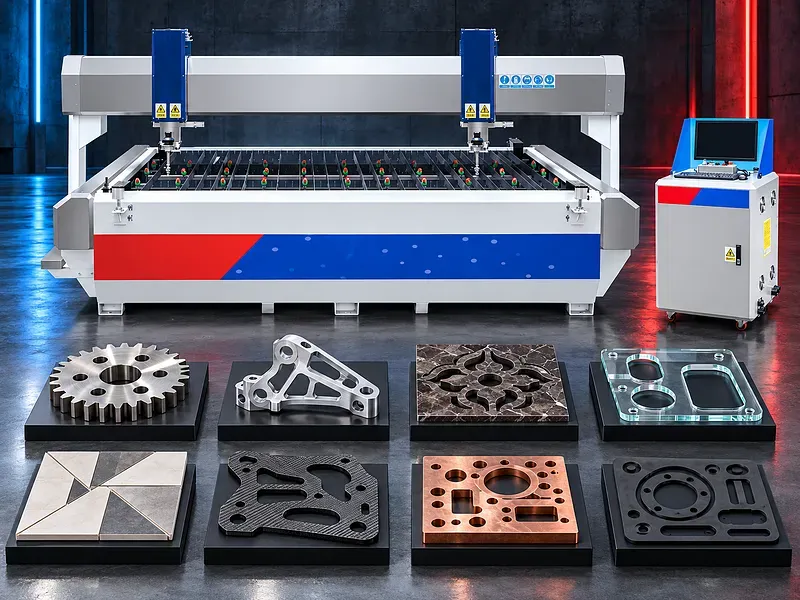
How waterjet cutting works
Prepared water is pressurized by a high pressure pump and delivered through high pressure tubing to the cutting head. The stream passes through an orifice and exits toward the workpiece along a programmed path.
For abrasive cutting, abrasive is metered into a mixing chamber and accelerated through a focusing or mixing tube. The water and abrasive stream erodes the material along the programmed cut.
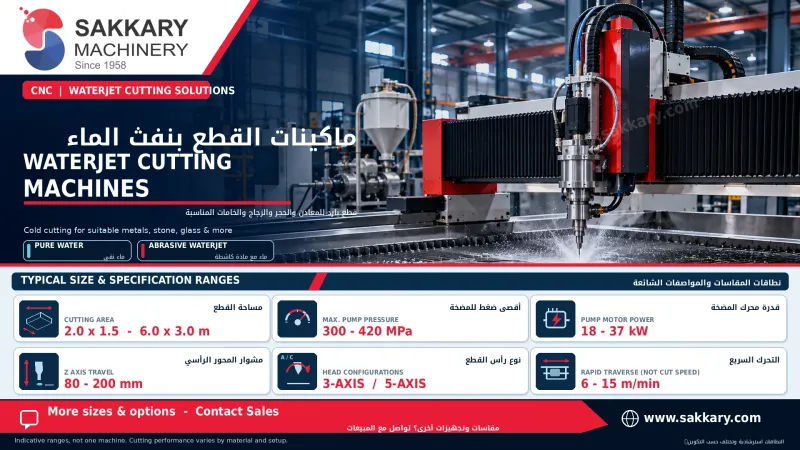
Pure waterjet cutting
Pure waterjet uses water without added abrasive and may suit selected soft or layered materials such as foam, rubber, gasket material, paper products, textiles, insulation, food related products, and other compatible materials.
Material construction, density, thickness, water absorption, delamination risk, hygiene, support, cut quality, and downstream use must be reviewed before confirming suitability.
Abrasive waterjet cutting
Abrasive waterjet adds a controlled abrasive, commonly a suitable garnet grade, to cut many metals, stone, ceramics, glass types, composites, and other compatible hard materials.
Suitability depends on material composition, hardness, brittleness, residual stress, thickness, coatings, laminations, piercing method, abrasive specification, support, and required edge condition.
Pump and pressure system
High pressure pumps may use intensifier, direct drive, or other verified designs. Pump selection should consider required pressure, flow, duty cycle, efficiency, water quality, maintenance method, service access, and the number of cutting heads.
The supplied pressure figure is not retained because operating pressure varies by system. Maximum and working pressure, flow, pump power, control range, pressure stability, accumulator or attenuator design, and test conditions require approved technical documentation.
Cutting head orifice and mixing tube
The cutting head controls the water path and, for abrasive systems, combines water and abrasive before the focusing tube. Orifice and mixing tube dimensions influence stream quality, kerf, cutting speed, abrasive flow, and component life.
Orifice material, diameter, mixing chamber, focusing tube diameter and length, alignment, operating limits, replacement criteria, and safe assembly must match the pump, abrasive, material, and process.
Abrasive delivery and storage
An abrasive system may include bulk storage, pressure pot, hopper, dryer, metering device, transfer equipment, level monitoring, and controls according to the machine configuration.
Abrasive grade, particle size, cleanliness, moisture, flow rate, storage, dust control, refill method, line condition, recovery strategy, and disposal affect process stability, cost, and workplace cleanliness.
Catcher tank slats and work support
The workpiece is supported above a catcher tank that absorbs the remaining jet energy and collects water, abrasive, and removed material. Slats or specialized supports should hold the part while limiting rebound and interference.
Tank depth, water level, slat spacing, support condition, part stability, small part retention, access, cleaning, sludge removal, and corrosion control require planning for the material and duty.
Materials and application review
Potential applications include sheet and plate components, gaskets, architectural stone, tiles, glass parts, composites, machine components, decorative parts, prototypes, and other profiles that benefit from nonthermal cutting.
Not every grade or product form is suitable. Tempered glass, laminated products, brittle ceramics, reactive materials, hazardous composites, thick stacks, porous materials, and contamination sensitive parts require specific review and may need trials.
Cold cutting characteristics
Waterjet can reduce thermal distortion, recast layers, melted edges, and metallurgical heat effects compared with thermal cutting processes because material removal is mainly erosive rather than heat based.
Cold cutting does not eliminate mechanical stress, water exposure, abrasive embedment, edge striation, taper, delamination, cracking, or material movement. These risks depend on the material and process settings.
Kerf taper and edge quality
Cut quality may be described by kerf width, taper, striation, roughness, edge chipping, delamination, top edge condition, bottom edge condition, dimensional error, and piercing marks.
Pressure, flow, orifice, mixing tube, abrasive rate, traverse speed, stand off distance, material, thickness, cutting direction, acceleration, corner strategy, machine motion, and support affect the result.
Piercing and lead strategy
Piercing can create high local forces and may damage brittle, laminated, coated, or sensitive materials. Low pressure piercing, dynamic piercing, edge starts, drilled pilot holes, or another approved method may be required.
Lead in and lead out position, piercing location, dwell, pressure sequence, abrasive timing, scrap side, corner behavior, and part support should be planned within the cutting program.
Taper compensation and multi axis cutting
Some systems use an articulated head to tilt the jet and compensate for taper or to cut selected bevels and three dimensional features. Other systems use a fixed vertical head.
Head axes, tilt range, compensation method, calibration, collision envelope, rotary center, software support, thickness limits, bevel capability, and achievable tolerance require exact technical verification.
Motion control software and nesting
The CNC and software coordinate the cutting path, speed, corner control, piercing sequence, quality level, pressure commands, abrasive timing, and optional head functions.
Nesting should consider material utilization, part spacing, kerf, lead paths, common line rules, small part retention, cutting sequence, plate movement, grain or pattern direction, remnant management, and traceability.
Water quality and treatment
Water quality affects pump seals, check valves, orifices, tubing, cutting head components, reliability, and process consistency. Untreated water may cause scale, corrosion, wear, contamination, or premature component failure.
The site review should confirm hardness, dissolved solids, particles, temperature, pH, supply pressure, flow, filtration, softening or reverse osmosis needs, storage, drainage, and wastewater requirements according to the approved system specification.
Consumables and operating cost
Consumables may include abrasive, orifices, mixing tubes, seals, check valves, high pressure tubing and fittings, filters, slats, lubricants, water treatment media, pump components, and waste handling materials.
Cost per part depends on cutting time, pressure, flow, abrasive rate, material, thickness, edge quality, pump efficiency, consumable life, nesting, labor, maintenance, water treatment, energy, sludge handling, and secondary operations.
Quality inspection and sample trials
Acceptance may cover dimensions, profile, hole size, kerf, taper, perpendicularity, edge roughness, striation, chipping, delamination, water staining, abrasive residue, piercing condition, and downstream fit.
Critical or unfamiliar applications may require sample cutting, dimensional inspection, edge evaluation, cleaning validation, forming or welding trials, coating tests, and assembly approval before production.
How to choose the correct machine
Provide drawings and files, material grade and product form, thickness, sheet or plate size and weight, part geometry, smallest features, tolerances, edge quality, quantities, batch sizes, target output, and downstream operations.
Selection should review pure or abrasive process, pump pressure and flow, bed size, head count, head type, taper compensation, piercing, motion control, nesting, abrasive delivery, catcher tank, sludge removal, water treatment, loading, guarding, utilities, floor space, and future materials.
Technical information to verify
Approved technical documents must confirm the supported cutting processes, pump type, maximum and working pressure, flow, pump power, duty rating, number of heads, orifice range, mixing tube range, abrasive flow, cutting head configuration, axis travels, bed size, and allowable load.
They must also confirm positioning accuracy, repeatability, taper compensation, bevel or multi axis functions, maximum piercing and cutting capacities by verified material and quality level, water requirements, abrasive system, tank, sludge removal, cooling, electrical supply, air, dimensions, weight, foundation, guarding, software, included equipment, and options.
Safety and high pressure risks
The risk assessment should cover high pressure injection injury, jet exposure, stored pressure, hose or fitting failure, abrasive discharge, flying particles, sharp parts, heavy plates, moving axes, slips, noise, dust, water, electrical hazards, chemical or material contamination, and maintenance isolation.
Required controls may include guards, interlocks where provided, pressure relief, safe depressurization, rated components, hose inspection, exclusion zones, emergency stops, lifting plans, suitable personal protection, training, housekeeping, and documented lockout procedures.
Installation maintenance and lifecycle support
Site planning should cover floor loading, foundation, leveling, electrical supply, clean water, treatment, drainage, compressed air when required, cooling, abrasive delivery, dry storage, sludge handling, ventilation, loading equipment, access, noise control, and maintenance clearance.
Preventive maintenance should follow approved documents for the pump, seals, check valves, intensifier or drive system, high pressure tubing, fittings, orifice, mixing tube, abrasive feeder, motion axes, lubrication, catcher tank, slats, water treatment, guards, controls, backups, alignment, and calibration.
Environmental and waste controls
Spent abrasive, removed material, water, sludge, filters, and cleaning residues must be characterized and handled according to the processed materials and local requirements. Hazardous coatings or materials can make the waste hazardous.
Water recirculation, abrasive removal, sludge dewatering, filtration, noise control, mist control, housekeeping, spill prevention, and disposal should be planned before operation.
Limitations and alternative processes
Waterjet can have slower cutting speed or higher consumable cost for some materials and thicknesses. Edge taper, striation, wet parts, abrasive residue, sludge, pump maintenance, noise, and piercing limits may affect suitability.
Depending on the part, alternatives may include laser, plasma, oxyfuel, saw cutting, routing, milling, wire electrical discharge machining, die cutting, knife cutting, or another process.
Technical review and next step
Send drawings and cutting files, material and thickness, plate dimensions and weight, feature details, tolerances, edge requirements, quantities, batch sizes, target output, water analysis, utilities, floor plan, loading method, and waste constraints for technical review.
The technical review will identify the suitable pure or abrasive process, pump, bed, head, consumables, abrasive system, water treatment, support, nesting, quality plan, safety controls, installation needs, and any sample cutting requirement.
Questions we are asked
What is a waterjet cutting machine?
It is a CNC cutting system that uses a high pressure water stream with or without abrasive to erode a programmed path through suitable material.
What is the difference between pure and abrasive waterjet?
Pure waterjet uses water for suitable softer materials. Abrasive waterjet adds controlled abrasive particles for many harder or denser materials.
Does waterjet create a heat affected zone?
Waterjet is a cold cutting process and generally limits thermal effects compared with laser plasma or flame cutting but it does not guarantee zero temperature change or zero material stress.
Can it cut every material and thickness?
No. Material condition thickness brittleness water sensitivity piercing behavior support pump head and quality requirements must be reviewed and some applications need sample cutting.
What controls edge quality?
Pressure flow orifice mixing tube abrasive rate traverse speed stand off material thickness piercing motion accuracy support and process strategy all affect the edge.
What information is required for selection?
Provide cutting files material thickness plate size and weight feature details tolerance edge quality quantities target output water analysis utilities floor plan loading method and waste constraints.
Tell us the part you need to make
An engineer reads every request. Usually the same working day.
Related
- VICTOR Slant-Bed CNC Lathes Slant-bed CNC turning machines from VICTOR Taichung for machining shafts, bushings, flanges, threaded parts, and other rotational components. The appropriate model is selected according to the workpiece, operations, accuracy, and production requirements.
- CNC Vertical Machining Center (VMC) Vertical CNC machining solutions for milling, drilling, tapping and producing engineered metal components.
- CNC Wire EDM Machines Precision machining solutions for producing complex profiles in electrically conductive materials using a CNC-controlled wire electrode.