

EDM MACHINES
CNC EDM DRILL
A CNC electrical-discharge drilling machine for producing small and deep holes in suitable electrically conductive materials. Selection depends on the material, hole dimensions, tolerance, entry surface, flushing conditions, and production requirements.
A CNC EDM drill removes material through controlled electrical discharges between a tubular electrode and an electrically conductive workpiece. Dielectric-fluid flushing cools the machining zone and removes particles produced during erosion.
EDM drilling is commonly used to create start holes for Wire Cut EDM and for suitable small or deep-hole applications. Machine selection must be based on the drawing, material, hole geometry, tolerances, and production quantity.
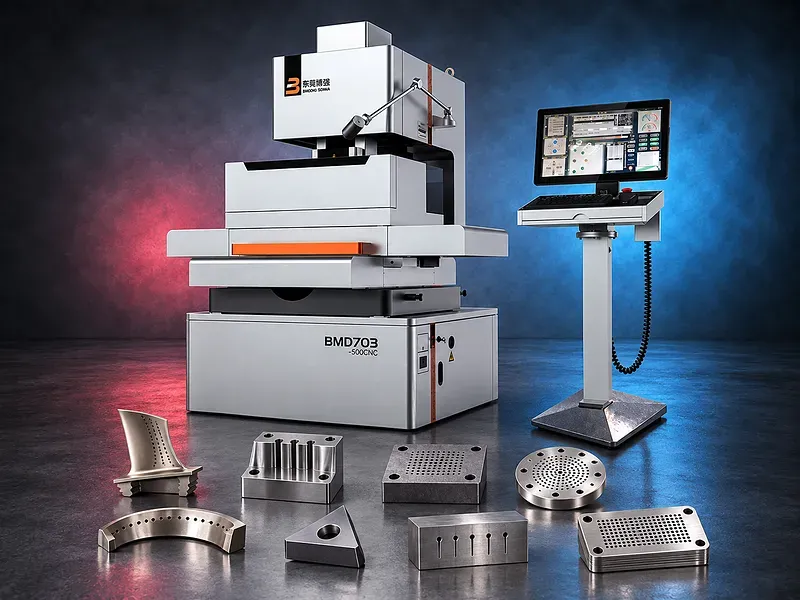
What is a CNC EDM drill?
A CNC EDM drill uses controlled electrical pulses to remove material from a conductive workpiece. Because the process does not depend on a conventional cutting edge, it can machine suitable hardened conductive materials when the machine and process are correctly selected.
The supported electrode range, drilling depth, speed, accuracy, axes, flushing system, and materials vary by manufacturer and model.
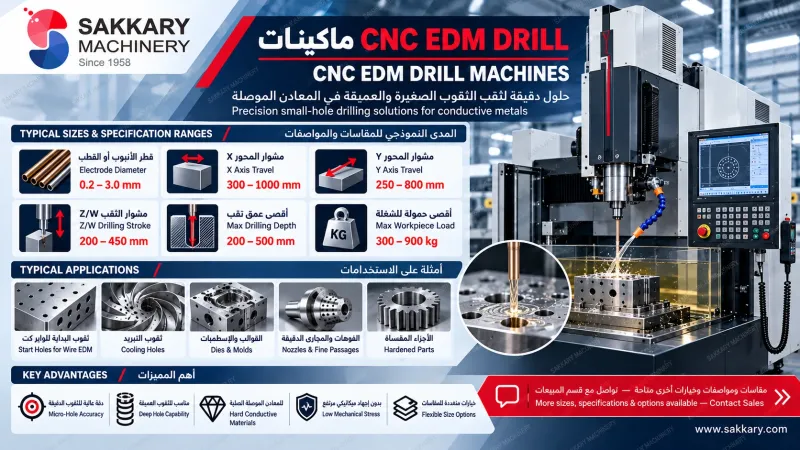
Suitable materials
- Steel and tool steel
- Hardened steel
- Stainless steel
- Copper and copper alloys
- Aluminum and suitable aluminum alloys
- Electrically conductive carbide grades
- Other electrically conductive alloys
- Material compatibility must be confirmed for the selected machine, electrode, dielectric system, and hole requirement.
Typical applications
- Start holes for wire-cut EDM
- Small holes in dies and molds
- Cooling and vent holes in suitable components
- Holes in spinneret and extrusion-related plates
- Grouped holes in filter and sieve plates
- Suitable holes in engine or turbine components
- Fluid passages in hydraulic and pneumatic components
- Holes on curved or inclined surfaces where supported
- Removal of suitable broken drills, taps, or conductive tools
- Every application must be verified from the component drawing and the official machine documentation.
How EDM drilling works
A tubular electrode approaches the conductive workpiece while controlled electrical pulses generate repeated discharges across a small gap. The discharges erode the material, while dielectric fluid passes through or around the electrode to remove particles and stabilize the process.
Potential production benefits
- Produce small holes without conventional cutting contact
- Machine suitable hardened conductive materials
- Create start holes for wire-cut EDM
- Reduce mechanical cutting forces on suitable parts
- Program repeated hole locations and patterns
- Approach suitable inclined or curved entry surfaces
- Remove some broken conductive tools under controlled conditions
- Drilling speed, accuracy, straightness, surface condition, and tool-removal results depend on the material, electrode, hole depth, flushing, setup, and machine configuration.
- EDM process planning for dies and molds
- Wire-cut EDM can produce through profiles after creating a suitable start hole.
- Hole-drilling EDM produces start holes and other supported small holes.
- Die-sinking EDM may be required for blind cavities and recessed forms.
- CNC machining centers can perform bulk material removal and general machining.
- CNC engraving and milling machines may produce supported detailed features.
- Grinding, polishing, heat treatment, and inspection may also be required.
- Wire-cut and hole-drilling EDM alone must not be presented as sufficient for every die, mold, or injection-mold application.
How to choose the EDM drill
- Provide the complete component drawing
- Confirm the material grade and conductivity
- Define minimum and maximum hole diameter
- Define hole depth and depth-to-diameter requirement
- Identify through, blind, inclined, or curved-entry holes
- State diameter, position, and straightness tolerances
- Define the number and pattern of holes
- Confirm electrode material, diameter, and length
- Review dielectric-fluid and flushing requirements
- Confirm workholding and component access
- Define batch size and target output
- Review filtration and conductivity-control requirements
- Confirm power, air, drainage, and site conditions
- Technical data to verify
- Manufacturer, brand, model, and country of origin
- CNC control and controlled axes
- Worktable dimensions and maximum load
- Axis travels and machining envelope
- Supported electrode-diameter range
- Maximum verified drilling depth
- Verified depth-to-diameter ratio
- Drilling speed and applicable test conditions
- Hole-diameter, position, and straightness accuracy
- Electrode rotation and guiding system
- Pulse generator and power specifications
- Dielectric type and delivery pressure
- Filtration and conductivity-control systems
- Automatic electrode or guide options
- Broken-tool removal capability and limitations
- Dimensions, weight, utilities, drainage, and safety requirements
Claims requiring verification
The supplied text states a hole-diameter range of 0.2–3.0 mm and a depth-to-diameter ratio of up to 300:1. These values must not be published until verified by the latest official datasheet for the exact model, including material, electrode, flushing method, and test conditions.
Limitations and alternatives
EDM drilling works only with electrically conductive workpieces. Electrode wear, flushing, material, depth, entry angle, and process stability affect the result. Conventional drilling, gun drilling, laser drilling, wire-cut EDM, die-sinking EDM, or another process may be more suitable for some applications.
Installation and lifecycle support
Installation planning must consider electrical supply, grounding, compressed air where required, dielectric-fluid preparation, filtration, conductivity control, drainage, temperature, ventilation, electrode storage, and operator safety. Supply, commissioning, training, maintenance, spare parts, consumables, and warranty scope must be confirmed in the approved offer.
Request a technical review
Send the drawing, material, hole diameters and depths, tolerances, entry-surface geometry, hole quantity, and production target. SAKKARY MACHINERY will review the application before recommending an EDM drilling solution.
Questions we are asked
Which materials can be drilled by EDM?
The workpiece must be electrically conductive. Compatibility depends on the material grade, electrode, dielectric system, hole geometry, and machine capability.
Why is EDM drilling used with wire-cut EDM?
It creates a start hole for threading the wire when the cutting path does not begin from an accessible edge.
Can it drill hardened materials?
It can process suitable electrically conductive hardened materials, but the hole dimensions, speed, accuracy, and finish must be verified.
Can it remove a broken drill or tap?
Some configurations may erode suitable broken conductive tools. Access, geometry, and the risk of affecting the original hole must be reviewed first.
Can it drill from 0.2 to 3.0 mm with a 300:1 depth ratio?
These are unverified supplier claims and require confirmation from the exact model’s official datasheet and test conditions.
Tell us the part you need to make
An engineer reads every request. Usually the same working day.
Related
- VICTOR Slant-Bed CNC Lathes Slant-bed CNC turning machines from VICTOR Taichung for machining shafts, bushings, flanges, threaded parts, and other rotational components. The appropriate model is selected according to the workpiece, operations, accuracy, and production requirements.
- CNC Vertical Machining Center (VMC) Vertical CNC machining solutions for milling, drilling, tapping and producing engineered metal components.
- CNC Wire EDM Machines Precision machining solutions for producing complex profiles in electrically conductive materials using a CNC-controlled wire electrode.