

CNC MACHINING CENTERS
Alloy Wheel Machining Center
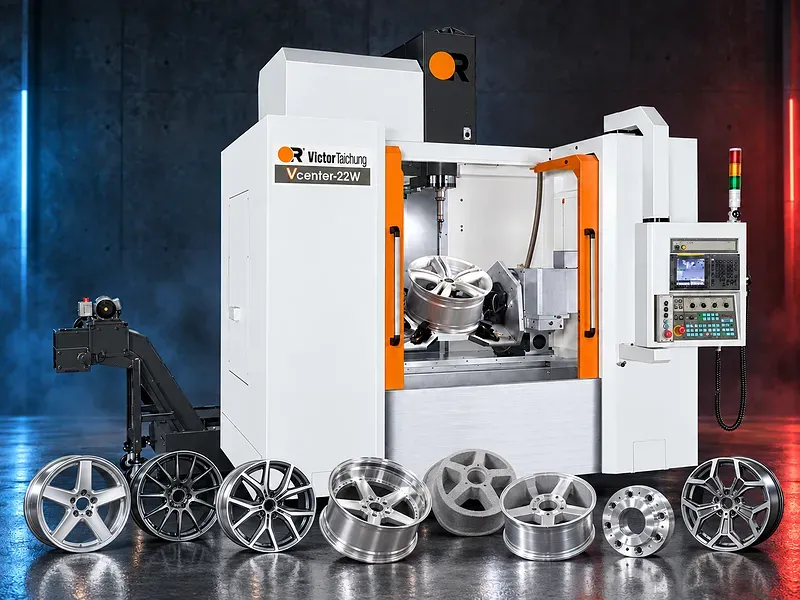
A CNC machining center configured for controlled machining of alloy wheels. Machine selection depends on the wheel material, manufacturing stage, dimensions, geometry, tolerances, finish requirements, and production volume.
An alloy wheel machining center is designed to perform specified machining operations on wheel blanks or semi-finished wheels. Depending on its verified configuration, the machine may support turning, drilling, milling, boring, or finishing operations required by the approved wheel design.
Machine selection must begin with the wheel drawing, material, blank condition, diameter, width, mounting geometry, tolerances, finish requirements, production volume, and loading method. Explore related CNC machines or submit your wheel specifications for a technical application review.
What is an alloy wheel machining center?
An alloy wheel machining center is a CNC machine configured for the geometry and production requirements of alloy wheels. Machine architecture, supported operations, workholding, axes, spindles, tools, and automation vary by manufacturer and model.
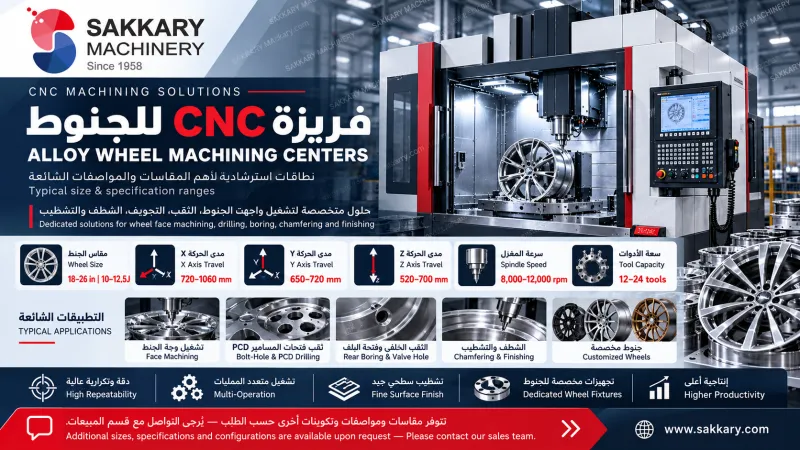
Typical operations
- Machining wheel faces and profiles
- Machining center bores and mounting surfaces
- Drilling bolt holes where supported
- Machining bead-seat and rim-related surfaces
- Producing pockets or decorative features where supported
- Finishing specified surfaces before later production stages
- Machining approved wheel designs from suitable blanks
- Every operation must be verified against the wheel drawing and the selected machine’s official capability.
Production stages to define
- Blank manufacturing method
- Blank condition before machining
- Rough-machining requirements
- Finish-machining requirements
- Drilling or milling requirements
- Deburring and cleaning requirements
- Inspection and traceability requirements
- Surface-treatment or coating stages after machining
- Potential production benefits
- Machine configuration focused on wheel geometry
- Programmed control of defined machining operations
- Repeatable workholding under controlled conditions
- Support for multiple wheel programs where compatible
- Integration with loading and inspection systems where available
- Reduced manual handling through suitable automation
- Productivity, accuracy, finish, scrap rate, and cycle time must be validated for the actual wheel, blank, tooling, fixtures, and machine model.
How to choose the machining center
- Provide the complete wheel drawing and 3D model where available
- Confirm alloy grade and blank-manufacturing method
- Define wheel diameter, width, offset, and mounting geometry
- State the blank dimensions and machining allowance
- List all turning, drilling, boring, and milling operations
- Confirm dimensional and geometric tolerances
- Define surface-finish and visible-face requirements
- Identify the wheel range and product-change frequency
- Define batch size, target output, and cycle-time objective
- Review fixture, chucking, and deformation-control requirements
- Define loading, unloading, marking, and traceability needs
- Confirm inspection and quality-control methods
- Review coolant, chip removal, utilities, and site conditions
Technical data to verify
- Manufacturer, brand, model, and country of origin
- Machine architecture and supported operations
- Wheel diameter and width range
- Maximum blank dimensions and weight
- Spindle speed, power, torque, and interface
- Axis configuration, travels, and rapid movements
- Tooling system, turret, or tool-magazine capacity
- Workholding and fixture configuration
- Positioning accuracy and repeatability
- Verified machining tolerances and surface-finish conditions
- CNC control and wheel-program management
- Probing and in-process measurement options
- Loading, unloading, identification, and automation systems
- Coolant, filtration, chip-conveyor, and mist-extraction systems
- Machine dimensions, weight, power, air, foundation, and safety requirements
Quality and process control
Wheel machining must follow approved drawings, process plans, inspection methods, and applicable safety requirements. Critical dimensions, mounting features, balance-related characteristics, and finished surfaces require controlled verification by qualified production and quality teams.
Limitations and alternatives
A machining center does not replace blank production, heat treatment, deburring, washing, inspection, balancing, leak testing, coating, or other wheel-production stages unless the selected equipment explicitly includes those functions. A separate turning, drilling, finishing, or automated production line may be preferable for some applications.
Installation and lifecycle support
Installation planning must consider the foundation, leveling, electrical supply, compressed air, coolant, chip handling, mist extraction, wheel handling, guarding, tooling, fixtures, and inspection equipment. Supply, training, maintenance, spare parts, consumables, software, and warranty scope must be confirmed in the approved offer.
Request a technical review
Send the wheel drawing, material, blank details, dimensions, tolerances, required operations, product range, and production target. SAKKARY MACHINERY will review the application before recommending a machine configuration.
Questions we are asked
What information is required to select an alloy wheel machining center?
Provide the wheel drawing, material, blank condition, diameter, width, offset, mounting geometry, tolerances, required operations, and production target.
Which machining operations can the center perform?
Operations may include turning, drilling, boring, milling, and finishing, but the exact capabilities depend on the selected model and configuration.
Can one machine process different wheel sizes?
Some machines support multiple wheel programs and fixtures, but the verified size range, changeover method, and tooling requirements must be confirmed.
Does the machine include automatic loading and inspection?
Automation, probing, measurement, identification, and handling systems vary by model and may be standard, optional, or unavailable.
Does the center provide a complete alloy-wheel production line?
No. Blank production, heat treatment, inspection, balancing, leak testing, coating, and other stages may require separate equipment.
Tell us the part you need to make
An engineer reads every request. Usually the same working day.
Related
- VICTOR Slant-Bed CNC Lathes Slant-bed CNC turning machines from VICTOR Taichung for machining shafts, bushings, flanges, threaded parts, and other rotational components. The appropriate model is selected according to the workpiece, operations, accuracy, and production requirements.
- CNC Vertical Machining Center (VMC) Vertical CNC machining solutions for milling, drilling, tapping and producing engineered metal components.
- CNC Wire EDM Machines Precision machining solutions for producing complex profiles in electrically conductive materials using a CNC-controlled wire electrode.