

Automatic 3-Roller CNC Arc Bending for Profiles & Pipes
3-Roller Automatic CNC Profile & Pipe Arc Bending Machine
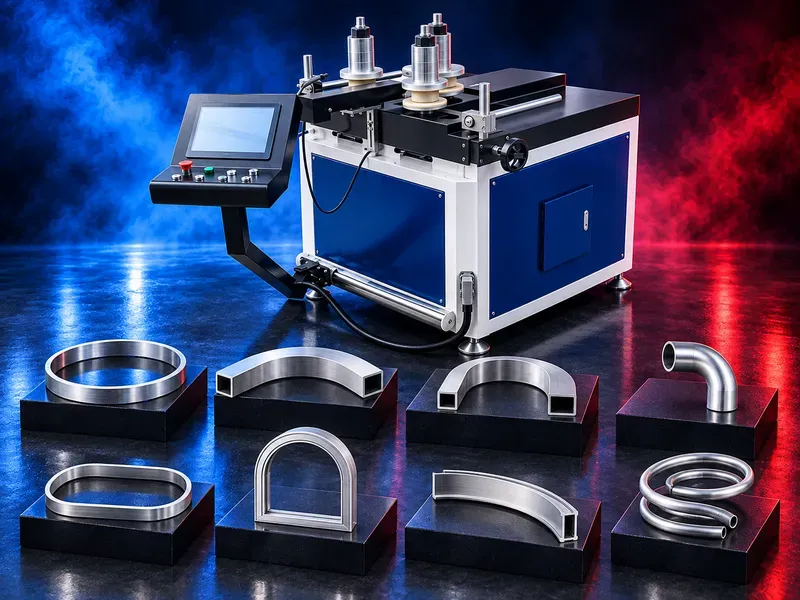
An automatic 3-roller CNC bending solution for producing controlled arcs, curves, rings and radius-formed components from suitable metal profiles and pipes. Typical applications include aluminium architectural profiles, furniture frames, decorative metalwork and suitable special-shaped sections.
This 3-roller automatic CNC profile bending machine is designed to form suitable metal profiles and pipes into controlled arcs and curved shapes. The current SAKKARY MACHINERY product description identifies iron, copper and aluminium among the applicable materials, with final suitability depending on the actual section geometry, material grade, dimensions, wall thickness and required bending radius. The three-roll bending principle progressively forms the profile as it passes through the rollers. Correctly matched tooling is important because the roller geometry must support the section during bending and help control unwanted deformation, twisting or surface marking. CNC control is particularly useful when the application requires repeatable production of defined curves. The final machine configuration should be selected from the finished-part requirement rather than from profile width alone. For aluminium doors, windows and architectural components, profile bending must be evaluated against the exact extrusion cross-section, alloy/temper, visible-surface requirements and allowable distortion. A sample profile, section drawing or DXF/PDF drawing is strongly recommended before technical selection.
What the Machine Does
- Arc and radius bending of suitable profiles
- Curving of suitable round, square or rectangular tubes
- Bending of aluminium architectural profiles
- Curving suitable iron and steel sections
- Bending suitable copper profiles or tubes
- Forming rings, partial rings and curved components where supported by the selected machine and tooling
- Repeatable CNC-controlled bending programs on appropriately configured machines
Typical Applications
- Curved aluminium doors and windows
- Arched window and facade elements
- Curved furniture frames and components
- Decorative steel structures
- Wrought-iron and ornamental fabrication
- Curved railings and architectural metalwork
- Frames, rings and radius-formed assemblies
- Suitable special-shaped profile bending
Suitable Profile Types
- Round tube and pipe
- Square tube
- Rectangular tube
- Flat bar
- Angle and selected open profiles
- Aluminium extrusions
- Special-shaped profiles
Materials
- Aluminium profiles and suitable extrusions
- Iron and suitable steel sections
- Copper profiles or tubes where technically suitable
- Other metal sections only after technical review
How 3-Roller Profile Bending Works
The profile is supported and driven through a set of three rollers. The relative roller position applies progressive bending force to create the required curvature. Multiple passes may be required depending on the profile, material, radius and machine configuration.The finished result is influenced by roller geometry, pressure, feed, material springback, profile orientation and the relationship between section dimensions and requested radius.CNC Control & Repeatability
- Programmed control of supported bending movements
- Repeatable settings for recurring production jobs
- Reduced dependence on manual repositioning for programmed operations
- Ability to store or reproduce job parameters where supported by the selected controller
- Controlled production of arcs and radius-formed parts
Tooling & Rollers
Roller tooling is a critical part of profile bending. The tooling should match the workpiece cross-section and support the surfaces that must retain their shape and finish.- Standard roller sets for compatible sections
- Dedicated rollers for aluminium extrusions
- Special tooling for irregular or asymmetric profiles
- Surface-sensitive tooling where marking must be minimized
- Application-specific roller geometry for hollow or decorative profiles
Bending Radius & Capacity
There is no single universal capacity figure for a CNC profile bending machine. Capacity changes with profile shape, section dimensions, wall thickness, material grade, bending orientation, requested radius and tooling.For this reason, machine suitability should be confirmed against the customer actual profile and finished-part requirement rather than an unsupported maximum profile size or minimum radius.What Affects the Minimum Bending Radius?
- Profile cross-section and dimensions
- Wall thickness
- Material grade and temper
- Bending direction/orientation
- Open versus closed section geometry
- Requested surface quality
- Permitted ovality, flattening or section distortion
- Roller/tooling design
- Springback behavior
- Whether one or multiple passes are acceptable
Aluminium Profile Bending
Aluminium extrusion bending requires particular attention to cross-section geometry and cosmetic surfaces. Thin walls, internal chambers and asymmetric shapes can deform if the tooling does not support the profile correctly.- Send the extrusion cross-section drawing
- Identify alloy and temper if known
- Mark the bending direction
- State the required inside/centerline/outside radius
- Identify visible or cosmetic surfaces
- State acceptable distortion or surface marking
- Provide a sample profile when possible
Production Benefits
- Repeatable curved components for recurring jobs
- Controlled radius production compared with improvised manual forming
- Potential reduction in rework when tooling and process are correctly matched
- Suitable for prototype, batch or production work depending on machine configuration
- Digital job control can support production consistency
How to Select the Correct Machine
- Send the profile or pipe cross-section drawing.
- Identify the material type, grade and temper where applicable.
- Provide width, height, diameter and wall thickness.
- Specify the bending direction.
- Define the required bending radius and whether it is inside, centerline or outside radius.
- Provide finished arc dimensions, ring diameter or drawing.
- State the required production quantity or parts per shift.
- Identify visible surfaces and acceptable deformation/marking.
- Confirm whether special tooling is required.
- Provide a sample or photos of the finished part when available.
Information Required for Quotation
- Profile cross-section drawing (PDF/DXF/DWG if available)
- Material and grade
- Profile dimensions
- Wall thickness
- Profile length
- Required bending radius
- Bending orientation
- Finished arc/ring dimensions
- Required quantity and production rate
- Surface-finish requirements
- Allowed deformation/ovality
- Sample profile or finished-part photo if available
- Electrical requirements and installation location
Questions we are asked
What is a CNC profile bending machine used for?
It is used to form suitable metal profiles and pipes into controlled arcs, curves and radius-formed parts for architectural, furniture, fabrication and industrial applications.
Can the machine bend aluminium profiles?
Yes. Final suitability depends on extrusion geometry, alloy/temper, wall thickness, bending direction, radius and tooling.
Can it bend round, square and rectangular tubes?
These are common applications, but dimensions, wall thickness, material and requested radius must be checked against the selected machine and tooling.
Can it make complete rings?
Some 3-roller configurations can produce rings or near-complete rings. Feasibility depends on section, machine geometry, tooling and final diameter.
What is the minimum bending radius?
There is no reliable universal minimum radius. It depends on profile geometry, dimensions, wall thickness, material, orientation, tooling and acceptable deformation.
Will the profile deform during bending?
Some deformation, ovality, twisting or surface marking can occur if the profile, radius or tooling is unsuitable. Correct tooling and application review are important.
Why is the profile drawing required?
Profiles with similar outside dimensions can behave differently because of wall thickness, internal chambers or section geometry. The cross-section drawing is essential for selection.
Does CNC control improve repeatability?
CNC control can improve repeatability by reproducing programmed machine movements and job settings. Exact functions depend on the selected controller.
Can one roller set bend every profile?
No. Different cross-sections may require different roller geometries, and special or cosmetic profiles can require dedicated tooling.
What should I send for a technical recommendation?
Send the profile drawing, material, dimensions, wall thickness, bending direction, required radius, finished-part drawing or photo and expected production quantity.
Tell us the part you need to make
An engineer reads every request. Usually the same working day.
Related
- Aluminum Profile End Milling Machine End milling solutions for preparing aluminum profile ends for accurate fitting and assembly in suitable window, door and facade systems.
- Automatic Up Cut Mitre Saw for Aluminium and PVC An automatic up cut mitre saw uses a guarded blade that rises through the work area to cut approved aluminium and PVC profiles at straight or angled settings supported by the machine. Correct selection depends on profile material cross section length cut angles finished quality blade clamping feeding cooling extraction output target utilities and safety requirements.
- Double Head Mitre Saw for Aluminium and PVC A double head mitre saw cuts both ends of an approved aluminium or PVC profile to the required length and supported angles within one coordinated cycle. Correct selection depends on profile material cross section finished length angle combination cut quality blade configuration head positioning clamping support output utilities and safety requirements.