

Aluminum Profile Processing
Aluminum Profile End Milling Machine
End milling solutions for preparing aluminum profile ends for accurate fitting and assembly in suitable window, door and facade systems.
An Aluminum Profile End Milling Machine removes material from the end of an aluminum profile to produce the shape required for accurate connection with another profile during frame or structure assembly.
Machine selection depends on the profile system, section dimensions, required end shape, cutter arrangement, milling capacity, operating method and production volume. Explore our aluminum and PVC machines or send your profile drawings for technical selection.
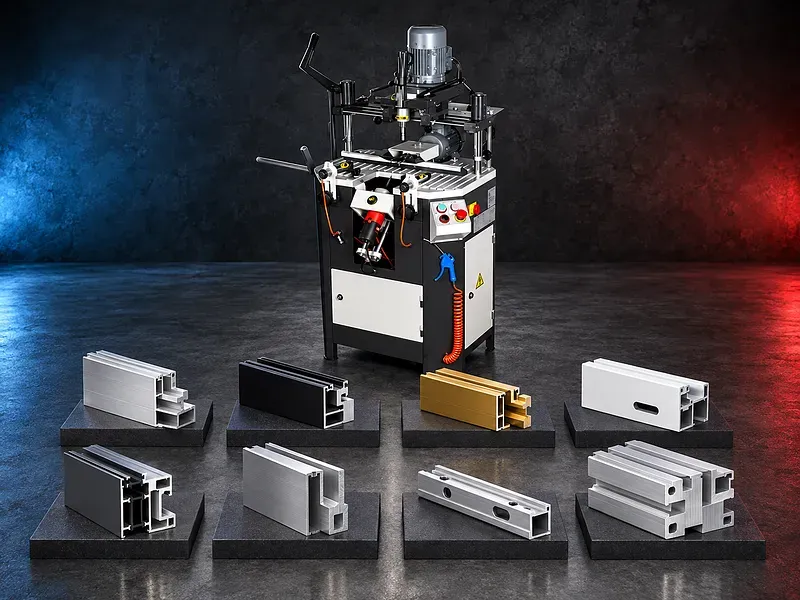
Typical Applications:
- End milling aluminum window profiles
- Preparing door-frame and sash profiles
- Machining mullion and transom profile ends
- Preparing profile joints before assembly
- Producing notches and matching end contours
- Processing suitable curtain-wall and facade profiles
- Repetitive end milling in aluminum fabrication workshops
- Processing PVC profiles only when approved for the selected model
What Does an End Milling Machine Do?:
The machine uses a rotating milling cutter or cutter set to remove a defined section from the end of a profile. The resulting contour allows the machined profile to fit against another profile during assembly.
Depending on the model, cutter movement may be manual, pneumatic, hydro-pneumatic, motor-driven or automatically controlled. Profile clamping, cutter feed and guarding arrangements must be verified for the selected machine.
The cutter profile must match the required joint and profile system. Using the wrong cutter geometry can produce an unsuitable joint or damage the profile.
How to Select the Right Machine:
- 1.Provide drawings of the aluminum profile and finished joint.
- 2. Identify the profile system and intended window, door or facade application.
- 3. Confirm the maximum profile width, height and wall thickness.
- 4. Define the required end contour, milling depth and machining width.
- 5. Confirm the cutter diameter, bore, thickness and profile arrangement.
- 6. Specify whether straight or angled end milling is required.
- 7. Choose between manual, semi-automatic and automatic operation.
- 8. Define the required production volume and cycle pattern.
- 9. Review vertical and horizontal profile-clamping requirements.
- 10. Confirm lubrication, compressed-air and electrical requirements.
- 11. Review profile supports, operator access and safety guarding.
- 12. Approve a sample-machining test before production use.
Technical Data to Verify:
- Maximum profile clamping width and height
- Maximum end-milling width, height and depth
- Cutter or cutter-set diameter
- Cutter bore and spindle interface
- Maximum cutter-stack width
- Spindle speed and motor power
- Cutter-feed direction and operating method
- Available end-milling angles
- Cutter-position adjustment range
- Vertical and horizontal clamping system
- Required compressed-air pressure and consumption
- Tool-lubrication or spray-cooling system
- Profile support length and capacity
- Safety guard and operating controls
- Electrical supply and total connected power
- Machine dimensions, net weight and installation space
Standard and Optional Equipment:
- Depending on the selected model, equipment may include:
- End-milling spindle and cutter mounting system
- Manual, pneumatic or automatic cutter feed
- Vertical pneumatic profile clamp
- Horizontal pneumatic profile clamp
- Adjustable profile stop
- Cutter-position spacers or adjustment system
- Tool-lubrication or spray-cooling system
- Protective cutter guard
- Two-hand safety controls
- Machine stand
- Profile-support arms
- Air gun
- Profile-specific cutter sets
- Multiple-cutter or quick-change systemStandard equipment, optional equipment and cutter sets must be confirmed in the approved quotation.
Compatible Profiles and Materials:
The machine is intended for end milling suitable aluminum profiles when the profile dimensions, alloy condition, cutter geometry and clamping arrangement are compatible with the selected model.
PVC profiles may be processed only when the manufacturer explicitly approves the material and machine configuration.
Steel, stainless steel, composite or other materials must not be listed as compatible without confirmation in the official machine documentation.
Application Limits:
An Aluminum Profile End Milling Machine is designed for profile-end preparation. It is not automatically a replacement for an aluminum machining center, copy router, profile saw, drilling machine or corner-crimping machine.
The machine cannot produce every end shape using one cutter set. Each profile system and joint may require a dedicated cutter arrangement.
Maximum profile size does not automatically equal maximum milling capacity. Both the clamping capacity and actual cutter working envelope must be verified.
Installation and Support:
- Profile, joint and application review
- Cutter drawing and tooling confirmation
- Site, electrical and compressed-air assessment
- Machine unloading and positioning requirements
- Installation and operating checks
- Profile-clamping and cutter-alignment setup
- Sample machining and joint-fit verification
- Operator and safety training
- Tooling and lubrication recommendations
- Preventive-maintenance planning
- Cutter, spare-parts and consumables support
- Warranty according to the approved quotation
The exact installation, training, tooling, service and warranty scope must be confirmed for the selected model and approved commercial offer.
Request a Technical Recommendation:
Send the profile drawing, finished-joint drawing, material, section dimensions, required end contour, cutter information and production volume to determine the appropriate machine, milling capacity and tooling configuration.
Questions we are asked
What is an Aluminum Profile End Milling Machine?:
It is a machine that mills the end of an aluminum profile to create the contour required for fitting and assembly with another profile.
What products use end-milled profiles?:
Typical applications include suitable aluminum window, door, mullion, transom and facade-profile assemblies. Compatibility must be confirmed for the actual profile system.
What information is required to select the machine?:
Provide the profile drawing, joint drawing, material, profile dimensions, required end contour, milling depth, cutter information and production volume.
Does every profile require a different cutter?:
The required cutter depends on the profile geometry and finished joint. Different profile systems may require different cutters or cutter combinations.
Can the machine process angled profile ends?:
Angle capability depends on the machine design and cutter movement. The required angle must be verified for the selected model.
Can it process PVC profiles?:
Only models explicitly approved by the manufacturer for PVC profiles should be presented as suitable for that material.
Are cutter sets included?:
The number, profile, diameter, bore and capacity of included cutter sets must be confirmed in the approved quotation.
Are installation and operator training included?:
Installation, setup, sample testing, training, tooling, warranty and service scope are defined in the approved quotation.
Tell us the part you need to make
An engineer reads every request. Usually the same working day.