

Teaching-Free Intelligent Robotic Welding for Steel Structures
HRWR Steel Structure Intelligent Robot Welding Workstation
Intelligent robotic welding workstation for automated and flexible welding of H-beams, box beams and other steel structural components, using ground-rail deployment and teaching-free programming workflows for standardized, customized and mixed-production requirements.
The HRWR steel structure intelligent robot welding workstation is designed for automated welding of H-beams, box beams and other steel structural components used in steel-structure buildings, ships, bridges and mechanical equipment.
The system uses a ground-rail arrangement that can be installed according to workshop layout and production flow. It is intended for high-volume production as well as non-standard or diversified steel structural parts.
Its intelligent welding control workflow can generate welding programs from a 3D digital model or from reverse modeling using a line laser stereo camera. The system then plans welding paths, applies laser-based path correction and can use arc tracking and laser tracking during welding.
Multi-layer and multi-pass welding can be performed when the application conditions and welding procedure allow it.
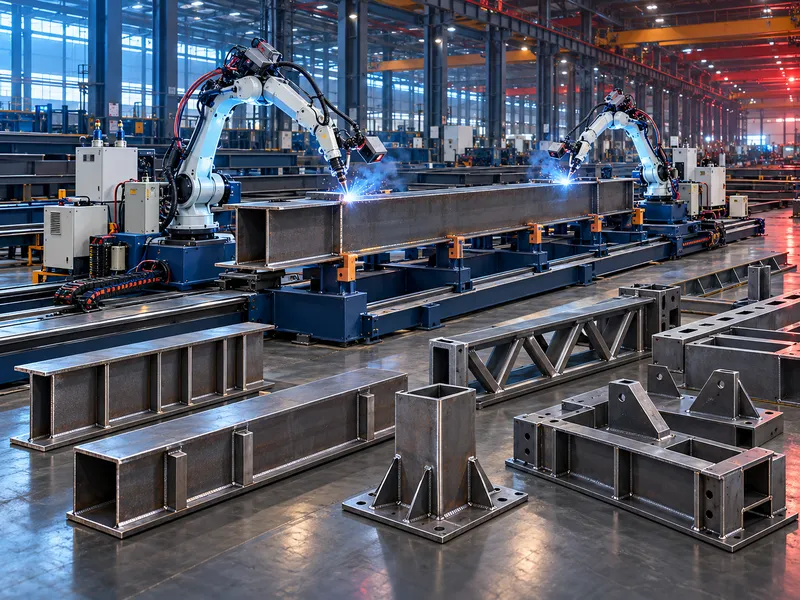
- Applications: H-beams, box beams, structural steel components, steel building fabrication, bridge structures, ship-related steel structures and mechanical equipment components.
- Ground-Rail Workstation: the robot is deployed on a ground-rail structure and arranged according to workshop layout and production process.
- Teaching-Free Workflow: supports automatic programming from a 3D digital model of the workpiece.
- 3D Model Compatibility: source states support for Tekla-related workflows and .ifc, .step and .stp files; exact software/version integration should be confirmed before publication.
- Reverse Modeling: when a 3D model is unavailable, the workpiece can be scanned using a line laser stereo camera to obtain contour information for subsequent welding operations.
- Intelligent Path Planning: the workflow includes obstacle-avoidance path planning for required welds and laser-vision-based correction of the welding path.
- Automatic Welding Process Matching: the source describes automatic matching of the welding process according to plate thickness and welding position.
- Real-Time Tracking: arc tracking and laser tracking can correct the welding path during the welding process.
- Multi-Layer / Multi-Pass Welding: supported when application conditions are met.
- Selection inputs: workpiece type, drawings or 3D model, material, plate thickness, weld type and position, component dimensions, production mix, required output and workshop layout.
Teaching-Free / Programming-Free AI Workflow
- Import the available 3D digital model of the workpiece, or scan the workpiece with the line laser stereo camera for reverse modeling.
- Identify the welds and perform intelligent obstacle-avoidance path planning.
- Scan and correct the welding path using the laser vision sensor.
- Match the welding process and automatically create the welding program.
- Execute robotic welding while arc tracking and laser tracking provide real-time path correction.
Questions we are asked
What is the HRWR steel structure intelligent robot welding workstation?
It is an automated robotic welding workstation designed for H-beams, box beams and other steel structural components, using a ground-rail arrangement and intelligent welding-control workflow.
Can it work without manual teaching programming?
The supplied source describes a teaching-free workflow that can generate welding programs from a 3D digital model. It also describes reverse modeling by scanning the workpiece when a 3D model is unavailable.
Which 3D file formats are mentioned?
The supplied source mentions .ifc, .step and .stp files and states support for Tekla software. Exact software versions, interfaces and workflow compatibility should be verified for the supplied configuration.
What does the line laser stereo camera do?
It scans the workpiece and obtains contour information that can be used for reverse modeling and to guide subsequent welding operations.
Does the system support path correction during welding?
Yes. The supplied description states that arc tracking and laser tracking can correct the welding path in real time.
Can it perform multi-layer and multi-pass welding?
Yes, when the application conditions and the selected welding procedure are suitable
Tell us the part you need to make
An engineer reads every request. Usually the same working day.
Related
- Robotic Welding Solutions Flexible robotic welding solutions configured around the workpiece, welding process, production volume, and handling requirements. Available concepts include collaborative robots, positioners, industrial workstations, and gantry-based systems.
- Handheld Fiber Laser Welding Machine Handheld fiber laser welding solution for joining metal sheets, tubes and fabricated components with a concentrated laser beam and controlled heat input.
- Automated Continuous Fiber Laser Welding Machine Automated continuous fiber laser welding solution for repeatable welding of metal components, with configurable process parameters and an optional wobble welding head for wider process control.