

WELDING AUTOMATION
Robotic Welding Solutions
Flexible robotic welding solutions configured around the workpiece, welding process, production volume, and handling requirements. Available concepts include collaborative robots, positioners, industrial workstations, and gantry-based systems.
Robotic welding is a complete production solution combining a robot, welding source, torch, workholding, positioner or motion system, controls, safety equipment, and application software. The correct configuration depends on the parts, joints, materials, welding process, accessibility, and target output.
HAIRUI’s published product range includes collaborative and industrial welding robots, positioner-equipped solutions, steel-structure workstations, and cantilever or gantry configurations. Explore related welding machines or send your parts for a technical application review.
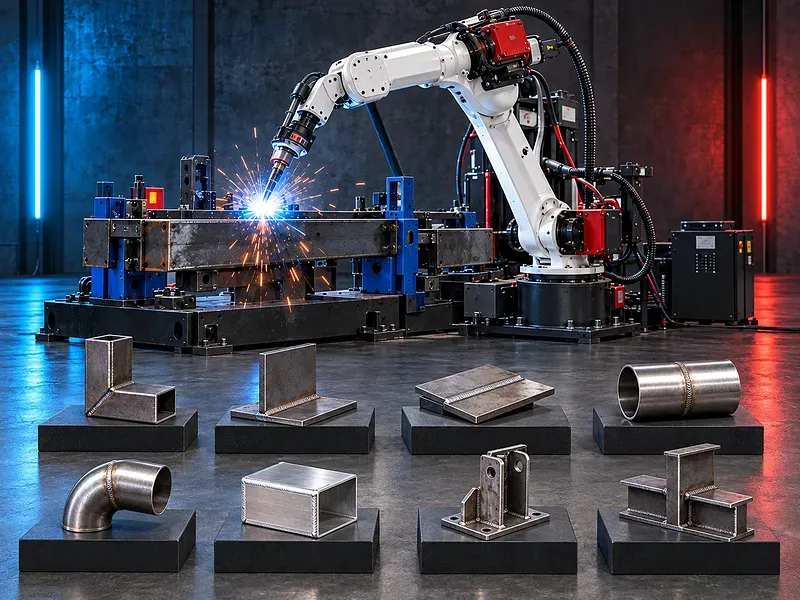
What are robotic welding solutions?
Robotic welding solutions automate defined welding operations through a configured combination of robot motion, welding equipment, fixtures, sensors, controls, safety systems, and part handling.
A robot alone is not a complete welding solution. Successful integration requires a stable welding process, repeatable part preparation, suitable fixtures, controlled joint gaps, safe access, qualified programs, and inspection criteria.
Available solution concepts
- Collaborative robotic welding systems
- Industrial robotic welding systems
- Robots combined with welding positioners
- Ground-rail robotic welding systems
- Cantilever robotic welding workstations
- Gantry robotic welding stations
- Steel-structure welding workstations
- Single-robot or dual-robot configurations
- Integrated robotic cells with fixtures and safety equipment
- The exact configuration, number of axes, robot quantity, sensors, and supported functions must be verified for each system.
Supported welding processes
Selected collaborative solutions can be configured for MIG/MAG, TIG, or laser welding according to the workpiece and process requirements. Process availability must be confirmed for the exact system, welding source, torch, material, joint, and application.
Typical applications
- Repetitive welded fabrications
- Steel structures and fabricated assemblies
- Frames, brackets, bases, and welded subassemblies
- Components requiring coordinated positioning
- Small-batch or mixed production where the selected system supports flexible setup
- Large components requiring a rail, cantilever, or gantry arrangement
- Custom welding cells designed around approved parts
- Every application requires a welding trial and technical review before confirming suitability, quality, or output.
Potential production benefits
- Repeatable robot movement under controlled conditions
- Consistent execution of approved welding programs
- Reduced manual torch handling
- Coordinated welding with a suitable positioner
- Improved access to defined joints through additional motion axes
- Support for repeated parts and product families
- Integration with seam sensing, vision, or tracking where verified
- Collection of production data where supported
- These are potential benefits, not guaranteed results. Weld quality and productivity depend on joint preparation, fit-up, material, welding procedure, fixtures, consumables, programming, process control, and inspection.
How to select a robotic welding solution
- Provide drawings and photographs of the parts and joints
- Confirm materials, thicknesses, and surface condition
- Identify the welding process and approved welding procedure
- Define joint types, sizes, positions, and accessibility
- State allowable joint-gap and fit-up variation
- Provide part dimensions, weight, and center of gravity
- Define fixtures, clamping, and positioner requirements
- Confirm batch size, product mix, and takt-time target
- Define loading, unloading, and operator involvement
- Identify seam-searching, vision, or tracking requirements
- Define quality, inspection, and traceability requirements
- Review fumes, extraction, guarding, interlocks, and safety
- Confirm floor space, utilities, and integration requirements
Technical data to verify
- Manufacturer and exact system or model
- Robot type, payload, reach, repeatability, and mounting
- Number and function of robot and external axes
- Positioner capacity, axes, speed, and accuracy
- Ground-rail, cantilever, or gantry travels
- Welding process, source, torch, and duty cycle
- Supported wire, electrode, shielding gas, and consumables
- Vision, seam-searching, tracking, or AI functions
- Teaching, drag-programming, offline-programming, or automatic path-generation functions
- Workpiece and fixture capacity
- Controller, software, and data interfaces
- Safety scanner, fencing, interlocks, emergency stops, and risk controls
- Fume extraction and environmental requirements
- Dimensions, weight, power, air, gases, and installation requirements
Teaching-free and AI claims
“Teaching-free,” “programming-free,” automatic seam recognition, path generation, and real-time correction are configuration-specific capabilities. They must be supported by the exact vision system, software version, workpiece conditions, joint types, tolerance limits, and documented acceptance tests.
Positioners and external axes
A positioner can present the joint at a more suitable welding orientation and may coordinate with robot movement. Capacity, axis count, synchronization, fixture design, balance, and safe loading must be engineered for the workpiece.
Welding quality and acceptance
The system must be validated using actual parts, approved welding procedures, specified materials, fixtures, consumables, and inspection methods. Visual inspection, dimensional checks, destructive or non-destructive testing, and production acceptance criteria depend on the application and governing requirements.
Safety and installation
A collaborative robot does not make the complete welding application automatically safe. Arc radiation, heat, fumes, spatter, sharp edges, moving fixtures, positioners, and external axes require a documented risk assessment and appropriate guarding, extraction, interlocks, procedures, and training.
Request an application review
Send part drawings, joint details, materials, thicknesses, welding process, part weight, quantity, current cycle time, and quality requirements. SAKKARY MACHINERY will review the application before recommending a robotic welding concept.
Questions we are asked
Which robotic welding system is suitable for my production?
Selection depends on the parts, joints, materials, welding process, part weight, production mix, cycle time, accessibility, quality, and safety requirements.
Can the robot work without teaching or programming?
Only verified systems equipped with the necessary vision and software may support automated path generation. Capability and operating limits must be tested on the actual parts.
Which welding processes are supported?
Selected HAIRUI collaborative solutions may be configured for MIG/MAG, TIG, or laser welding. The exact process and equipment must be confirmed for each system.
When is a positioner required?
A positioner may be needed to orient the joint, improve access, or coordinate workpiece movement. Its capacity and axes depend on the part and welding sequence.
Can one system weld different products?
A system may support multiple product programs, but fixtures, joint consistency, setup, programming, tooling, and acceptance testing are required for every product family.
Tell us the part you need to make
An engineer reads every request. Usually the same working day.
Related
- Handheld Fiber Laser Welding Machine Handheld fiber laser welding solution for joining metal sheets, tubes and fabricated components with a concentrated laser beam and controlled heat input.
- Automated Continuous Fiber Laser Welding Machine Automated continuous fiber laser welding solution for repeatable welding of metal components, with configurable process parameters and an optional wobble welding head for wider process control.
- Portable Air-Cooled Fiber Laser Welder Compact handheld fiber laser welding solution designed for flexible metal fabrication work, with an air-cooled configuration and operator-oriented controls. Final functions and technical capability depend on the exact machine model and verified configuration.