

INDUSTRIAL IDENTIFICATION
Industrial Marking Solutions
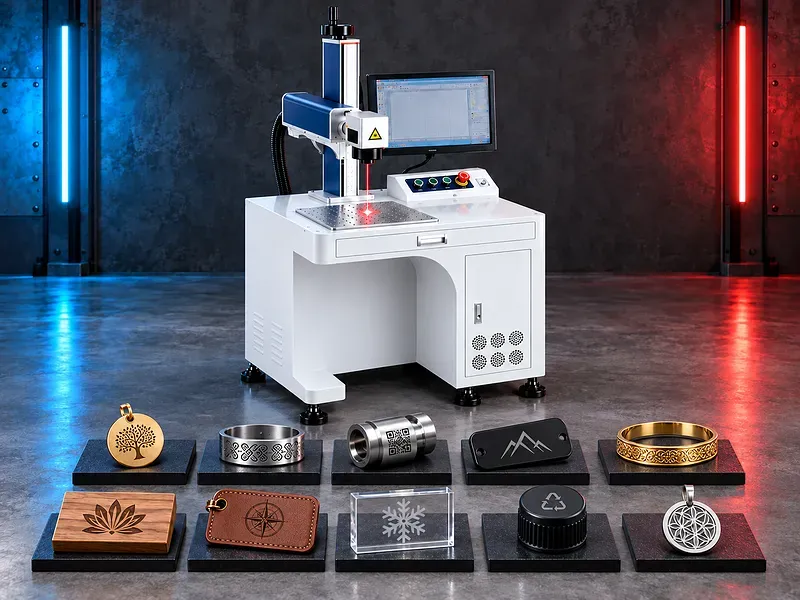
Laser and industrial marking solutions selected according to the material, mark content, contrast, permanence, production speed, and integration requirements.
Different materials interact differently with each marking technology. Fiber, UV, green, and CO₂ lasers, together with inkjet and other coding systems, serve different materials and production requirements.
The correct solution starts with the actual material, coating, mark content, marking area, required contrast, permanence, cycle time, and production environment. Explore related laser machines or send samples for an application test.
What are industrial marking solutions?
Industrial marking solutions create identification, traceability, decorative, or functional marks on products and packaging. Depending on the technology, the mark may be produced through engraving, annealing, color change, ablation, foaming, carbonization, printing, or another verified interaction.
No single marking technology is suitable for every material. Selection requires matching the wavelength or marking method to the material and required result.
Available marking technologies
- Fiber laser marking for suitable metals and selected plastics
- UV laser marking for suitable sensitive materials and fine marks
- Green laser marking for selected reflective or difficult materials
- CO₂ laser marking for suitable organic and non-metallic materials
- Inkjet coding for supported products and packaging lines
- Dot-peen or mechanical marking where appropriate
- Rotary marking for suitable cylindrical components
- Vision-assisted marking and verification where available
- Exact technology availability must be confirmed from the approved product range.
Typical marking content
- Serial and part numbers
- Batch and lot codes
- Dates and production information
- Barcodes and Data Matrix codes
- QR codes
- Logos and product branding
- Technical symbols and scales
- Traceability and identification data
- Decorative text and patterns
- Code readability and traceability require suitable contrast, resolution, data control, and verification.
Materials requiring application testing
- Steel, stainless steel, aluminum, and other metals
- Coated or painted metals
- Gold, silver, and other precious-metal products
- Engineering and consumer plastics
- Acrylic and transparent polymers
- Glass and crystal
- Wood, leather, paper, and cardboard
- Ceramic, marble, granite, and related materials
- Packaging, bottles, containers, bags, and labels
- Listing a material does not confirm compatibility with every machine. Grade, color, coating, additives, surface condition, and required result can change the outcome.
How to choose the marking solution
- Provide a physical sample or exact material specification
- Identify coating, finish, color, and surface condition
- Define the mark content and variable data
- State the required marking area and character size
- Define contrast, depth, permanence, and appearance
- Confirm abrasion, chemical, heat, or wash resistance
- Define batch size, takt time, and line speed
- Confirm stationary, handheld, or inline operation
- Identify flat, curved, or cylindrical surfaces
- Define code-verification and traceability requirements
- Review software, database, ERP, or production-line integration
- Confirm extraction, ventilation, guarding, and laser safety
- Complete a sample test before final selection
Technical data to verify
- Manufacturer, brand, model, and country of origin
- Marking technology and wavelength
- Verified laser power or printing configuration
- Supported materials and sample-test results
- Marking field and focal-distance options
- Spot size, line width, resolution, and repeatability
- Marking speed and applicable test conditions
- Flat, rotary, 3D, or dynamic-focus capability
- Manual, automatic, conveyor, or production-line configuration
- Controller, software, file formats, and variable-data functions
- Barcode, Data Matrix, and QR-code support
- Camera, autofocus, positioning, and code-verification options
Rotary axes and fixtures
Cooling, extraction, filtration, and consumablesLaser classification, guarding, interlocks, and safety requirements
Dimensions, weight, power, air, and installation requirements
Material and technology selection
Fiber laser, UV, green, CO₂, and inkjet systems do not produce the same result on every material. Official selection guidance shows that suitability varies substantially by wavelength and material, particularly across plastics, glass, metals, and organic materials.
Mark quality and acceptance
A sample test should confirm appearance, contrast, depth, readability, cycle time, heat effect, surface damage, adhesion where ink is used, and resistance to the product’s operating environment. Machine selection should not rely on a visual mockup alone.
Safety and installation
Laser marking requires appropriate enclosure, interlocks, extraction, eye protection, procedures, and trained operators according to the system’s laser classification and risk assessment. Marking some plastics, coatings, leather, or organic materials may produce fumes that require controlled extraction and filtration.
Request a sample test
Send the material sample, mark artwork, dimensions, required contrast, permanence, quantity, and target cycle time. SAKKARY MACHINERY will review the application before recommending a marking technology.
Questions we are asked
Which marking machine is suitable for my material?
The correct system depends on the exact material, coating, color, required mark, permanence, speed, and sample-test result.
Can one machine mark every material?
No. Fiber, UV, green, CO₂, inkjet, and mechanical systems interact differently with metals, plastics, glass, and organic materials.
Can the system produce QR and Data Matrix codes?
Selected systems can generate these codes, but resolution, contrast, data control, marking speed, and verification must be tested.
Can the machine be integrated into a production line?
Selected models may support conveyors, sensors, cameras, variable data, and production-system integration. The interfaces must be verified.
Is the mark permanent?
Permanence depends on the technology, material interaction, mark type, depth, environment, and acceptance test.
Tell us the part you need to make
An engineer reads every request. Usually the same working day.
Related
- CO2 Laser Engraving and Cutting Machine A CO2 laser engraving and cutting machine processes compatible nonmetal materials by directing a controlled laser beam over the workpiece. Correct selection depends on whether the task is engraving or cutting material composition and thickness required edge and mark quality work area laser power extraction cooling software and production volume.
- Gantry Type Large Format UV Laser Marking Machine A gantry type UV laser marking machine combines an ultraviolet laser source with programmable large area motion for fine marking engraving or other verified microprocessing tasks. Correct selection depends on material response workpiece size mark content field stitching quality laser power and wavelength focus motion accuracy extraction cooling software safety and production volume.
- MOPA Fiber Laser Marking Machine for Precision & Color Marking MOPA fiber laser marking solution for precision marking, stainless-steel color marking, anodized aluminium blackening, controlled surface processing and selected electronics applications.