

PRECISION FIBER LASER CUTTING MACHINES
High Precision Mini Fiber Laser Cutting Machine
A compact fiber laser solution for programmed cutting of suitable thin metal sheets and small precision components. Machine selection depends on the material, thickness, work area, feature size, tolerance, edge requirement, part handling, inspection method, and production target.
A mini precision fiber laser cutting machine is intended for small format metal parts and detailed sheet geometries when supported by the verified model. Potential applications include jewelry components, metal eyewear frames, watch and clock parts, lighting components, small automotive parts, craft products, gift items, electronic parts, and precision machinery components. Precision must be defined by measurable part requirements rather than the product name alone. The review should cover positioning accuracy, repeatability, kerf, minimum feature size, heat effect, burr condition, part retention, material recovery, tolerances, and the inspection method for the finished component.
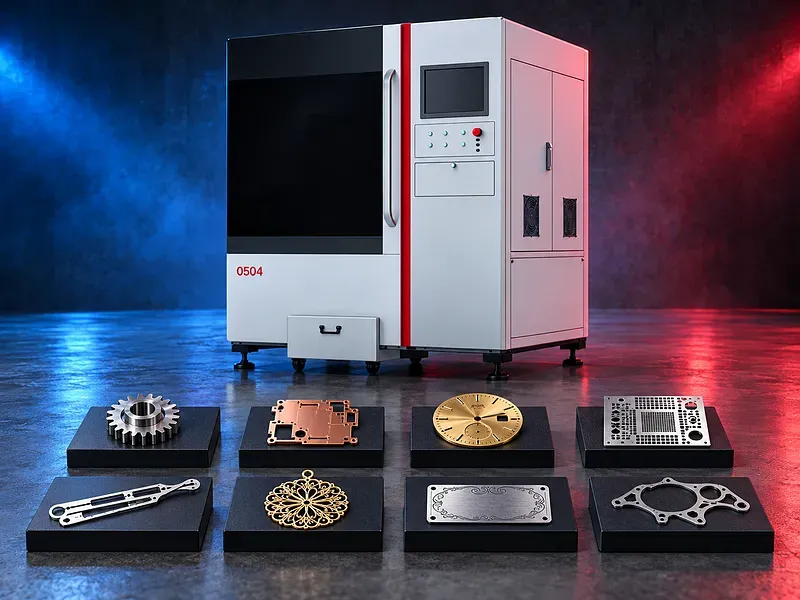
Precision cutting for small metal parts
The machine coordinates the fiber laser source, optical system, cutting head, motion axes, height control, workholding, gas delivery, software, and cutting data to produce small programmed metal parts.
The terms mini and high precision must be verified through the exact machine dimensions, usable work area, axis design, positioning accuracy, repeatability, beam delivery, calibration method, and acceptance test.
Suitable applications
Potential applications include jewelry findings and components, metal eyewear frame parts, watch and clock components, decorative lighting parts, instrument details, small automotive parts, precision brackets, electronic components, nameplates, craft products, gift items, and small machinery parts.
Application suitability depends on the actual drawing, material, thickness, feature size, surface condition, tolerance, edge requirement, appearance requirement, downstream forming or finishing, and production volume.
Jewelry watches and decorative components
Small decorative parts may require fine contours, controlled heat input, careful part retention, clean material handling, and an approved method for collecting valuable offcuts and dust.
The machine must not be presented as suitable for gold, silver, platinum, coated metals, or other valuable materials until the exact laser source, process data, extraction, recovery method, sample quality, and material accounting requirements are verified.
Eyewear lighting and small industrial parts
Eyewear applications refer to suitable metal frame components and fittings. Standard fiber laser cutting of glass lenses or nonmetal glass must not be assumed.
Lighting, automotive, craft, gift, and machinery applications require review of the material, coating, appearance surface, part strength, joining method, electrical function, and downstream finishing or assembly.
Materials and thickness range
Potential materials may include suitable grades of stainless steel, carbon steel, aluminum, copper, brass, titanium, and other metals compatible with the verified laser source, optical system, cutting head, gas system, and process data.
Material compatibility, minimum and maximum thickness, reflective material capability, coating limits, surface protection, and edge quality must be confirmed for the exact model.
What precision means
Machine positioning accuracy and repeatability are not the same as guaranteed finished part accuracy. The final result also depends on material flatness, thermal behavior, sheet support, workholding, feature spacing, focus, nozzle condition, gas stability, calibration, and measurement method.
The required tolerance, minimum hole or slot size, kerf, corner condition, burr limit, heat affected area, flatness, and cosmetic acceptance should be defined on the part drawing and verified through sample cutting.
Part retention and material handling
Small parts can tip, move, fall through the support, become attached to the surrounding sheet, or be damaged during removal. The production method may require microjoints, tabs, suitable support spacing, controlled cutting order, collection trays, vacuum handling, or custom fixtures.
Valuable materials require controlled loading, identification, segregation, collection of offcuts, dust handling, weighing, reconciliation, and approved storage procedures.
How to choose the correct machine
Provide finished part drawings and CAD files, material grades, coatings, sheet sizes, thicknesses, minimum feature sizes, tolerances, edge requirements, appearance requirements, quantities, batch sizes, and target output.
Selection should also consider laser type and power, beam quality, work area, motion system, cutting head, focus control, camera or vision options, fixturing, part collection, nesting, extraction, gas delivery, cooling, inspection, and future product range.
Technical information to verify
The approved manufacturer documents must confirm the brand, model, laser source, rated output, beam delivery, work area, supported materials, thickness range, cutting head, axis travels, positioning accuracy, repeatability, speed, and stated test conditions.
They must also confirm focus control, height sensing, vision or camera functions, software, nesting, minimum supported feature guidance, table and fixture options, part collection, extraction, cooling, gas requirements, electrical supply, compressed air, machine dimensions, weight, and safety systems.
Sample cutting and inspection
Sample cutting should use the actual material grade, thickness, surface condition, coating, drawing, feature sizes, and required cutting gas. The test should record cutting data and acceptance conditions.
Inspection may include dimensional measurement, optical measurement, microscope review, burr assessment, heat effect, edge appearance, flatness, fit, surface condition, and downstream forming, polishing, coating, joining, or assembly trials.
Cutting gases extraction and safety
The process may require nitrogen, oxygen, compressed air, or another approved gas depending on the material, thickness, edge requirement, and verified cutting process.
The installation must include a documented enclosure and access plan, laser protection, interlocks, extraction for fumes and fine particles, fire precautions, safe handling of reflective or valuable materials, and approved waste and dust procedures.
Installation and lifecycle support
Site planning should cover machine footprint, access, foundation or floor requirements, electrical supply, grounding, cooling, cutting gases, compressed air, extraction, ventilation, fire precautions, software connectivity, inspection equipment, and operator training.
The exact supply scope, commissioning, training, preventive maintenance, optics care, consumables, spare parts, warranty, and service commitments require confirmation in the approved technical and commercial offer.
Limitations and alternative processes
A mini fiber laser cutting machine is not automatically suitable for every small component, nonmetal material, transparent material, three dimensional part, thickness, tolerance, or cosmetic finish.
Ultrashort pulse laser processing, stamping, fine blanking, wire EDM, CNC machining, chemical etching, waterjet, engraving, or another laser type may be more suitable for some components. The complete production route should be reviewed.
Technical review and next step
Send the part drawings with material specifications, thicknesses, tolerances, minimum features, surface requirements, quantities, inspection method, and target output.
SAKKARY MACHINERY will review the application and identify the required process, machine configuration, sample cutting plan, and information that still needs manufacturer verification.
Questions we are asked
What makes this machine suitable for precision parts?
Suitability depends on verified positioning accuracy repeatability beam delivery workholding process stability cutting data and inspection results for the actual part.
Can it cut jewelry and watch components?
It may process suitable metal components after verifying the material thickness feature sizes heat effect edge quality part retention and recovery of valuable material.
Can it cut eyeglass frames and glass lenses?
It may process suitable metal eyewear frame parts. Cutting nonmetal glass lenses must not be assumed and may require a different laser technology.
Which materials and thicknesses can it cut?
Supported materials and thicknesses depend on the exact laser source optical system cutting head gas system machine design and approved process data.
How is precision confirmed?
Precision should be confirmed through sample cutting under recorded conditions followed by dimensional optical and functional inspection against the approved drawing.
What information is required for technical selection?
Provide part drawings material grades coatings thicknesses minimum features tolerances surface requirements quantities inspection method and target output.
Tell us the part you need to make
An engineer reads every request. Usually the same working day.
Related
- Fiber Laser Cutting Machines Industrial fiber laser solutions for cutting metal sheets with a configuration selected according to the material, thickness, part dimensions, required cut quality, and production target.
- Integrated Fiber Laser Processing Machine An integrated CNC solution designed to combine compatible sheet-metal operations such as fiber laser cutting, punching, forming, and marking. Actual functions depend on the selected model and configuration.
- Tube Fiber Laser Cutting Machine A fiber laser cutting solution for suitable tubes and metal profiles. Machine selection depends on the material, section type, dimensions, wall thickness, part geometry, cutting requirements, loading method, and production target.