

DESKTOP LASER ENGRAVING MACHINES
Desktop Fiber Laser Cutting and Engraving Machine
A compact fiber laser system for marking, engraving, personalization, and verified cutting applications on suitable metal items. The correct configuration depends on the material, required process, laser type, power, work area, part geometry, accessories, extraction, safety design, and production target.
A desktop fiber laser machine can support personalization, identification, surface marking, engraving, and selected cutting tasks when these processes are documented for the exact model. Potential users include jewelry workshops, gift shops, personalization businesses, small production workshops, repair centers, and industrial part marking operations. Marking, engraving, deep engraving, annealing, surface removal, and cutting are different processes. The machine must be selected from the required result, material, depth, contrast, edge quality, cycle time, work area, fixture, and sample approval rather than from the fiber laser label alone.
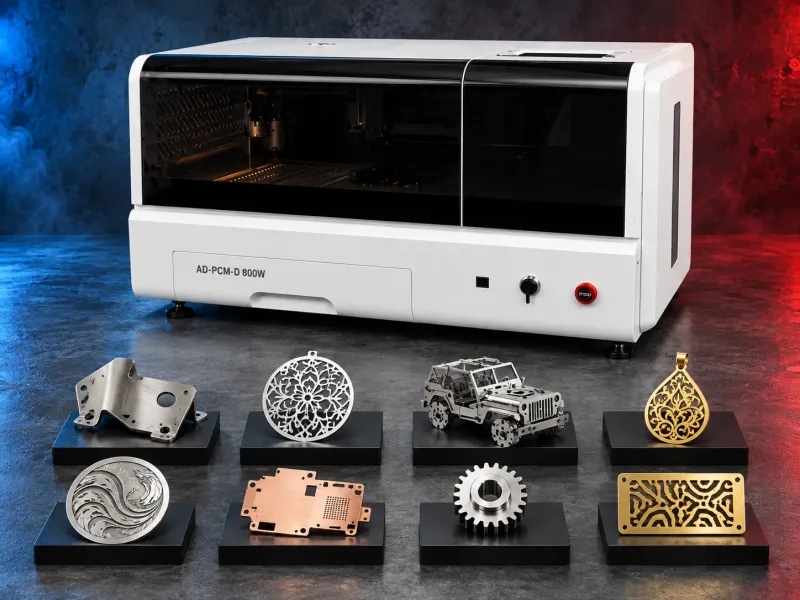
Desktop fiber laser processing
The machine may combine a fiber laser source, scanning head or motion system, focusing lens, work platform, height adjustment, control software, enclosure, extraction connection, and application fixtures in a compact format.
The terms desktop, mini, small, and portable must be verified through the exact machine dimensions, weight, lifting method, power supply, cooling, extraction, setup requirements, and approved operating location.
Marking engraving and cutting are different
Marking can change color, texture, or surface appearance. Engraving removes material to create depth. Deep engraving requires additional energy and process time. Cutting separates the material through its full thickness.
A machine capable of marking or engraving is not automatically capable of cutting the same material. Cutting capacity depends on the laser source, pulse characteristics, optical system, focus, thickness, gas or air support, table, part retention, and verified process data.
Jewelry and gift shop applications
Potential applications include names, dates, logos, serial numbers, patterns, textures, and personalized designs on suitable rings, bracelets, pendants, tags, keyrings, plaques, pens, tools, accessories, metal gifts, and small parts.
Inside ring engraving, cylindrical items, repeated positioning, or batch personalization may require a verified rotary axis, chuck, fixture, focus method, software function, and sample approval.
Materials and surface results
Potential materials may include suitable grades of stainless steel, carbon steel, aluminum, anodized aluminum, brass, copper, titanium, gold, silver, platinum, coated metals, and other metals supported by the verified laser source and process data.
Material grade, coating, polish, color, reflectivity, heat sensitivity, required contrast, engraving depth, cutting thickness, and cosmetic acceptance must be confirmed for each application.
Fiber MOPA and other laser options
A standard fiber laser may suit many metal marking and engraving tasks. A MOPA source may provide additional control of pulse parameters for selected contrast, color, heat sensitive, or surface processing applications when documented.
Green, ultraviolet, carbon dioxide, or ultrashort pulse laser systems may be more suitable for some plastics, organic materials, glass, coated products, transparent materials, or heat sensitive components. The material and desired result determine the technology.
Cutting capability and part retention
If cutting is required, the approved documents and sample test must confirm the material, thickness, feature size, edge condition, cycle time, and safe operating method.
Thin parts can move, tip, fall, overheat, discolor, or become attached to the surrounding material. The process may require a cutting table, pin table, support, tabs, suitable cutting order, air flow, collection tray, or custom fixture.
Valuable material control
Jewelry production may require controlled loading, part identification, secure fixtures, collection of offcuts, dust extraction, segregation, weighing, reconciliation, and approved storage of valuable materials.
Suitability for precious metals must be confirmed through manufacturer documentation, sample quality, extraction and recovery design, accounting procedures, and the approved production method.
How to choose the correct machine
Provide the actual products or drawings, material grades, coatings, object dimensions, marking area, engraving depth, cutting thickness, feature sizes, desired contrast or color, quantities, cycle target, and inspection method.
Selection should also consider laser source, average power, pulse parameters, peak power, wavelength, lens, spot size, focus range, work area, object height, rotary options, camera functions, fixtures, software, extraction, cooling, enclosure, and future services.
Technical information to verify
The approved manufacturer documents must confirm the brand, model, laser type, wavelength, average power, pulse range, peak power where relevant, marking or work area, supported object height, focus method, supported materials, and documented processes.
They must also confirm scanning or axis speed, stated accuracy and repeatability, lens options, rotary compatibility, camera options, table accessories, cutting setup, software, file formats, extraction connection, cooling, electrical supply, dimensions, weight, enclosure, access control, interlocks, and safety classification.
Artwork workflow and repeatability
The workflow should define supported vector or image files, artwork preparation, text and font handling, serial data, barcodes or codes, positioning references, focus setting, fixture identification, parameter control, and approval samples.
Repeatability depends on consistent materials, clean optics, stable focus, controlled fixtures, calibrated positioning, approved parameters, operator discipline, preventive maintenance, and inspection.
Retail use extraction and safety
A machine used in a shop or customer facing area requires verified enclosure design, controlled access, interlocks, viewing protection, emergency stop, safe loading, fume and particle extraction, odor control, fire precautions, and appropriate operating procedures.
The term desktop does not mean the machine can be used without extraction, risk assessment, trained operation, material approval, and the safety requirements of the exact laser system.
Installation and lifecycle support
Site planning should cover a stable work surface, machine space, access, electrical supply, grounding, cooling, extraction, ventilation, fire precautions, computer and software requirements, fixtures, inspection tools, and operator training.
The exact supply scope, commissioning, training, preventive maintenance, optics care, filters, consumables, spare parts, warranty, and service commitments require confirmation in the approved technical and commercial offer.
Limitations and alternative solutions
A desktop fiber laser machine is not automatically suitable for every material, engraving depth, color result, cutting thickness, transparent object, organic product, glass item, or customer facing environment.
A MOPA, green, ultraviolet, carbon dioxide, ultrashort pulse, mechanical engraving, CNC, or other process may be more suitable. The decision should be based on approved samples, required result, safety plan, cycle time, and production route.
Technical review and next step
Send the product samples or drawings with material details, dimensions, required marking or engraving result, cutting requirement, quantities, cycle target, and shop conditions.
SAKKARY MACHINERY will review the application and identify the required laser technology, machine configuration, accessories, extraction, safety requirements, and sample testing plan.
Questions we are asked
Is a desktop fiber laser mainly for marking engraving or cutting?
The answer depends on the exact laser source optics table accessories and documented process. Many desktop systems focus on marking and engraving while cutting requires separate verification.
Can it engrave rings bracelets and jewelry?
It may engrave suitable metal jewelry when the material geometry fixture rotary option focus method extraction and sample quality are verified.
Can it cut metal jewelry parts?
Cutting must be confirmed for the exact material thickness laser configuration table support and process data through an approved sample test.
Which materials can it process?
Material capability depends on the laser type wavelength pulse characteristics optics and process data. Fiber MOPA green ultraviolet and carbon dioxide lasers serve different materials and results.
Is the machine portable and safe for a gift shop?
Portability and shop suitability require verification of dimensions weight lifting setup enclosure access control extraction odors fire precautions noise and the documented safety classification.
What information is required for technical selection?
Provide product samples or drawings material coatings dimensions required marking engraving or cutting result quantities cycle target and shop conditions.
Tell us the part you need to make
An engineer reads every request. Usually the same working day.
Related
- Fiber Laser Cutting Machines Industrial fiber laser solutions for cutting metal sheets with a configuration selected according to the material, thickness, part dimensions, required cut quality, and production target.
- Integrated Fiber Laser Processing Machine An integrated CNC solution designed to combine compatible sheet-metal operations such as fiber laser cutting, punching, forming, and marking. Actual functions depend on the selected model and configuration.
- Tube Fiber Laser Cutting Machine A fiber laser cutting solution for suitable tubes and metal profiles. Machine selection depends on the material, section type, dimensions, wall thickness, part geometry, cutting requirements, loading method, and production target.