

COIL FED FIBER LASER CUTTING
Coil Laser Cutting Machine for Steel
An integrated coil fed laser cutting line that combines decoiling, leveling, controlled feeding, and programmed cutting for suitable thin steel coil. The correct configuration depends on the coil, material, thickness, width, part geometry, quality requirements, and target output.
A coil laser cutting machine processes material directly from a steel coil instead of relying only on individual standard size sheets. The production route brings decoiling, leveling, feeding, and laser cutting into one connected line, which can reduce repeated sheet preparation and handling for compatible parts. This configuration is intended for repeat production from suitable thin coiled steel where part shape, nesting direction, coil condition, flatness, feed control, and downstream collection have been reviewed. Laser power, coil capacity, cutting range, speed, accuracy, and automation must be verified for the exact model.
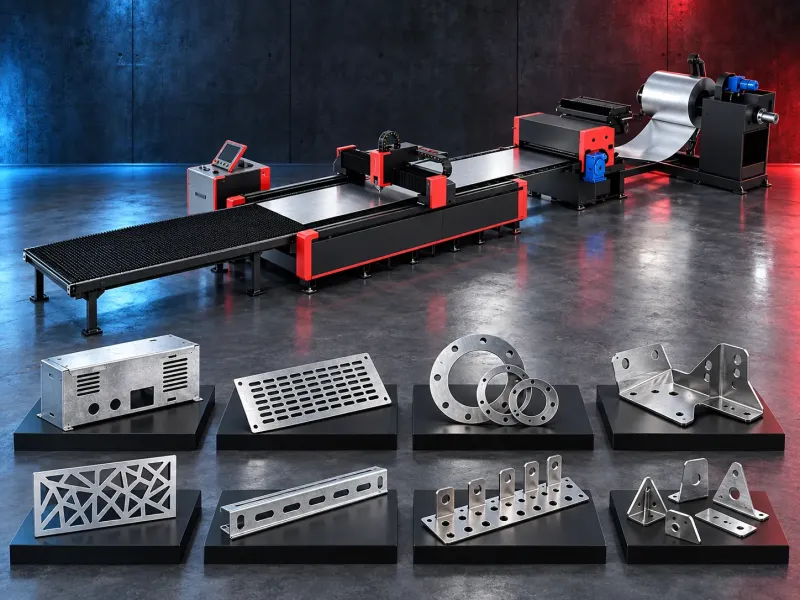
Integrated production workflow
The line receives coiled steel, unwinds it, corrects the strip through a leveling stage, advances the material by a controlled feeding system, and cuts programmed parts with the laser system. The actual sequence and degree of automation depend on the verified machine configuration.
Stable coordination between the decoiler, leveler, feeder, cutting bed, control, extraction, and part collection system is essential. Each section must be sized for the same coil range, strip condition, production pace, and safety strategy.
Suitable production applications
Potential applications include repeat sheet metal blanks, brackets, panels, covers, electrical components, ventilation parts, metal furniture components, appliance parts, lighting components, automotive support parts, and general fabricated products made from compatible coiled steel.
Application suitability depends on the material grade, surface condition, strip width, thickness, required flatness, part length, feature size, tolerance, edge condition, batch pattern, and downstream forming, welding, coating, or assembly.
Materials and coil condition
The described line is intended for suitable steel coil. Exact carbon steel, galvanized steel, coated steel, stainless steel, or other material capability must be confirmed from the approved documentation for the selected model and process package.
Coil inner diameter, outer diameter, width, weight, thickness, camber, edge condition, surface treatment, yield strength, and incoming flatness affect decoiling, leveling, feeding, cutting quality, and safe handling.
Why use coil fed laser cutting
For compatible repeat parts, feeding from a coil may reduce the need to handle separate sheets and may support continuous material flow. It may also reduce unused sheet remnants when the part layout and strip width are selected effectively.
Actual savings in material, labor, floor movement, setup time, and cost per part depend on coil purchasing, nesting, changeovers, scrap handling, uptime, consumables, staffing, and downstream operations. No production or cost result should be confirmed without application data and a verified trial.
Open style machine configuration
The described product uses an open style structure. The exact cutting area, access zones, guards, barriers, warning systems, interlocks, viewing arrangements, and laser safety classification must be confirmed for the exact machine.
An open structure does not remove the need for a documented risk assessment, controlled access, laser protection, extraction, fire precautions, emergency stops, trained operation, and compliance with applicable site requirements.
Cutting quality and process control
Finished part quality depends on the material, thickness, surface, leveling result, feed accuracy, support beneath the strip, laser source, cutting head, focus control, cutting gas, process data, thermal movement, and inspection method.
The acceptance plan should define part dimensions, hole and slot sizes, pitch between repeated parts, squareness, flatness, burr, dross, heat effect, edge condition, surface protection, traceability, and suitability for the next production step.
Automation and material flow
Depending on the verified configuration, the line may coordinate coil loading, powered decoiling, strip guidance, leveling, loop control, servo feeding, cutting, conveyor movement, part collection, and scrap handling.
Automation should be chosen from the actual coil weights, changeover frequency, part mix, batch sizes, shift pattern, operator availability, collection method, floor space, and required production traceability.
How to choose the correct line
Provide part drawings and CAD files with material grades, coil dimensions, coil weights, thickness range, surface condition, part dimensions, feature details, tolerances, edge requirements, quantities, batch sizes, shift pattern, and target output.
Selection should also consider decoiler capacity, leveling arrangement, feeder accuracy, supported strip width, usable cutting length, laser power, cutting gases, extraction, part discharge, scrap handling, controls, software, floor space, and future product range.
Technical information to verify
The approved exact model source must confirm the manufacturer, brand, model, laser source, laser power, supported materials, thickness range, coil width range, coil weight, coil inner and outer diameters, leveling capacity, feed range, usable cutting area, and supported part length.
It must also confirm positioning and feed accuracy, repeatability, cutting speed and test conditions, cutting head, control, software, nesting, extraction, cooling, gas requirements, electrical supply, compressed air, dimensions, weight, foundation, guarding, safety systems, and included automation.
Installation and utilities
Site planning should cover coil delivery and storage, lifting equipment, coil loading access, line footprint, material flow, finished part collection, scrap removal, foundation, electrical supply, grounding, cooling, cutting gases, compressed air, extraction, ventilation, and fire precautions.
The site must also provide safe operator routes, maintenance access, protected production zones, inspection space, network or software connections where required, and suitable environmental conditions for the laser and control equipment.
Sample trial and production approval
A representative trial should use the intended material grade, coating, coil thickness, strip width, surface condition, part geometry, smallest features, longest parts, tolerances, cutting gas, and downstream operations.
Approval should consider dimensional inspection, flatness, edge quality, feed pitch, repeatability across the coil, forming trials, welding trials, coating performance, assembly fit, cycle time, changeover, scrap handling, and operator tasks.
Service and lifecycle planning
The line combines several connected systems, so preventive maintenance should cover the decoiler, leveling rolls, strip guides, feeding mechanism, laser source, cutting head, optics, motion system, extraction, cooling, pneumatics, electrical controls, conveyors, and safety devices.
The exact supply scope, installation, commissioning, training, preventive maintenance, consumables, spare parts, warranty, and service commitments require confirmation in the approved technical and commercial offer.
Limitations and alternative processes
Coil fed laser cutting is not automatically suitable for every material, thickness, surface, tolerance, part geometry, production volume, or downstream process. Low volume work, frequent material changes, heavy plate, very short batches, or demanding flatness may favor another production route.
Sheet fed laser cutting, punching, press blanking, shearing, roll forming, plasma cutting, or a combined process may be more suitable for some products. The choice should be based on the complete production route and approved sample results.
Technical review and next step
Send the part drawings and coil data with material, thickness, width, coil weight, part sizes, features, tolerances, quantities, shift plan, downstream operations, and target output.
SAKKARY MACHINERY will review the application, material flow, site requirements, safety needs, sample trial, and information that still requires confirmation before recommending a line configuration.
Questions we are asked
What is a coil laser cutting machine?
It is a connected production line that feeds suitable metal strip from a coil through decoiling leveling and controlled feeding before programmed laser cutting.
What is the main difference from sheet fed laser cutting?
A coil fed line processes continuous strip instead of loading separate sheets. Its suitability depends on repeat part production coil condition part geometry and the complete material flow.
Which steel coils can the line process?
The exact material grades coatings widths thicknesses weights and coil diameters are model specific and must be confirmed from the approved documentation and sample trial.
Is the machine suitable for low laser power applications?
The supplied description refers to a lower power configuration for thin coil. The actual laser power material range thickness capacity and cutting result require verification for the exact model.
Does the line improve material utilization?
It may reduce sheet remnants for compatible repeat parts when strip width and nesting are selected effectively. The actual result must be calculated from real parts coil sizes scrap and changeovers.
What information is required for selection?
Provide part drawings material grades coil width thickness weight and diameters together with tolerances quantities shift plan downstream operations and target output.
Tell us the part you need to make
An engineer reads every request. Usually the same working day.
Related
- Fiber Laser Cutting Machines Industrial fiber laser solutions for cutting metal sheets with a configuration selected according to the material, thickness, part dimensions, required cut quality, and production target.
- Integrated Fiber Laser Processing Machine An integrated CNC solution designed to combine compatible sheet-metal operations such as fiber laser cutting, punching, forming, and marking. Actual functions depend on the selected model and configuration.
- Tube Fiber Laser Cutting Machine A fiber laser cutting solution for suitable tubes and metal profiles. Machine selection depends on the material, section type, dimensions, wall thickness, part geometry, cutting requirements, loading method, and production target.