

Precision Laser Spot Welding for Appearance-Critical Metal Parts
Platform Style Seamless Laser Spot Welding Machine
A platform-style laser spot welding machine with a stable work platform and flexible swing-arm welding head for precise joining of metal components. It is intended for applications where weld strength, controlled heat input and finished-part appearance are important.
The Platform Style Seamless Laser Spot Welding Machine is designed for precision welding of metal components that require controlled heat input and a clean finished appearance. Its platform structure supports stable workpiece positioning, while the swing-arm laser welding head provides flexible access to different welding positions. Under suitable material, joint and process conditions, the system can perform single-side laser welding while keeping the reverse surface with very limited visible marking. This can reduce the amount of grinding, polishing and other finishing operations required after welding. Typical application areas include precision hardware, sheet-metal assemblies, electronic and intelligent-terminal components, medical-device parts, battery connection components and selected automotive parts. Suitability must be confirmed according to the exact material, thickness, joint design and required weld result.
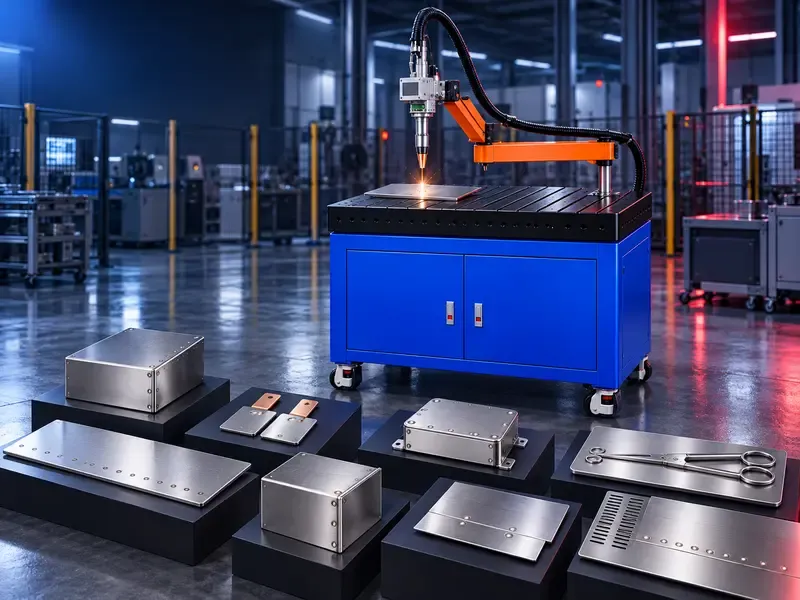
What Is a Platform Style Laser Spot Welding Machine?
This machine combines a fixed working platform with a movable swing-arm laser welding head. The arrangement is intended to give the operator a stable area for positioning components while allowing the welding head to be directed to the required joint location. It is used for localized laser spot welding and precision joining of suitable metal parts.
Key Product Characteristics
- Stable platform structure for controlled workpiece positioning.
- Flexible swing-arm laser welding head for access to different welding locations.
- Localized laser energy input for precision joining applications.
- Designed for products where the visible condition of the welded surfaces is important.
- Can support single-side welding with a nearly mark-free reverse surface when the material, joint design and process parameters are suitable.
- Applicable to a range of precision metal components and assemblies.
- Can help reduce post-weld grinding and polishing when the achieved weld finish meets the product requirement.
Welding Challenges This Machine Is Intended to Address
- Visible weld marks on appearance-sensitive products.
- Excessive finishing work after conventional welding.
- Localized deformation caused by unsuitable heat input.
- Difficulty accessing small or precision joint locations.
- Inconsistent appearance on precision metal assemblies.
- Applications that require joining from one side while limiting visible marking on the opposite surface.
Suitable Materials
The supplied product description lists applications involving the following metal materials. Actual weldability and process settings depend on alloy grade, thickness, joint geometry, surface condition and the selected laser configuration.
- Steel
- Stainless steel
- Copper
- Aluminum
- Galvanized materials
Typical Applications
- Mobile-phone components and housings
- Computer and electronic-device components
- Earbud and small electronic components
- Microelectronic and precision parts
- Intelligent-terminal product components
- Medical-device components
- Stainless-steel products
- Precision sheet-metal assemblies
- Precision hardware
- Battery connection components
- Selected automotive parts
- Other appearance-critical metal products suitable for laser spot welding
Industries
- Consumer electronics
- Precision hardware manufacturing
- Sheet-metal fabrication
- Medical-device manufacturing
- Battery and electrical-component production
- Automotive component manufacturing
- General precision metalworking
How the Welding Process Works
- Position and secure the workpiece on the platform or suitable fixture.
- Adjust the swing-arm welding head to the required joint location.
- Set the welding parameters according to the material, thickness and joint requirement.
- Apply localized laser energy to form the required weld spot or welding path.
- Inspect weld strength, surface appearance and the reverse side according to the product requirement.
- Optimize the process parameters and fixture when required before production use.
Why Reverse-Side Appearance Matters
For housings, covers, precision assemblies and visible metal products, the reverse side of a weld may also be part of the finished surface. Under suitable welding conditions, controlled laser input can limit visible reverse-side marking. The achievable result depends on material, thickness, fit-up, joint design, focus, laser parameters and fixturing, so sample testing is recommended before defining the production process.
How to Select the Correct Configuration
- Identify the part and production application.
- Confirm the material and exact alloy or grade.
- Provide material thickness and joint geometry.
- Define the required weld type, spot size or welding path.
- Specify the required front-side and reverse-side appearance.
- Confirm production quantity and expected cycle requirements.
- Confirm workpiece dimensions and required working reach.
- Confirm whether dedicated fixtures are required.
- Confirm the required laser source, welding head, cooling system and electrical supply from the selected configuration.
- Perform sample welding when appearance or weld qualification is critical.
Information Required for a Quotation
- Workpiece photos or drawings
- Material type and grade
- Material thickness
- Joint type and weld location
- Part dimensions
- Required weld appearance
- Required production quantity or cycle target
- Photos of current welding results, if replacing an existing process
- Available electrical supply
- Any required fixture, automation or special process requirements
Technical Data to Confirm for the Exact Machine
The following items should be completed from the official datasheet of the selected machine configuration before publishing a technical specification table:
- Laser source type and rated power
- Laser wavelength
- Welding head configuration
- Working reach / platform dimensions
- Applicable thickness range by material and joint
- Cooling system
- Electrical supply
- Control system and interface
- Pulse / welding parameter ranges where applicable
- Machine dimensions and weight
- Fixture options
- Safety enclosure or protection configuration
- Included accessories and optional equipment
Recommended Page CTA
Request a Welding Test or Quotation
Send the workpiece material, thickness, joint drawing or photos, required appearance and production quantity. SAKKARY MACHINERY can use this information to identify a suitable machine configuration and sample-welding requirement.
Questions we are asked
What is a platform style seamless laser spot welding machine?
It is a laser welding system that combines a stable work platform with a flexible welding head for localized precision welding of suitable metal components, particularly where finished appearance is important.
Can the machine weld from one side with little marking on the reverse side?
Under suitable material, thickness, joint and parameter conditions, the process can achieve a nearly mark-free reverse surface. The result is application-dependent and should be verified by sample welding.
Which materials can be welded?
The supplied product description lists steel, stainless steel, copper, aluminum and galvanized materials. Exact compatibility depends on alloy, thickness, joint design and the selected laser configuration.
What products are suitable for this machine?
Typical examples include precision hardware, electronic components, stainless-steel products, sheet-metal assemblies, medical-device parts, battery connection components and selected automotive parts.
Can it reduce grinding and polishing after welding?
It can reduce finishing work when the laser process produces the required surface appearance, but the result depends on the part, material, joint design and welding parameters.
Is the machine suitable for appearance-critical products?
Yes, this is one of its intended application areas. For critical cosmetic requirements, sample welding should be used to confirm the achievable result.
What information should I send for a quotation?
Send the material, thickness, part dimensions, joint details, photos or drawings, required appearance, production quantity and available electrical supply.
What laser power should I choose?
Laser power should not be selected from the product name alone. It should be matched to the material, thickness, joint, required penetration, cycle time and the exact machine configuration.
Tell us the part you need to make
An engineer reads every request. Usually the same working day.
Related
- Robotic Welding Solutions Flexible robotic welding solutions configured around the workpiece, welding process, production volume, and handling requirements. Available concepts include collaborative robots, positioners, industrial workstations, and gantry-based systems.
- Handheld Fiber Laser Welding Machine Handheld fiber laser welding solution for joining metal sheets, tubes and fabricated components with a concentrated laser beam and controlled heat input.
- Automated Continuous Fiber Laser Welding Machine Automated continuous fiber laser welding solution for repeatable welding of metal components, with configurable process parameters and an optional wobble welding head for wider process control.