

Automated Welding Systems with Positioning & Rail Options
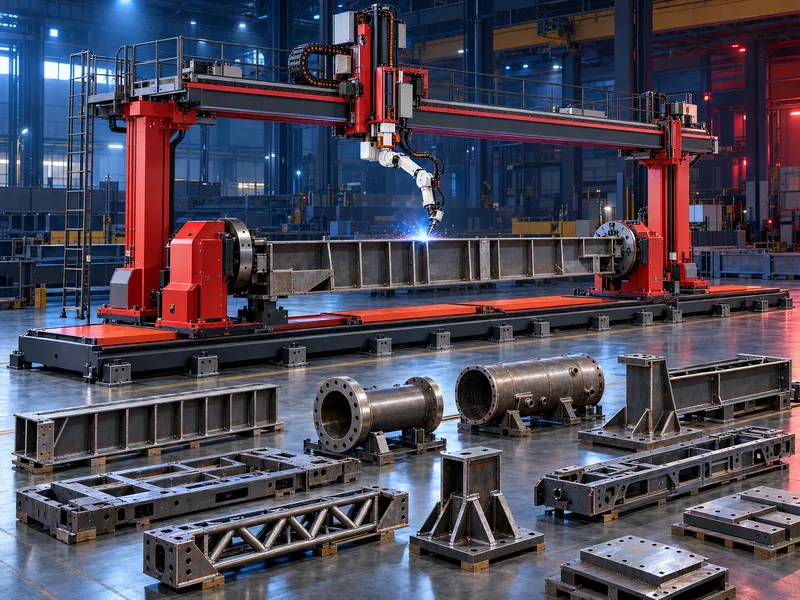
Intelligent Welding Robot with Positioner, Ground Rail, Cantilever & Gantry Mechanism
: Configurable robotic welding system for automated welding of complex and large metal structures, with fixed, ground-rail, cantilever and gantry arrangements plus multiple positioner options for workpiece rotation and positioning.
The system is intended for automatic and efficient welding of metal structural parts, particularly large workpieces and repeat-production applications where coordinated robot and workpiece motion can improve access to weld joints. Configurations can include fixed robot mounting, ground rail, cantilever or gantry structures together with single-axis or multi-axis positioners. Programming can use conventional teaching, while compatible configurations may also use a teaching-free workflow based on imported 3D models. Available welding-process configurations may include MIG/MAG, TIG or laser welding, depending on the selected robot, welding source, sensors and application requirements.
System Functions
- Automatic robotic welding
- Path and speed planning
- Swing welding
- Dynamic welding-parameter modification
- Post-weld wire drawing function
- Teaching programming
- Optional teaching-free programming from imported 3D models
- Integration options for arc tracking, laser tracking, laser positioning and 3D visual weld recognition
Available Mechanical Configurations
- Fixed robot system
- Ground rail system
- Cantilever mechanism
- Gantry mechanism
- Single-axis rotation positioner
- Single-axis rotation head & tail positioner
- Three-axis rotation positioner
Technical Specifications for Positioners
The provided data covers load capacities of 300, 500, and 1000 kg. It specifies a positioning accuracy of ±0.03° and a repeatability of 0.02°, with variations in worktable diameters, rotation speeds, motor capacities, and workpiece lengths depending on the positioner type and size. The English tables above retain the technical values exactly as stated in the source to avoid altering figures or associating them with unverified equipment configurations.Questions we are asked
What positioner capacities are listed?
The supplied data lists 300 kg, 500 kg and 1000 kg load options.
What positioning accuracy is stated?
The supplied data states ±0.03° positioning accuracy and 0.02° repeated positioning accuracy for the listed positioner variants.
Which robot structures are available?
The source describes fixed, ground-rail, cantilever and gantry configurations, with different positioner arrangements.
Which welding processes can be configured?
Depending on the workpiece and process requirements, the source lists MIG/MAG, TIG and laser welding.
Can the system use 3D-model-based programming?
The source states that compatible systems can be equipped with a teaching-free system that generates welding programs from imported 3D models.
Tell us the part you need to make
An engineer reads every request. Usually the same working day.
Related
- Robotic Welding Solutions Flexible robotic welding solutions configured around the workpiece, welding process, production volume, and handling requirements. Available concepts include collaborative robots, positioners, industrial workstations, and gantry-based systems.
- Handheld Fiber Laser Welding Machine Handheld fiber laser welding solution for joining metal sheets, tubes and fabricated components with a concentrated laser beam and controlled heat input.
- Automated Continuous Fiber Laser Welding Machine Automated continuous fiber laser welding solution for repeatable welding of metal components, with configurable process parameters and an optional wobble welding head for wider process control.