

Flexible Robotic Welding Automation
Collaborative Intelligent Welding Robot for Metal Structural Parts
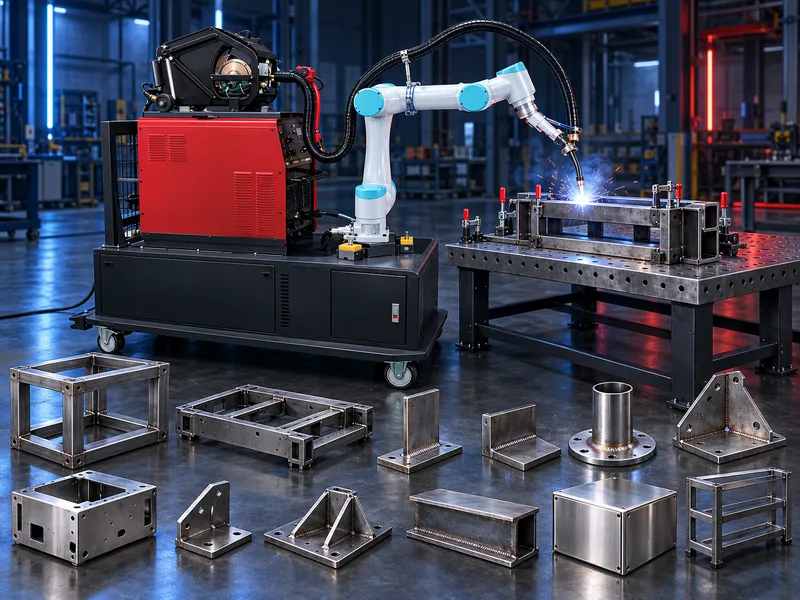
Flexible collaborative welding robot for automatic welding of metal structural parts, especially small-batch, non-standard and mixed-specification workpieces. It supports teaching and manual drag programming, flexible mounting and multiple welding processes according to the selected configuration.
The collaborative intelligent welding robot is designed for automatic, efficient and flexible welding of metal structural parts. It is particularly suited to small batches, customized non-standard components and production where workpiece specifications and varieties change frequently.
Programming can be completed by conventional teaching or manual drag programming, helping simplify program creation for changing jobs. When access is restricted, the robot posture can be adjusted to suit the available welding space.
The robot can be mounted upright, sideways or inverted. According to the supplied configuration, a magnetic base can be used to fix the robot to suitable metal structural parts or other compatible equipment. After the welding program is generated, the robot can execute the programmed weld automatically.
Supported welding processes can include MIG/MAG, TIG or laser welding, depending on the configured welding package and application requirements.
Suitable Applications
- Small-batch metal structural parts
- Non-standard customized metal components
- Mixed specifications and high-variety production
- Metal frames and fabricated structures
- Jobs where welding access or robot positioning needs to remain flexible
Programming & Operation
- Teaching programming
- Manual drag programming
- Automatic execution after the welding program is generated
- Flexible robot posture for restricted welding spaces
- Upright, sideways or inverted installation
- Magnetic-base mounting where the workpiece and configuration are suitable
Welding Forms
- Horizontal fillet welding
- Vertical fillet welding
- Flat welding
- Vertical welding
- Horizontal welding
- Overhead welding
- Linear welding
- Circular welding
- Envelope welding
- Continuous welding
- Intermittent welding
- Multi-layer and multi-pass welding when application conditions are suitable
Welding Processes
- MIG/MAG welding
- TIG welding
- Laser welding
- Final process availability depends on the configured welding source, torch/head, controls and application requirements.
How to Select the Correct Configuration
- Workpiece material and thickness
- Part dimensions and weight
- Joint type and weld position
- Required welding process: MIG/MAG, TIG or laser
- Batch size and product variety
- Available working space and mounting orientation
- Required weld path and whether multi-layer/multi-pass welding is needed
- Welding source and peripheral equipment to be integrated
Questions we are asked
What is a collaborative intelligent welding robot?
It is a flexible robotic welding system designed to automate welding of metal structural parts while supporting easier programming and adaptable positioning for changing production requirements.
Is it suitable for small batches and customized parts?
Yes. The supplied description specifically positions it for small batches, non-standard customized parts and metal structures with diverse specifications.
How is the robot programmed?
The supplied configuration supports teaching programming and manual drag programming to generate the welding program.
Can the robot be installed in different orientations?
Yes. The supplied description states that it can be installed upright, sideways or inverted. Magnetic-base mounting is also described, subject to a suitable surface and the actual machine configuration.
Which welding positions can it perform?
The supplied description includes fillet, flat, vertical, horizontal and overhead welding, as well as linear, circular, envelope, continuous and intermittent welding.
Can it perform multi-layer and multi-pass welding?
Yes, when the application conditions and configured welding process are suitable.
Which welding processes can be used?
The supplied description lists MIG/MAG, TIG and laser welding. The actual process must be confirmed for the selected robot and welding package.
What information is required before selecting the system?
Provide the workpiece material, thickness, dimensions, joint type, weld position, welding process, batch size, product variety and available working space.
Tell us the part you need to make
An engineer reads every request. Usually the same working day.
Related
- Robotic Welding Solutions Flexible robotic welding solutions configured around the workpiece, welding process, production volume, and handling requirements. Available concepts include collaborative robots, positioners, industrial workstations, and gantry-based systems.
- Handheld Fiber Laser Welding Machine Handheld fiber laser welding solution for joining metal sheets, tubes and fabricated components with a concentrated laser beam and controlled heat input.
- Automated Continuous Fiber Laser Welding Machine Automated continuous fiber laser welding solution for repeatable welding of metal components, with configurable process parameters and an optional wobble welding head for wider process control.