

3D Fiber Laser Marking Machine
3D Laser Marking & Deep Engraving
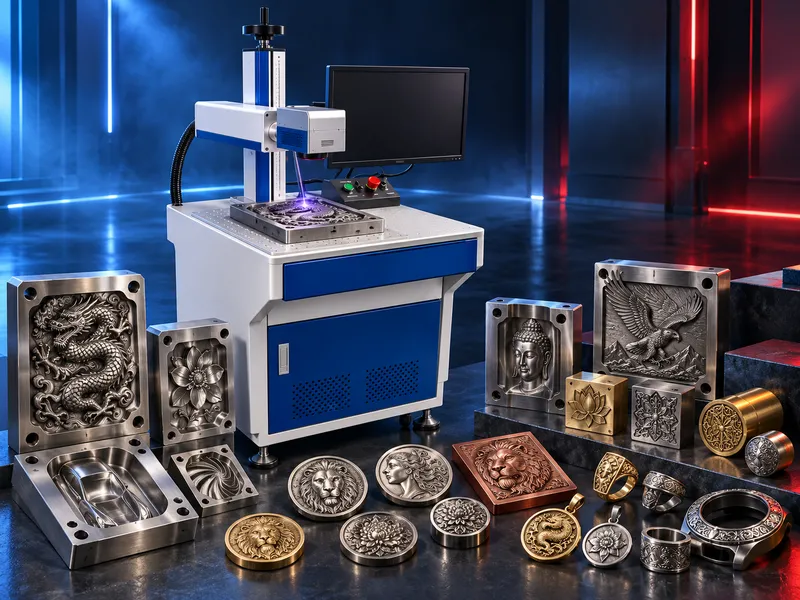
3D fiber laser marking and engraving solution for flat, inclined and curved metal surfaces, designed to maintain focus across changing surface heights for detailed marking and deep engraving applications.
SAKKARY MACHINERY offers 3D fiber laser marking and engraving solutions for metal parts that cannot be handled efficiently by conventional flat-field 2D marking alone. The system uses a high-speed, high-precision 3D galvo scanning architecture with dedicated 3D control software to adjust the laser focus across changing surface heights and geometries during processing. This makes the machine suitable for marking and engraving on inclined planes, stepped surfaces, cylindrical parts, conical surfaces, spherical surfaces, recessed areas and other three-dimensional metal features, subject to the actual workpiece geometry and selected machine configuration. For deep engraving, curved-surface marking or parts with significant height variation, the required laser source, power, field size, depth and cycle time should be selected from the actual application and sample part.
What it is for
- 3D marking on curved and contoured metal surfaces
- Deep engraving on suitable metals
- Marking on inclined and stepped surfaces
- Cylindrical and conical component marking
- Marking on spherical and extruded surfaces
- Logos, serial numbers, codes and traceability marks on complex parts
- Detailed engraving on moulds, dies, tooling and industrial components
- Applications where surface height changes across the marking area
Key Functions
- 3D galvo scanning for variable-height surfaces
- Dynamic focus adjustment across three-dimensional geometry
- Dedicated 3D marking and engraving control software
- Processing of flat and non-flat surfaces within the verified working range
- Fiber laser technology for compatible metal applications
- Support for detailed surface processing and deep engraving when configured for the required depth
Typical Surface Geometries
- Flat surfaces
- Inclined planes
- Stepped or segmented surfaces
- Cylindrical surfaces
- Conical surfaces
- Spherical surfaces
- Raised, recessed and contoured surfaces
How to choose
- Start with the workpiece geometry Provide the maximum part dimensions, surface shape and total height variation. These determine whether a 3D marking system is required and the working range needed.
- Define marking or deep engraving Surface marking and deep engraving have different power, depth and cycle-time requirements. State the required result and, where possible, provide a sample or drawing.
- Confirm the material Fiber laser suitability depends on the exact metal or compatible material and the required visual or engraved result.
- Select the working field The marking field must cover the required area while maintaining the detail and process requirements of the application.
- Evaluate production method
Define whether the machine will be used for individual parts, batch production or integration with fixtures, rotary devices or an automated production process.
Information required for machine selection
- Material
- Part drawing or sample
- Maximum workpiece dimensions
- Surface geometry and height variation
- Marking area
- Required engraving depth, if applicable
- Required text, logo, code or artwork
- Production quantity or cycle-time target
- Standalone, fixture-based or automated operation
Questions we are asked
What is a 3D fiber laser marking machine?
It is a fiber laser marking system designed to adjust focus across surfaces with changing heights or three-dimensional geometry, allowing marking or engraving beyond a conventional flat marking plane.
How is 3D laser marking different from conventional 2D laser marking?
Conventional 2D marking is primarily designed around a flat focal plane. A 3D system can dynamically adjust focus across supported height variations and curved or inclined surfaces within its verified working range.
Can it engrave curved metal surfaces?
Yes, the supplied product description supports processing of curved and non-flat surfaces such as cylinders, cones, spherical surfaces and inclined planes. The exact geometry and working range must be confirmed for the selected machine.
Can it perform deep engraving?
The machine is intended for marking and deep engraving applications. Achievable depth and processing time depend on the material, laser source, power, field size and required result.
What parts are suitable for 3D laser marking?
Typical candidates include parts with curved, inclined, stepped, recessed or raised surfaces, as well as industrial components where the marking area is not located on one flat plane.
What information is needed before selecting the machine?
Send the material, part dimensions, surface geometry, marking area, required engraving depth, artwork or code, and expected production output.
Tell us the part you need to make
An engineer reads every request. Usually the same working day.
Related
- Industrial Marking Solutions Laser and industrial marking solutions selected according to the material, mark content, contrast, permanence, production speed, and integration requirements.
- CO2 Laser Engraving and Cutting Machine A CO2 laser engraving and cutting machine processes compatible nonmetal materials by directing a controlled laser beam over the workpiece. Correct selection depends on whether the task is engraving or cutting material composition and thickness required edge and mark quality work area laser power extraction cooling software and production volume.
- Gantry Type Large Format UV Laser Marking Machine A gantry type UV laser marking machine combines an ultraviolet laser source with programmable large area motion for fine marking engraving or other verified microprocessing tasks. Correct selection depends on material response workpiece size mark content field stitching quality laser power and wavelength focus motion accuracy extraction cooling software safety and production volume.