

Ultra-Fine 3D UV Laser Marking
3D UV Laser Marking Machine for Curved & Precision Surfaces
3D UV laser marking solution for ultra-fine marking on flat, curved and variable-height surfaces, suitable for glass, PCB/FPC, ceramics, plastics, silicone, acrylic and selected metal applications.
The 3D UV Laser Marking Machine combines UV laser processing with three-axis dynamic focusing to mark flat, curved and variable-height workpieces with controlled focus across the marking surface. Its small focused spot and limited heat-affected zone make UV technology suitable for fine marking and applications involving materials that can be sensitive to thermal processing. Typical materials stated for this machine include glass, PCB/FPC, ceramics, plastics, silicone, acrylic and selected metal products. The system can create logos, text, QR codes, patterns, serial numbers and other identification marks. The supplied source lists 3W, 5W and 10W UV laser options; the correct power should be selected according to the material, geometry, required mark and production target.
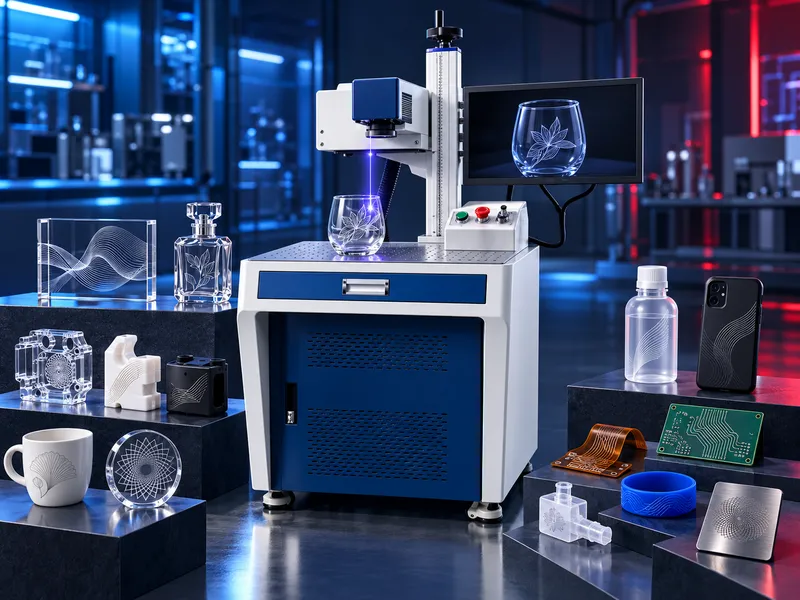
What it is for
- Ultra-fine product marking and identification
- Marking on curved and variable-height surfaces
- Logos, trademarks and text
- QR codes and traceability marks
- Serial numbers and symbols
- Patterns and decorative graphics
- Glass marking and engraving applications
- PCB and FPC marking
- Ceramic marking
- Plastic and silicone marking
- Acrylic marking
- Selected metal marking applications
Suitable materials mentioned in the source
- Glass
- PCB / FPC circuit boards
- Ceramics
- Plastics
- Silicone
- Acrylic
- Selected metal products
Key functions
- 3D dynamic focusing for non-flat surfaces
- High-speed 3D galvo scanning architecture
- Real-time focus adjustment across changing surface height
- Fine UV laser processing with a small focused spot
- Import and processing of compatible graphics from mainstream 3D design workflows, subject to software configuration
- Marking of text, codes, logos, patterns and serial identification
- Available source options stated as 3W / 5W / 10W, subject to exact machine configuration
Typical surface geometries
- Flat surfaces
- Curved surfaces
- Cylindrical or rounded components where geometry is within system capability
- Variable-height surfaces
- Complex 3D contours within the configured focusing range
How to choose
- Start with the material Confirm the exact material, coating and surface condition. UV laser suitability and marking response vary by material and finish.
- Define the surface geometry Specify whether the part is flat, curved, cylindrical or has significant height variation. This determines whether 3D dynamic focusing is required.
- Define the required markb Provide the logo, text, QR code, serial number, pattern or artwork and describe the required contrast, clarity and permanence.
- Select power for the real application The source lists 3W, 5W and 10W options. Selection should be based on sample testing, material response, required cycle time and mark quality rather than power alone.
- Confirm marking field and height range The required part dimensions, marking area and surface height variation should be checked against the exact optical configuration.
- Decide how the machine will be used
Bench, enclosed, portable or online production-line configurations have different requirements for handling, safety enclosure, extraction and automation.
Information required for machine selection
- Material and surface finish
- Workpiece dimensions
- Flat or 3D/curved geometry
- Maximum height variation across the marking area
- Required marking area
- Mark content: logo, text, code, pattern or serial number
- Required appearance and permanence
- Target production volume / cycle time
- Standalone or production-line operation
- Sample part or material for application testing where possible
Questions we are asked
What is a 3D UV laser marking machine?
It is a UV laser marking system with dynamic three-axis focusing designed to maintain focus across non-flat, curved or variable-height surfaces within the configured working range.
How is 3D UV marking different from conventional 2D marking?
A conventional 2D marker is optimized around a fixed focal plane. A 3D system dynamically adjusts focus to follow surface-height changes, making it more suitable for curved and three-dimensional parts.
What materials can it mark?
The supplied product information lists glass, PCB/FPC, ceramics, plastics, silicone, acrylic and selected metal products. Final compatibility should be confirmed by the exact material and required marking result.
Can it mark curved glass?
Yes. Curved glass marking is specifically described as an application of the 3D UV system. The exact curvature, marking area and required result should be confirmed for the application.
What can the machine mark?
Typical content includes logos, trademarks, text, QR codes, patterns, serial numbers and symbols.
What laser powers are available?
The supplied source lists 3W, 5W and 10W UV laser options. Availability and suitability should be confirmed for the selected machine configuration.
Can it be integrated into an automatic production line?
UV laser marking systems can be configured for online production use when the selected machine includes the required automation and integration features. The exact configuration should be confirmed.
Why use UV laser for fine marking?
The source describes a small focused spot and a small heat-affected zone, making UV processing suitable for fine marking and sensitive-material applications where controlled thermal impact is important.
Tell us the part you need to make
An engineer reads every request. Usually the same working day.
Related
- Industrial Marking Solutions Laser and industrial marking solutions selected according to the material, mark content, contrast, permanence, production speed, and integration requirements.
- CO2 Laser Engraving and Cutting Machine A CO2 laser engraving and cutting machine processes compatible nonmetal materials by directing a controlled laser beam over the workpiece. Correct selection depends on whether the task is engraving or cutting material composition and thickness required edge and mark quality work area laser power extraction cooling software and production volume.
- Gantry Type Large Format UV Laser Marking Machine A gantry type UV laser marking machine combines an ultraviolet laser source with programmable large area motion for fine marking engraving or other verified microprocessing tasks. Correct selection depends on material response workpiece size mark content field stitching quality laser power and wavelength focus motion accuracy extraction cooling software safety and production volume.