What Determines Machine Operator Training Cost? Scope and Cost Factors
8 min read
The cost of machine-operator training cannot be determined responsibly from the number of trainees or trainer days alone. Two programs with the same duration may involve very different machines, operator roles, practical exercises, production disruption, assessment methods and deliverables. A low headline price may exclude important resources; a higher price does not by itself prove better value.
The first step in budgeting is therefore to define what competence the factory needs and what evidence will confirm it. Once the scope is clear, cost items can be identified, responsibilities allocated and proposals compared on the same basis. This article explains the cost structure; it does not provide fixed prices because the required technical and commercial inputs vary by case.
Cost starts with the required outcome
“Train our operators” is not a sufficient scope. State what the relevant people should be able to do after the program, on which machine or process, under what level of supervision, and within what limits of authority.
Possible outcomes can differ substantially:
- General orientation to the machine, controls, hazards and documentation.
- Basic operation for an approved, stable production task.
- Setup or changeover within a defined product and tooling scope.
- Inspection, measurement and production-record requirements.
- Permitted daily care and escalation to maintenance.
- Shift handover and response to abnormalities within operator authority.
- Support for a new machine handover, production ramp-up or changed process.
- Development of selected internal coaches or assessors.
Each outcome requires different preparation, practical access, evidence and trainer capability. Do not add programming, maintenance, advanced setup or troubleshooting by implication. If those subjects are needed, define them explicitly and verify that the proposed trainer, machine documentation and workplace controls support them.
1. Needs analysis and scope design
The provider may need to review the machine, controller, application, current work instructions, operator roles, shift pattern, recurring issues and target result before designing the program. This discovery work is part of the cost even when it is not shown as a separate line.
A stronger needs analysis distinguishes among:
- A knowledge gap: the person does not understand a required concept.
- A practical skill gap: the person understands but cannot yet perform consistently.
- A documentation gap: the approved method is missing or unclear.
- An equipment or tooling problem: the task cannot be performed reliably in the current condition.
- A management or planning issue: time, supervision or authority is not available.
Only the first two are primarily solved by training. Correct diagnosis protects the budget from paying for a course that cannot fix the real problem.
2. Machine, controller and application complexity
Training for one clearly defined machine and stable application is different from training across multiple models, controllers, processes or product families. Preparation effort may increase when interfaces, software versions, tooling systems, materials, measurement methods or job documentation differ.
Complexity should not be guessed from the machine category alone. Confirm the exact manufacturer and model, control, options, current condition and approved manuals. Also define the production application: material, part type, drawing requirements, tooling, quality checks and the operator's responsibilities. Claims about suitable content should remain Needs Verification until the applicable technical documents and site conditions are reviewed.
The training scope must also respect boundaries. Machine-specific setup, protected parameters, safety functions and fault response should come from the manufacturer documentation and approved factory procedure. A generic course should not substitute for model-specific evidence where that evidence is required.
3. Number, role and baseline of trainees
Headcount affects cost, but group composition often matters more. A group of operators with similar experience and responsibilities can follow a focused path. A mixed group of new operators, experienced setters, supervisors and maintenance staff may require separate objectives, sessions or assessments.
Before requesting a quote, identify:
- How many people require training and on which shifts.
- Their current roles and permitted responsibilities.
- Previous experience with the machine, controller and application.
- Language and literacy needs relevant to the material and records.
- Whether any participant needs supervised practice before joining the main task.
- Who will assess, authorise and follow up after the course.
Large groups can reduce individual machine time. If practical competence is required, ask how many participants can practise and be assessed without creating queues or superficial observation. The appropriate ratio depends on the task, machine access and safety controls; it should be justified rather than assumed.
4. Practical exercises, material and tooling
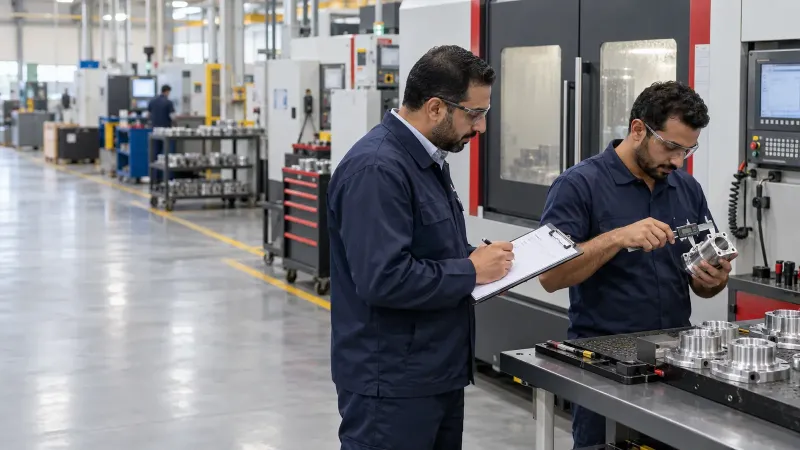
Practical work can require production material, blanks, tooling, consumables, measuring devices, approved programs, drawings, sample parts and safe disposal of scrap. The factory and provider should agree who supplies each item, in what quantity and to what specification.
The exercise should reflect the target competence without exposing people or equipment to uncontrolled risk. A demonstration is not the same as individual practice, and individual practice is not the same as a formal assessment. If every trainee must perform a task, allow for the resulting machine time, material and observation effort.
Avoid estimating consumables from an unrelated machine or product. Material type, dimensions, tooling and settings must be verified for the actual application. Any trial work should follow approved procedures and must not be used to improvise settings outside the available technical evidence.
5. Machine readiness and production downtime
Training time may compete with production time. A machine that is expected to produce cannot simultaneously provide unlimited practice. The budget should recognise the value of planned downtime, delayed production, setup changes and the time needed to restore the approved production condition.
Before the training date, confirm:
- The machine is installed, commissioned where applicable and safe for the planned scope.
- Approved manuals, work instructions and relevant drawings are available.
- Tooling, material and measuring equipment are ready.
- Utilities and workplace conditions meet the applicable requirements.
- Existing faults or maintenance work will not prevent practice.
- The production plan provides a realistic training window.
- A responsible site representative can coordinate access and authorisations.
Poor readiness creates hidden cost. The trainer may wait, the group may receive theory without practice, or a second visit may become necessary. A pre-training readiness check is therefore a cost-control tool, not administrative decoration.
6. Assessment and authorisation evidence
If the program promises competence, the proposal should explain how competence will be tested. Assessment may involve knowledge questions, observation of practical tasks, measurement records, fault-recognition scenarios within safe limits, or an approved production sample. The method must match the task.
Assessment adds time because each participant may need an individual opportunity, an assessor and a record. The budget may also need to cover reassessment for people who do not yet meet the standard. Clarify whether the quoted price includes one assessment, a defined reassessment, or only a completion certificate.
Separate these terms:
- Attendance: the person was present.
- Course completion: the person completed the planned learning activities.
- Competence evidence: the person demonstrated a defined task to an agreed standard.
- Authorisation: the employer permits the person to perform the task within a defined scope.
A training provider may supply evidence, but the factory should define its own authorisation responsibility and any legal or internal requirements.
Visible price versus total training cost
The provider's fee is only one component. A total-cost view may include needs analysis, trainer preparation, delivery, travel, translation, materials, consumables, machine time, lost or deferred production, internal supervision, assessment, documentation, follow-up and any repeat visit caused by missing readiness.
This does not mean the lowest-priced proposal is poor or the most expensive is best. It means the comparison must use the same scope and exclusions. An apparently expensive offer may include practical assessment and follow-up that another excludes. An apparently low-cost offer may be entirely suitable for a narrow orientation scope. Value depends on fit and evidence.
Information needed for a credible estimate
Prepare a short training brief before requesting a price:
- Factory location and preferred delivery format.
- Machine manufacturer, exact model, control and relevant options.
- Current installation and operating status.
- Application, material, product and applicable quality requirements.
- Required operator tasks and boundaries of authority.
- Number of trainees, roles, shifts and current experience.
- Available manuals, work instructions, programs, tooling and measuring equipment.
- Practical exercise and assessment requirements.
- Required languages and deliverables.
- Target timing, production constraints and available machine window.
- Follow-up expectations and the person responsible inside the factory.
If a key item is unknown, mark it Needs Verification. A range or provisional scope may be appropriate until a technical review or site readiness check is completed. Do not force a fixed quotation from incomplete data and then expect the scope to remain unchanged.
Frequently asked questions
Can training cost be estimated from the number of operators?
Headcount is one input, but it is not enough. The machine, controller, role, baseline, practical scope, shift coverage, assessment and deliverables can change the cost materially.
Why can two programs with the same duration have different prices?
One may include customised preparation, machine-specific technical input, individual practice, consumables, assessment, documentation and follow-up, while the other provides general orientation. Compare scope and exclusions before price.
Does on-site training always cost more?
Not necessarily. It may add travel and coordination, but it can avoid transporting people and allows work on the actual application. It may also create production downtime. Calculate total impact for the specific case.
Should machine downtime be included in the training budget?
Yes, when training uses production equipment. Even if downtime is not invoiced by the provider, it is a real planning cost. Confirm the training window and expected setup or restoration work.
Is post-training support necessary?
It depends on the outcome, operator baseline and production stage. New-machine ramp-up or a changed process may justify follow-up. A narrow awareness session may not. Define the need and limits rather than buying an undefined support promise.
Can a provider guarantee production improvement after training?
Training can address verified knowledge and skill gaps, but production results depend on many other factors. Treat guaranteed productivity, uptime, scrap reduction or ROI claims as unsupported unless a defined measurement method, baseline, responsibilities and evidence are agreed.
Request a scoped training estimate
SAKKARY MACHINERY can review the required operator roles, machine and control, application, trainee baseline, practical evidence and site readiness before confirming an appropriate training scope. The final content, schedule and commercial offer remain subject to technical review and verified information.
Need a machine, tooling or a service visit?
Request a price