Industrial Machine Operator Training Guide: From Needs Assessment to Competency Approval
5 min read
Short answer
Machine-operator training is not complete when a presentation ends or an attendance sheet is signed. It is complete when each trainee can perform the tasks permitted for the role safely, set up and run a representative job, inspect the result, respond correctly to abnormal conditions, and know when to stop and escalate.
Treat training as a production qualification process. It starts before the trainer or machine arrives with a needs assessment, and it continues after startup through performance review and targeted retraining.
1. Start with the work the operator must perform
Do not build the curriculum from a generic topic list. Start with the product, process and role. Define what the factory will make, the routine materials and operations, the shift pattern, and who owns operation, programming, quality and maintenance. An operator who calls an approved program needs different authority from a programmer who changes toolpaths or a technician who enters protected service functions.
Needs-assessment inputs
- Machine type, model, control and available software version.
- Representative products or job families.
- Each trainee's current experience with drawings, measurement and tooling.
- Permitted tasks and tasks requiring supervision or separate authorization.
- Current errors, downtime causes or quality gaps the training should address.
- Training language, controlled references, site conditions and shift coverage.
If these inputs are incomplete, label the scope provisional and state what must be verified before duration or outcomes are confirmed.
2. Convert the need into testable learning outcomes
A useful outcome describes an observable action. Replace “understands operation” with statements such as “completes the approved pre-start check,” “fixtures the workpiece according to the work instruction,” or “produces a trial part and checks the defined characteristics with the correct measuring instrument.”
Depending on the machine and role, the curriculum may cover hazards and limits, pre-start inspection, startup and shutdown, workholding and tooling, selection of an approved program or recipe, dry run or trial operation, first-piece inspection, production monitoring, daily care, alarm recording and shift handover.
3. Separate learning paths by role
Placing operators, programmers, maintenance technicians and inspectors in one undifferentiated session usually creates broad content that fits nobody. Share the safety and process overview, then split the practical modules.
- Operator: permitted operation, repeat setups, monitoring, measurement, daily care and escalation.
- Programmer or process engineer: program creation, simulation, revision control, validation and approval points.
- Maintenance: planned checks, authorized diagnosis, safe isolation and fault history.
- Quality: acceptance characteristics, measurement methods, sampling, nonconformity and traceability.
- Supervisor: authorization, record review, performance follow-up and retraining decisions.
4. Prepare the training environment
Practical training fails when the machine, material, tools, drawings or gauges are unavailable. Confirm utilities, machine condition, guarding, site rules, controlled manuals, the training job, material, tooling, measuring equipment, trainee names and machine availability before the session.
Use a job that represents real production but is appropriate for learning. A demonstration piece that avoids normal setup and inspection work will not prepare the operator. A high-risk or high-cost job should not be the first task before basic competence is established.
5. Deliver training in four stages
Directed explanation
The trainer explains the purpose, hazards, sequence and pass criteria using the machine manual and site instructions. Prohibited changes and protected functions are made explicit.
Demonstration
The trainer performs the task at a learnable pace and explains decision points, warning signs and stop conditions. Showing the result without the reasoning is not enough.
Supervised practice
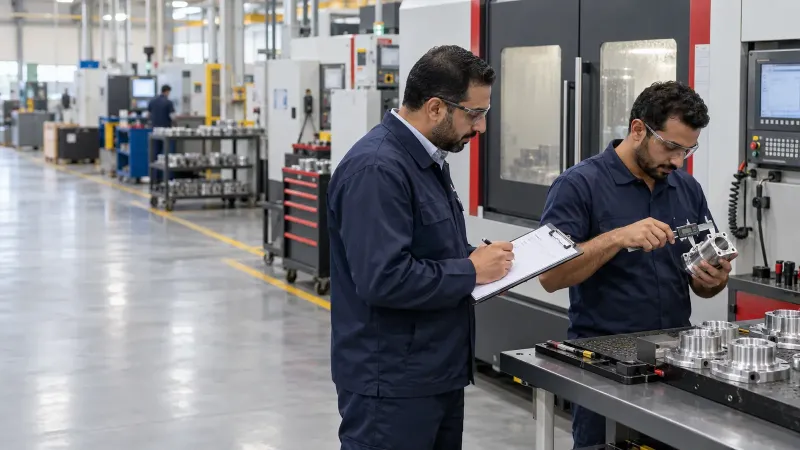
Every trainee performs the task. The trainer observes, intervenes to prevent danger or a material error, and records gaps for coaching.
Assessed independent performance
The trainee repeats the task without prompting, using only approved references and tools. The assessor scores evidence against defined criteria, not a general impression.
6. Test competence, not attendance
The practical assessment should cover preparation, safe behavior, setup, operation, measurement, response to an abnormal condition, shutdown and records. Outcomes can be competent, competent with restrictions, or further training required. Authorization never extends beyond the defined role.
Minimum authorization record
- Trainee, role and machine or equipment scope.
- Tasks assessed and assessment date.
- Pass criteria, result and observations.
- Restrictions and tasks that still require supervision.
- Assessor and review or reassessment date.
7. Connect training to real production
After startup, review results over a period appropriate to the process. Look at setup errors, first-piece rejection, scrap, requests for help, recurring alarms, completion of checks and shift handovers. Do not assume every problem is a training failure; tooling, material, programming, maintenance or planning may be responsible.
When a gap appears, use short targeted coaching on the observed task instead of repeating the entire program. Update work instructions and the skills matrix whenever the product, program, tooling or role changes.
Common mistakes
- Setting a fixed duration before assessing the people and application.
- Combining operation, programming and maintenance in one authorization.
- Using theory without individual practical performance.
- Training on a job that does not represent production.
- Allowing parameter changes or safety bypasses outside authorized duties.
- Failing to appoint a primary and backup operator for each shift.
- Omitting post-startup review and reassessment.
Frequently asked questions
How long should operator training take?
There is no universal duration. Complexity, application, trainee experience, group size and site readiness all matter. Closure should depend on demonstrated competence, not hours alone.
Does attendance mean an operator is authorized?
No. Attendance confirms participation. Authorization requires a documented practical assessment that defines the tasks the person can perform and any restrictions.
When is retraining required?
Retrain when a person moves to a new machine or role, the process or tooling changes, a skill-related error recurs, work resumes after a long gap, or assessment shows the skill is no longer stable.
Next step
To define a suitable training scope, provide the machine type, model, control, trainee count, roles, current level and target product or job. Use the machine-operator training page to request a structured technical review.
Need a machine, tooling or a service visit?
Request a price